The difference between political rhetoric and reality is much like that between poetry and prose.
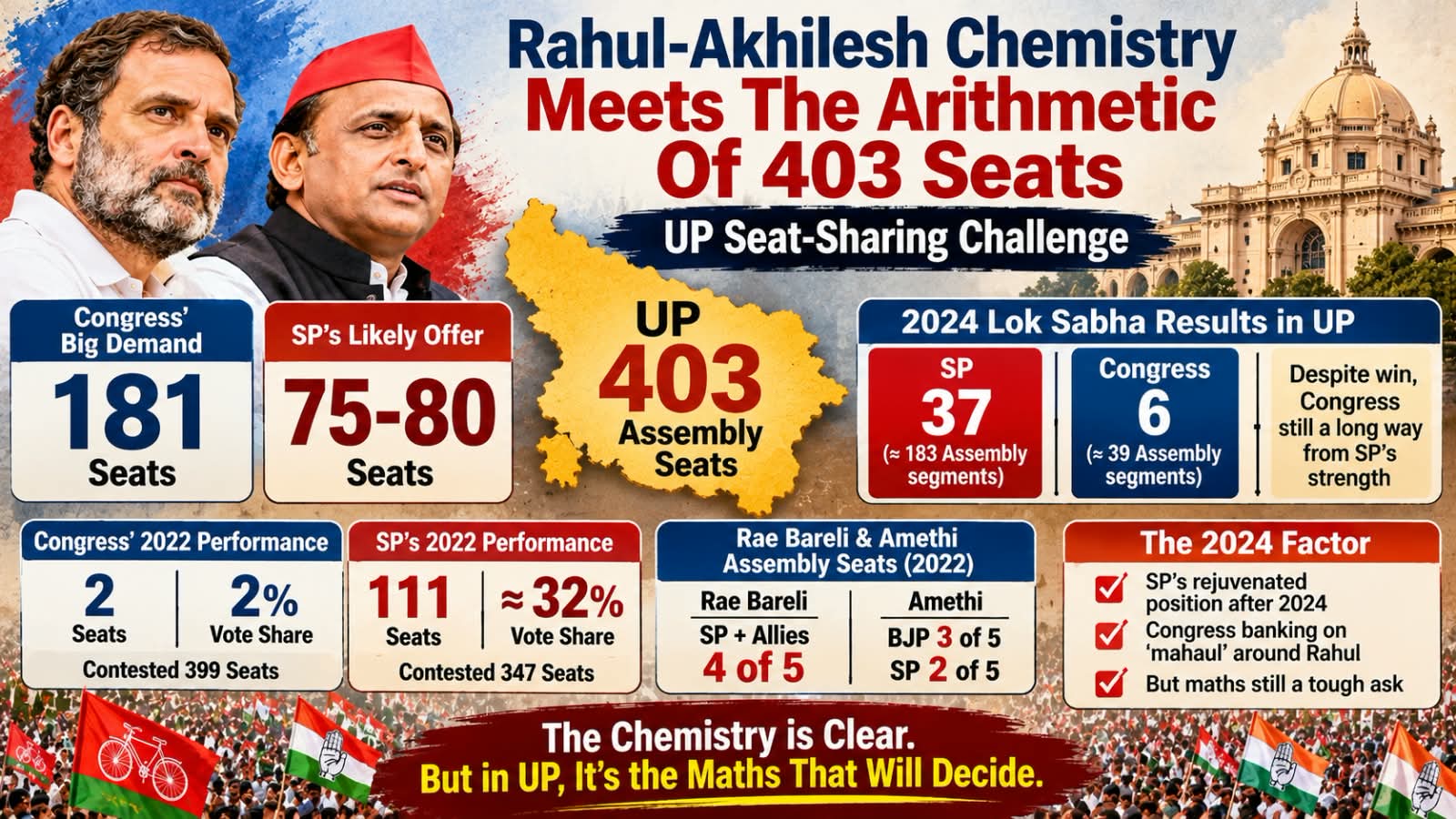
As the Congress and the Samajwadi Party get down to brass tacks to finalise their seat-sharing arrangement, the Congress has made an audacious demand for 181 seats from its alliance partner. The figure was revealed by Samajwadi Party (SP) chief Akhilesh Yadav himself at the HT Leadership Summit last week.
It is common political practice to enter negotiations with seemingly outlandish demands and then let pragmatism take over before arriving at a mutually acceptable number.
Advertisement – Scroll to continue
Seat-sharing negotiations are rarely easy. More so when they involve a regional force determined to guard its turf and a national party desperate to regain lost ground.
What Works For The Congress-SP Alliance
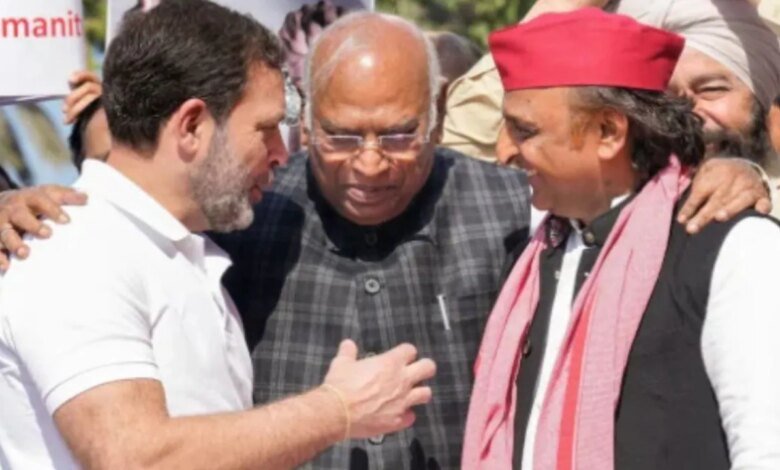
The intent is clearly articulated on both sides. The SP and Congress leaderships have repeatedly made it clear that the alliance will stay. The chemistry between their top leaders, Akhilesh Yadav and Rahul Gandhi, is there for all to see, particularly over the past few months, as the two have joined forces to take on the Centre.
Advertisement – Scroll to continue
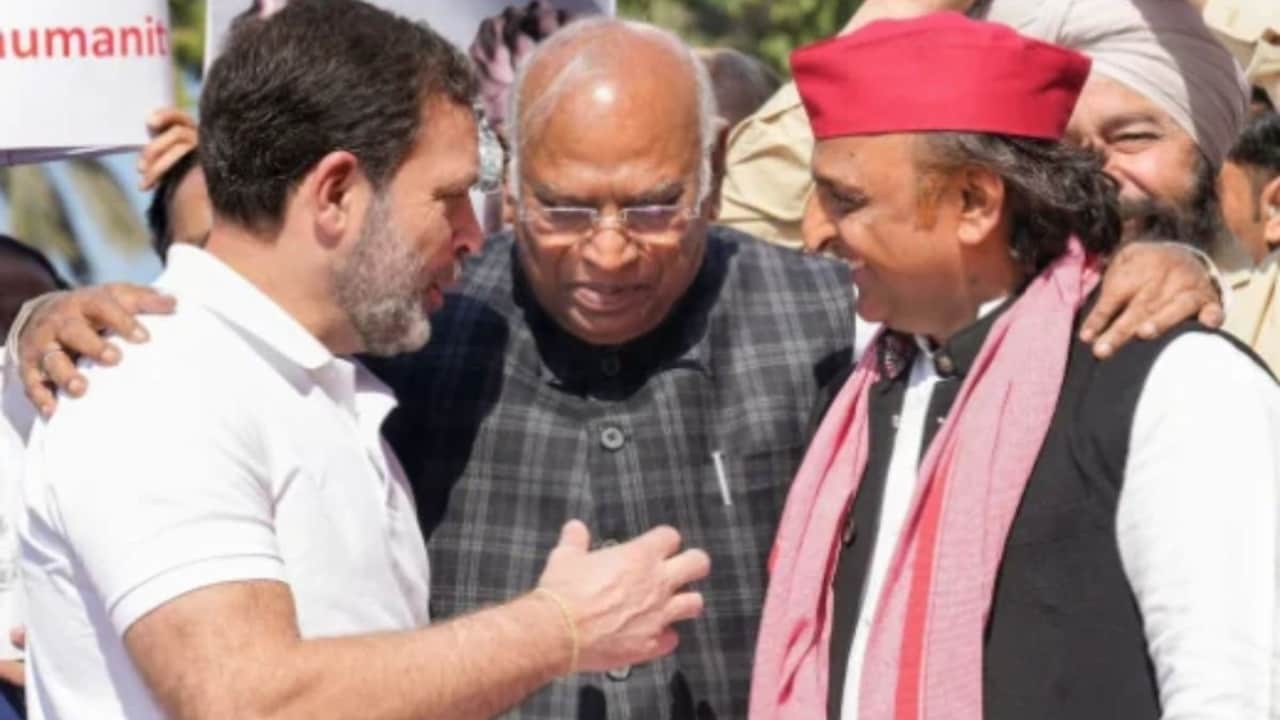
Rahul Gandhi and Akhilesh Yadav with Mallikarjun Kharge
Photo Credit: NDTV Photo
In a bid to smoothen the negotiations, the Congress leadership has reportedly asked its state leaders to refrain from making negative statements about the alliance in the media. The stage is now set for formal talks, with the Congress appointing a five-member panel to steer the seat-sharing negotiations.
The committee includes Congress general secretary Priyanka Gandhi Vadra, party general secretary KC Venugopal, AICC general secretary in-charge of Uttar Pradesh Rajendra Pal Gautam, Uttar Pradesh Congress president Aradhana Misra-Mona and working president Imran Masood.
Read | Eye On UP Polls, Congress Forms 5-Member Panel For Seat-Sharing Talks
Akhilesh Yadav being seated next to Sonia Gandhi in the front row at her book launch in New Delhi on Monday was another signal that all is well with the alliance.
What May Akhilesh Yadav Offer?
The SP chief has consistently maintained that the question is not about seat but jeet (victory) when it comes to deciding who contests from where.
The SP has reportedly already prepared a list of 350 candidates for the 403-member Assembly. That leaves just 53 seats outside its current calculations. The SP’s negotiations, therefore, could begin with a considerably smaller number than the Congress’s towering demand of 181.
It may be recalled that Akhilesh Yadav had left 56 seats for allies, including the RLD, SBSP and an Apna Dal faction, in the last Assembly elections, apart from a couple of friendly contests. The party won 111 of the 347 seats it contested.
The Congress, on the other hand, contested 399 seats under Priyanka Gandhi’s leadership and managed to win just two, with a vote share of a little over 2 per cent. The results further reinforced the perception that the Congress had become a spent force in a state where it lost power four decades ago. A high-voltage campaign led by Priyanka Gandhi made headlines, but the party failed to make any significant electoral headway.
The 2022 results, with the SP suffering its second consecutive defeat in the Assembly elections and the Congress facing a rout, eventually paved the way for a political rapprochement ahead of the 2024 Lok Sabha polls.
Graphic generated using AI
After its failed alliance with Mayawati in 2019, the SP showed considerable accommodation and gave the Congress 17 seats while contesting 62 itself. It also left one seat for Mamata Banerjee’s Trinamool Congress.
The gamble paid off handsomely, with the Opposition’s Save Constitution and reservation campaign striking a chord with voters. The SP won 37 seats, while the Congress bagged a surprising six. The results dealt a major blow to the BJP and provided a much-needed shot in the arm for the SP, which had been reeling from three successive electoral setbacks in 2017, 2019 and 2022.
The SP goes into the next Assembly election as a rejuvenated political force, rather than as a party coming off three successive defeats, as it was in 2022.
The question is whether it will be as accommodative of the Congress as it was in 2024. All indications are that the SP chief may be willing to part with 75-80 seats for the Congress.
Read | Lal Topi, Blue T-Shirt: Akhilesh Yadav’s ‘PDA’ For Blue Has A Coded Message
The Congress’s 2024 Argument
The Congress is pegging its ambitious demand on its 2024 performance, when it surprised even its fiercest critics by winning six Lok Sabha seats in Uttar Pradesh. The party contested 17 and won six.
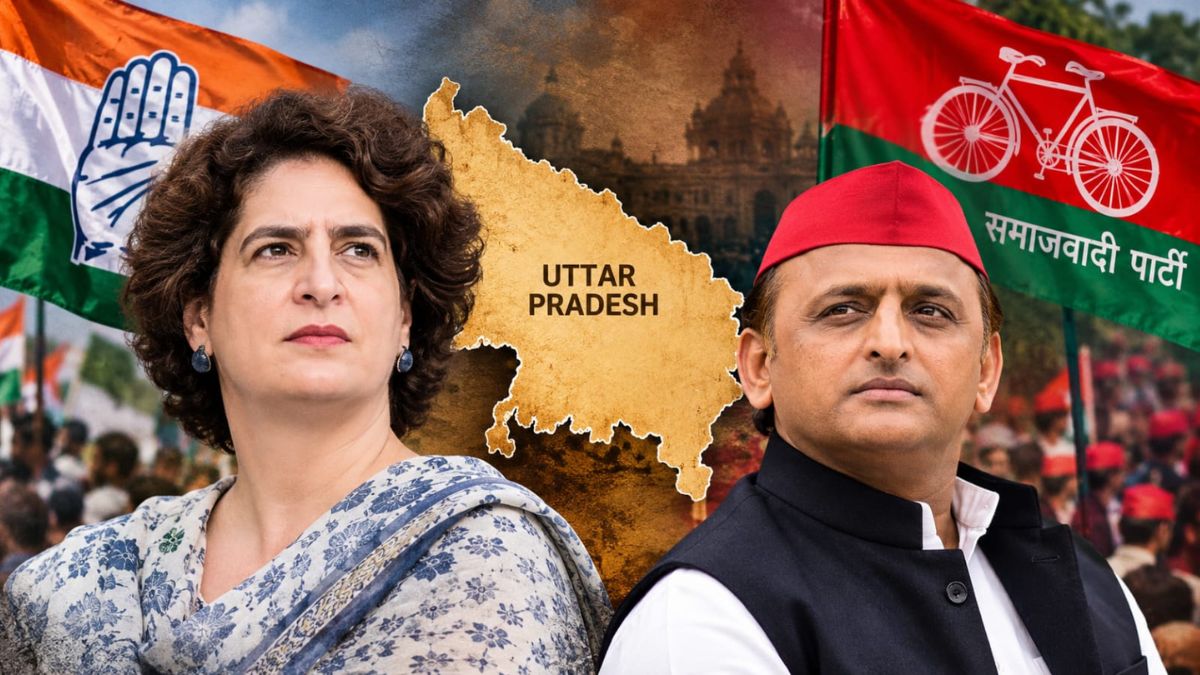
Priyanka Gandhi will lead seat sharing talks with SP
AI Generated image
It is also banking on what it describes as a favourable mahaul (political perception) around Rahul Gandhi to justify a bigger share of the electoral pie. But that mahaul is yet to be tested on the battlefield of an Assembly election. Alliances are ultimately negotiated on hard numbers, not just political perception.
The ground realities do little to substantiate the Congress’s claim to a larger share. The six Lok Sabha seats it won in 2024 account for roughly 39 Assembly segments. The SP, on the other hand, won 183 Assembly segments based on its 2024 Lok Sabha performance.
The Congress’s reported wishlist of 181 seats also includes at least 20 constituencies represented by sitting SP MLAs. It has reportedly staked a claim to all 10 Assembly segments falling under the Amethi and Rae Bareli Lok Sabha constituencies, none of which is currently represented by a Congress MLA.
The SP and its allies won four of the five Assembly segments in Rae Bareli, while the BJP secured three of the five segments in Amethi, with the SP winning the remaining two in 2022.
The twin constituencies, long regarded as Gandhi family strongholds, have repeatedly delivered a snub to the Congress in Assembly elections over the past two decades. It may be recalled that Sonia Gandhi had personally sought the support of late SP patriarch Mulayam Singh Yadav for the Gandhi family’s electoral prospects in 2014 when Rahul Gandhi faced a challenge from BJP’s Smriti Irani.
In 2022, the Congress secured around 21 lakh votes in total while contesting 399 seats, averaging roughly 5,200 votes per constituency. This represented a further decline from its 2017 performance.
The Congress had contested the 2017 Assembly election in alliance with the SP. Akhilesh Yadav had then allocated 114 seats to the Congress, which managed to win just six with about 4% votes. That electoral calculation will also weigh on the negotiations and cannot simply be wished away by the Congress’s mahaul narrative.
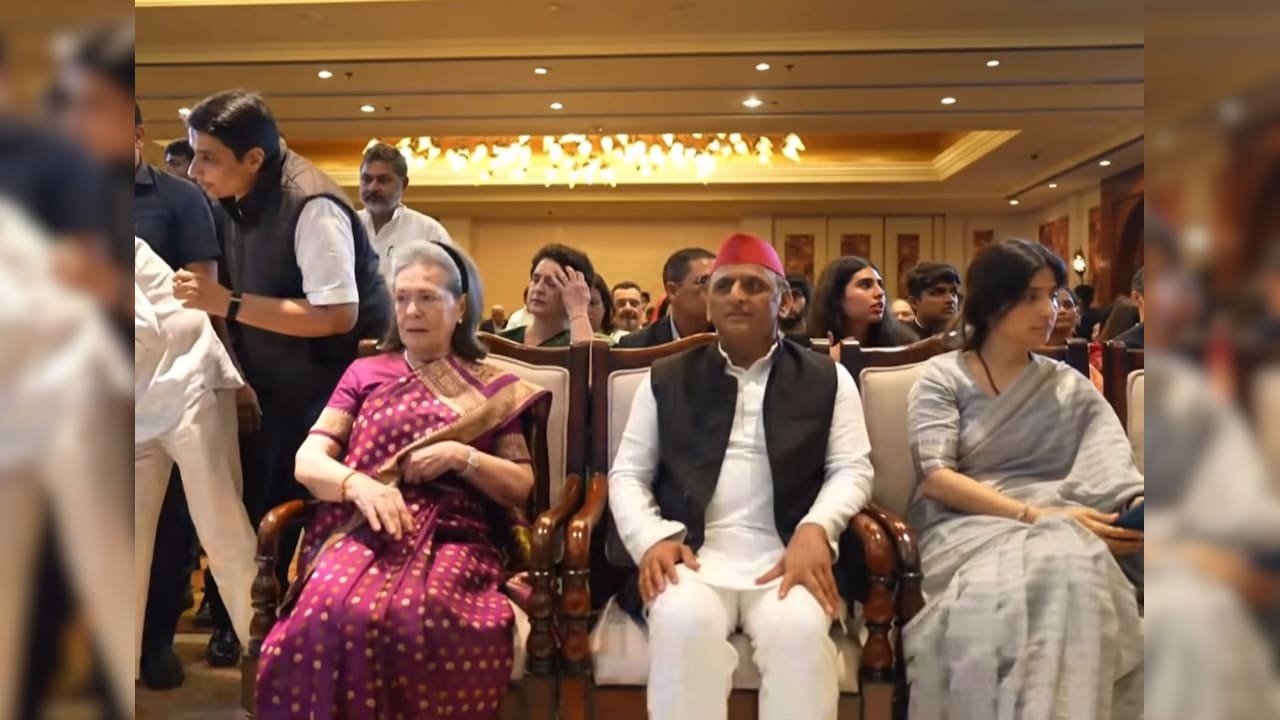
Akhilesh Yadav seated next to Sonia Gandhi at the launch of her book in Delhi on Monday
Photo Credit: NDTV Photo
Chemistry On, But Maths Off
The ground reality of the Congress, the Grand Old Party, in India’s most politically crucial state punctures its tall claims. Its improved performance in the 2024 Lok Sabha election has undoubtedly given it a renewed sense of confidence, but translating that momentum into Assembly seats is an entirely different proposition.
For Akhilesh Yadav, the challenge is to keep the alliance intact without compromising the SP’s electoral interests or alienating its own cadre by surrendering seats it believes it can win. For the Congress, the challenge is to convert its improved political visibility and Rahul Gandhi’s growing appeal into a credible claim for a larger share of the seats.
Neither party can afford a breakdown of the alliance. The BJP remains the common political adversary, and the Opposition’s 2024 performance has demonstrated what a united front can achieve in Uttar Pradesh. But that does not mean the two parties will necessarily agree on the price each should pay for keeping the alliance alive.
Ultimately, the negotiations will test whether political goodwill can prevail over competing electoral ambitions. The chemistry between Rahul Gandhi and Akhilesh Yadav may be unquestionable, but when it comes to dividing 403 Assembly seats, it is the maths – not the chemistry – that will have the final word.