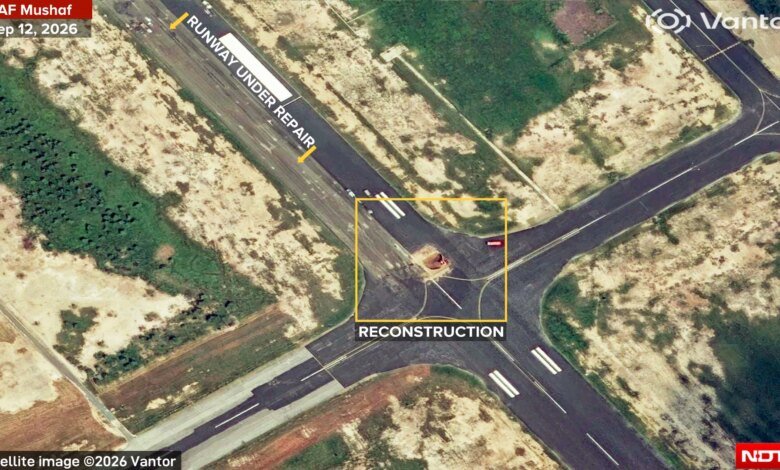
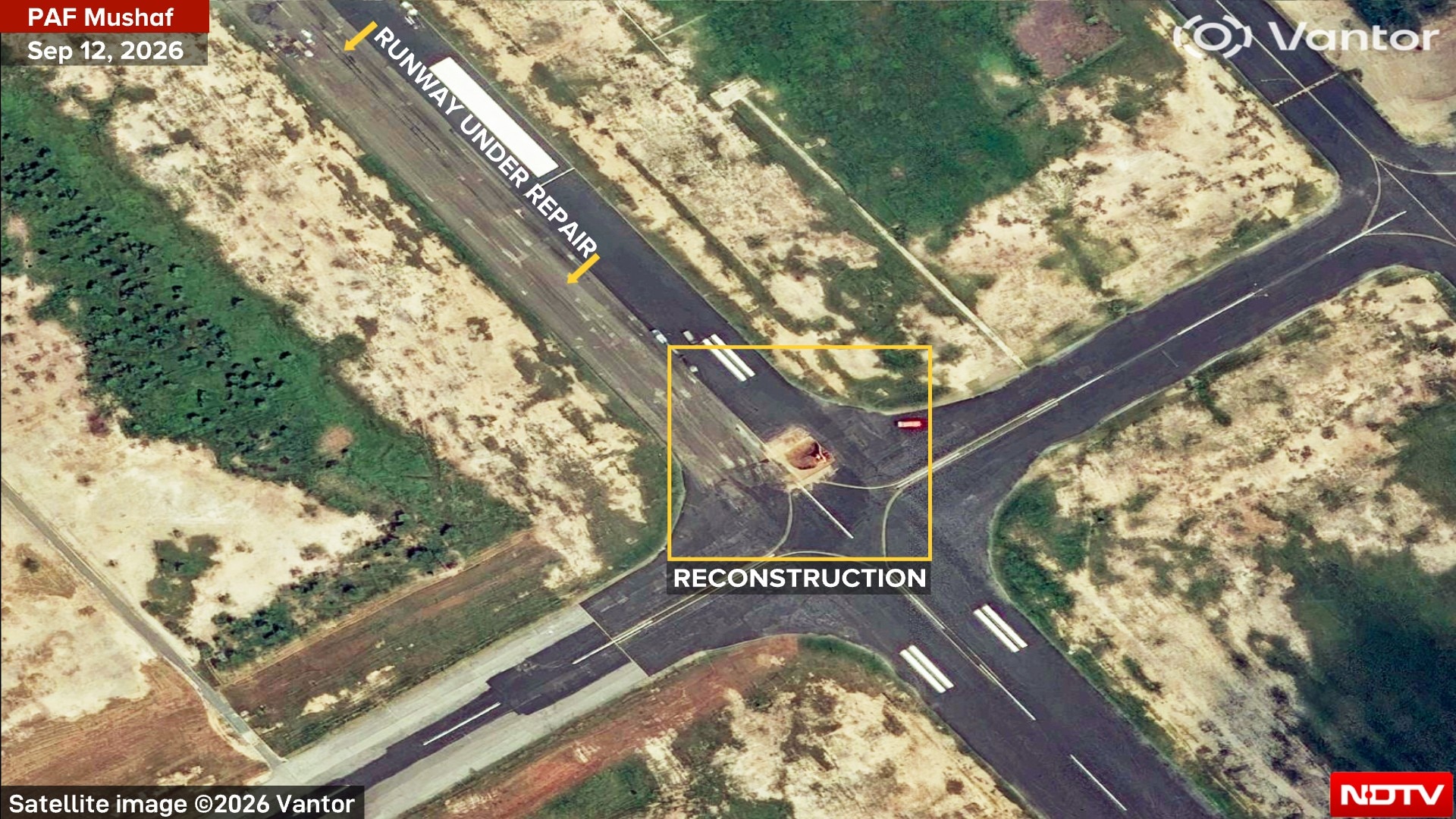
Fresh repair work is underway on the northern part of the runway with the reopening of the previously repaired missile crater. High res here
”This runway centreline was struck from more than 300 kms away. That is Indian Air Force precision,” says Air Marshal AK Bharti (retired) who was the IAF’s Director General of Air Operations during Operation Sindoor. ”The enemy wound has still not healed. The Sargodha runway remains under surgery even after sixteen months – that is operation Sindoor for you, and it continues!”
An earlier image from August 28 this year had shown the site of the original strike apparently repaired, though a visible resurfacing patch suggested disturbed earth underneath rather than a surface solid enough to bear the weight of aircraft operations. That section is now being reworked.
Vantor satellite imagery (then Maxar) from May 10, 2025, had shown the impact of two precise Indian Air Force hits along the length of the primary 3,200-metre runway at PAF Base Mushaf.
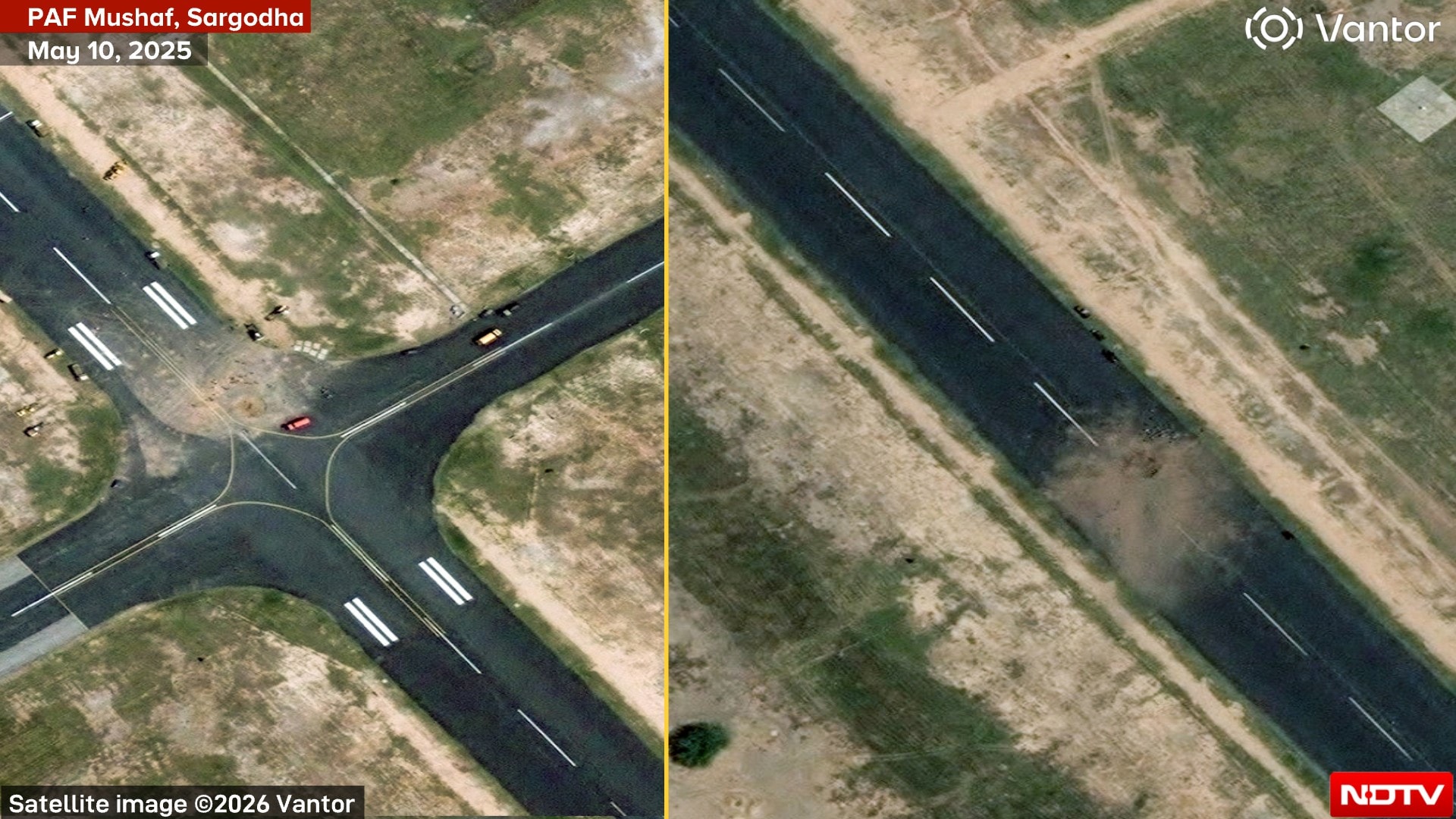
The IAF struck twice on the primary runway at PAF Mushaf (Sargodha) on May 10, 2025. High res here
Analysts say the blast crater at the intersection described above was 8-9 metres wide and 4-5 metres deep. Ejected asphalt and concrete fragments lay scattered around the site, with several ground vehicles positioned near the crater. A second site struck by the Indian Air Force on the runway lies 660 metres away.
Read | Exclusive: Indian Air Force Officers Recount “Once In A Lifetime” Op Sindoor Mission
The Indian Air Force has not commented on the weapons used in its strikes on Mushaf, but the diameter and depth of the crater appear consistent with the use of the air-launched BrahMos air-to-surface missile, fired from a Sukhoi-30 MKI aircraft.
On May 10, 2025, the Indian Air Force targeted ten Pakistani air bases, radars, and surface-to-air missile units. Mushaf airbase in Sargodha was hit between 10 am and 12 pm. The IAF also claims to have shot down either a PAF Airborne Early Warning and Control aircraft or an intelligence-gathering aircraft that day. At 3:35 pm the same day, Pakistan’s Director General of Military Operations phoned his Indian counterpart and called for a ceasefire. That ceasefire, which brought an end to what has been described as the 88-hour India-Pakistan war, officially took effect at 5 pm. Sporadic attacks continued for the next 48 hours before fighting between the two nuclear-armed neighbours came to a halt.