Bhopal:
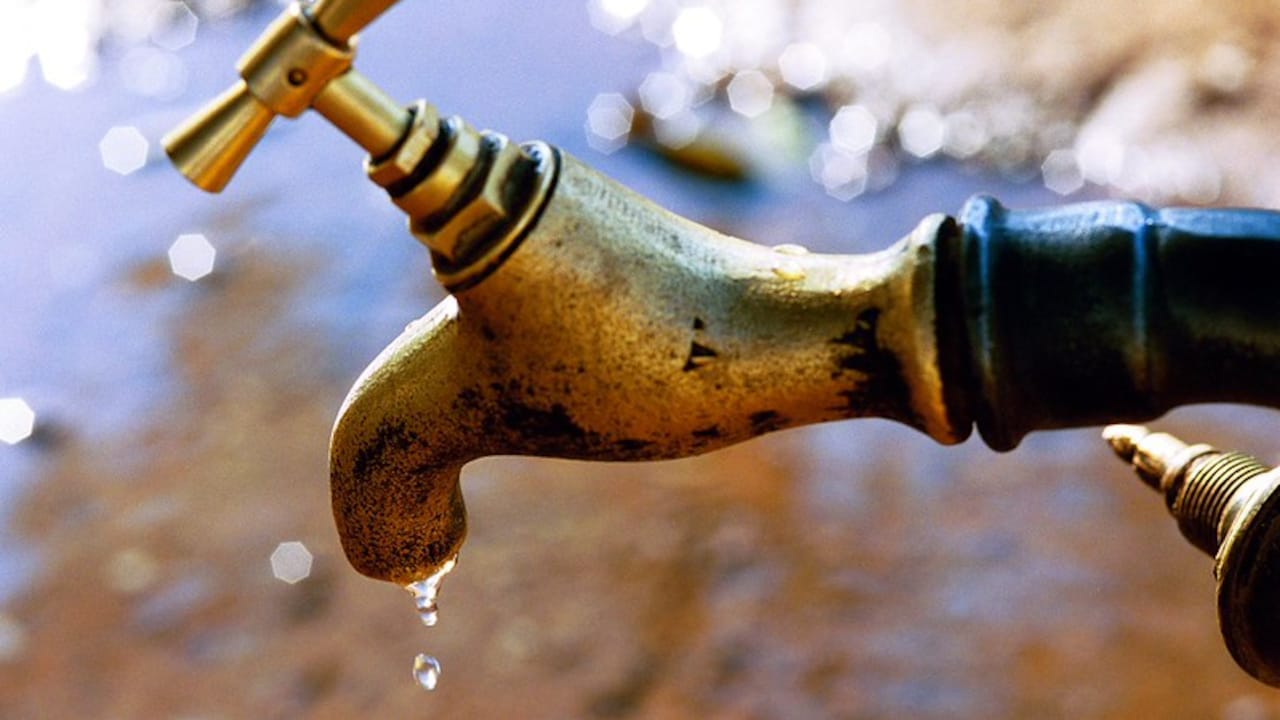
Madhya Pradesh’s water story is no longer just about dry wells, defunct handpumps, and women walking kilometres with pots of water balanced on their heads. Pipes have now been laid across villages, overhead tanks have come up, and taps have been installed. In government files, the Jal Jeevan Mission continues to make progress. But the fundamental question remains: is water actually reaching those taps? Images and reports emerging from different parts of Madhya Pradesh make that question increasingly difficult to ignore. In some places, there is a tap but no water. Elsewhere, water comes but not regularly. And even where water reaches households, there are questions over whether it is safe to drink.
Twenty-three of Madhya Pradesh’s 55 districts have been assessed as having less than 70 per cent coverage of potable tap water. In other words, nearly 42 per cent of the state’s districts are on a list where even seven out of every 10 households have not been covered by household tap connections. This is not the finding of a private survey.
The figures have been placed on record by the Union Ministry of Jal Shakti (water resources) in a written reply in the Rajya Sabha.
Story From The Ground
Even the state capital has not remained untouched by the larger water crisis. In March 2026, amid falling groundwater levels, the administration declared the entire Bhopal district a water-scarce area and imposed restrictions on the digging of new private borewells. The administration cited excessive extraction of groundwater and the continuing decline in the water table.
Read: Bhopal Declared Water-Scarce Zone, New Private Borewells Banned
About 40 kilometres from Bhopal, the desperation over water took an extraordinary form in Bishankhedi village of Sehore district in April 2025. A villager, identified as Bajrangi, tied copies of his old applications to his body and crawled to the divisional commissioner’s office to draw attention to the village’s water problem. He alleged that despite approaching officials from the collector to ministers and the chief minister, the problem had not been resolved. The administration did not agree with all his allegations, but the Public Health Engineering Department acknowledged a shortage of water around the village community hall and said an alternative borewell had been arranged. Of the 20 handpumps serving the village with a population of around 2,100, only 12 were reported to be functional at the time.
It is against this backdrop that a government response in Parliament has now put hard numbers to the distance between the promise of Har Ghar Jal and its reach on the ground in Madhya Pradesh.
The Union Ministry of Jal Shakti provided the tapwater coverage information in response to a question by Congress MP Vivek K Tankha, who sought details about water quality testing infrastructure in Madhya Pradesh, the functionality of household tap connections, and districts where coverage was below 70 per cent.
Put together, the government’s own figures for these 23 districts present a much more troubling picture.
They have a total of 49,49,461 (just below 50 lakh) households, of which only 29,55,970 have household tap connections, meaning 60%. That leaves 19,93,491 households, nearly 20 lakh families, outside household tap connection coverage in these 23 districts alone.
Read: After 25 Deaths In Indore, 24 Fall Ill in Mhow After Drinking Toxic Water
Maihar is at the bottom of the list. Of its 1,36,204 households, only 54,757 have household tap connections. As many as 81,447 households remain outside the coverage, putting the district at just 40.2 per cent tap coverage. In effect, roughly six out of every ten households in Maihar are outside household tap connection coverage.
The situation is almost identical in Singrauli. Of 1,61,082 households, only 65,431 have connections. Coverage stands at just 40.62 per cent, leaving 95,651 households outside the network. In Chhatarpur, the coverage is 42.77 per cent. Satna has 2,37,866 households, but only 1,03,097 have connections, thus the district’s coverage stands at 43.34 per cent.
In absolute numbers, however, the largest gap among the 23 districts is in Shivpuri. Of its 3,20,873 households, only 1,68,469 have household tap connections. That leaves 1,52,404 households outside coverage. Shivpuri’s coverage stands at 52.5 per cent.
Reasons The Government Gave
The government has also explained why these districts are lagging. According to information furnished by Madhya Pradesh’s Public Health Engineering Department, the primary reason for the low coverage is that these districts are largely dependent on multi-village schemes and other remaining water supply projects. Several of these schemes are still at different stages of implementation and completion.
The statewide average, though, presents a considerably better picture than these 23 districts, meaning large gaps among districts.
According to the government, the latest functionality assessment under the Jal Jeevan Mission indicated that functional household tap water connections were working in 77.21 per cent of households in Madhya Pradesh. However, the same assessment also pointed to the need for improvement in quantity, supply, and quality of drinking water.
That distinction perhaps explains the Madhya Pradesh tap water story better than any single statistic. Having a connection on paper, having a tap installed outside a house, and receiving an adequate quantity of safe water from that tap every day, these are three different things.
Quality Question Remains
The infrastructure for testing water quality raises another important question. The government told the Rajya Sabha that Madhya Pradesh has 155 water quality testing laboratories, including 103 at the sub-divisional level, 51 at the district level and one at the state level. Biological Oxygen Demand can be tested at the state-level laboratory, but the Parliamentary response clearly states that the facility for testing chemical toxicity is not available. The question in Madhya Pradesh, therefore, is no longer simply how many households have been given taps. It is also about how many of those taps actually receive water, how regularly they receive it, and whether the water coming out of them is safe to drink.
Amid such reports, images of government priorities have also periodically raised uncomfortable questions. In July 2025, NDTV reported from Jhunjha village in Shahdol that thousands of rupees had been spent on cashews, almonds, raisins, fruits and snacks for an event organised under the Jal Ganga Samvardhan Abhiyan, a campaign meant to promote water conservation. At the same time, villagers in the area were struggling with dry handpumps and water scarcity.
The administration subsequently said the expenditure would be investigated.
And the crisis is not only about whether water reaches a household. It is also about whether that water is fit to drink.
In January 2026, NDTV reported, citing the Jal Jeevan Mission’s Functionality Assessment Report, that only 63.3 per cent of water samples tested in rural Madhya Pradesh passed quality tests, compared with a national average of 76 per cent. The report also said that while 99.1 per cent of villages in the state had piped water supply systems, taps were found to be functional in only 76.6 per cent of households.