New Delhi:
Twenty-two-year-old Rohan noticed it first in a photo. A friend had tagged him at a wedding, and the flash caught something he hadn’t clocked in the mirror: his hairline had crept back. He’s not alone. Across India’s cities, men in their early twenties are booking dermatology appointments that used to be the domain of men twice their age.
The shift is no longer just a medical footnote. It’s building a market.
Patient Population Getting Younger
Dr Priyanka Keshav, a dermatologist at VLCC, has watched the age of her hair loss patients drop steadily over two decades. “Two decades ago, the typical patient walking in for a hair loss consultation was in his mid-30s to 40s, often presenting with established Stage 3 or 4 thinning,” she says. Now, a large share of her consultations are with men in their late teens and early twenties, catching the problem at its earliest stage.
Some of that, she admits, comes down to vanity and visibility — front-facing cameras and Instagram grids have made men scrutinise themselves the way women always have. But she’s clear the shift isn’t only psychological. Modern city life is hard on hair follicles. Processed food, broken sleep, workplace stress, and polluted air all feed low-grade inflammation in the body. That inflammation, she explains, can switch on hair loss genes years earlier than it would have in a man’s father or grandfather.
Genetics still loads the gun, in her framing. Lifestyle just pulls the trigger sooner.
Gap Between Suffering & Spending
Here’s where the story turns from clinic to commerce. Industry research firm Redseer estimates that 82 million urban Indians — nearly four in ten city dwellers — are dealing with hair loss right now. Most of them do nothing structured about it. Fifty-nine million reach for home remedies. Sixteen million buy a shampoo or serum off a shelf. Only around five million ever try a medicated product, and barely a million walk into a clinic.
That’s still a big market. That’s a funnel with a massive, unclaimed middle — and it’s exactly where India’s newest wave of consumer health startups has planted its flag.
India’s hair loss treatment segment was worth close to $282 million in 2024 and is on track to more than double, past $539 million, within the decade. Pull the lens back to the wider hair care category and the number gets bigger still: roughly $4.1 billion in 2026, climbing toward $5.2 billion by 2031, driven as much by tier-two and tier-three India as by metro buyers.
Follow The Funding
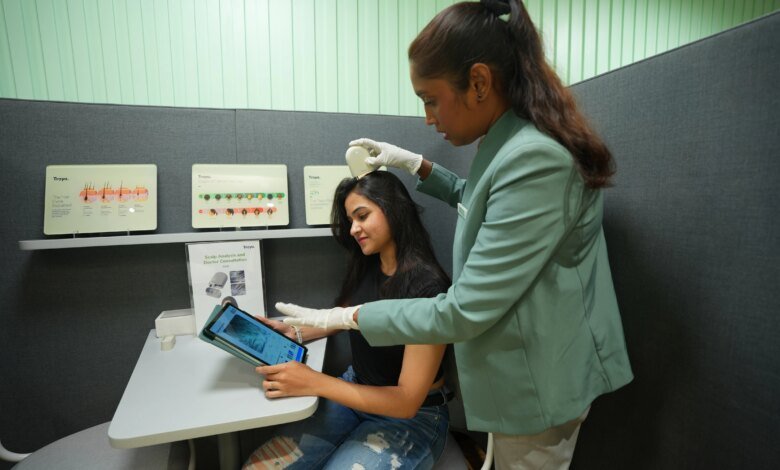
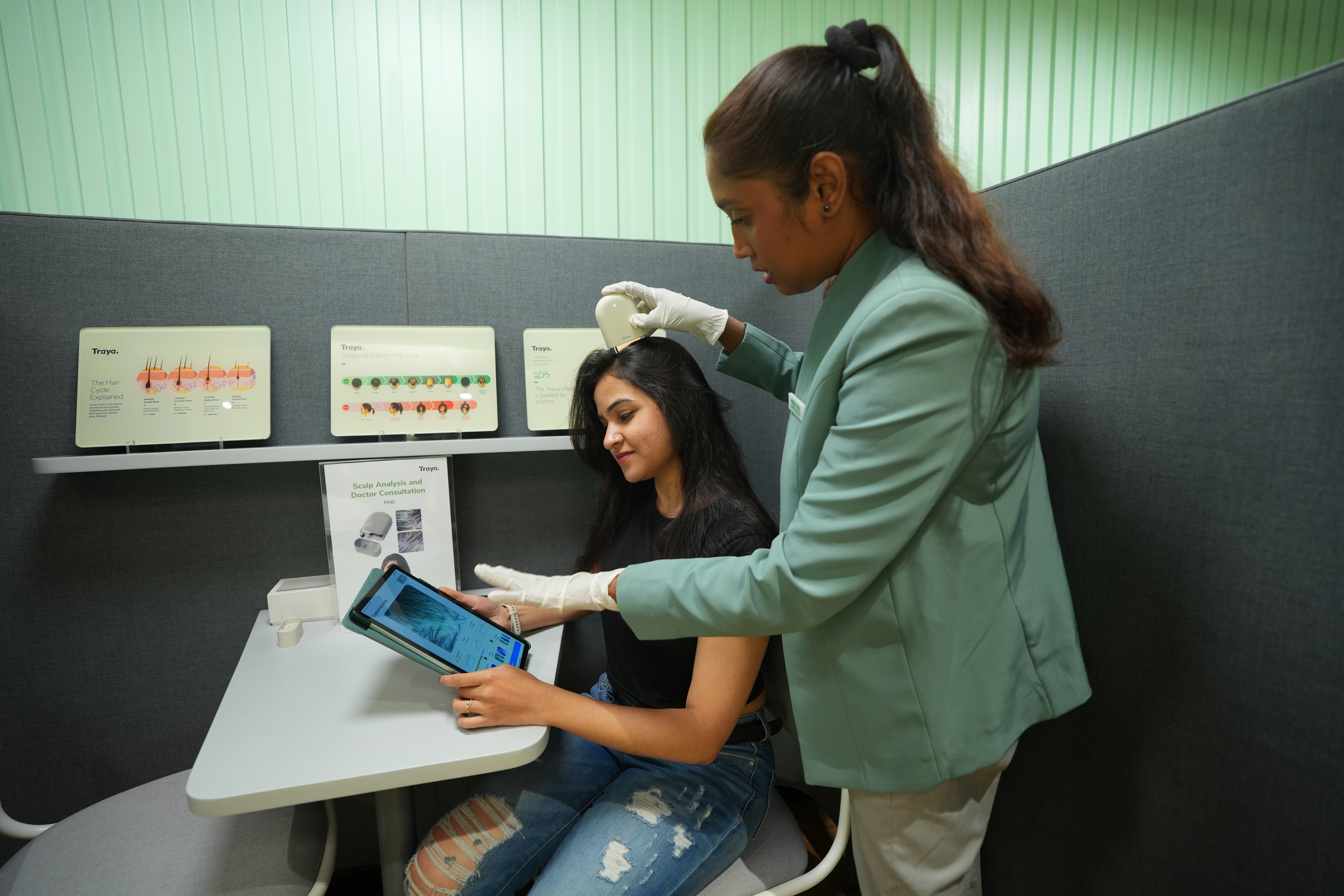
No brand captures this shift better than Traya. Founded in Mumbai in 2019, the company built its pitch around a simple reframe: hair loss isn’t a cosmetic complaint, it’s a systemic health issue, and it deserves a diagnosis, not just a bottle of oil. Customers take an online test, get a personalised regimen blending allopathy, Ayurveda and nutrition, and commit to it for months, not days.
Investors liked the story. Traya has raised close to $18.7 million across five funding rounds, backed by names like Fireside Ventures, Kae Capital and Xponentia Capital, and now carries a reported valuation north of $135 million. It’s chasing a revenue target of Rs 2,000 crore, banking on a hundred-store offline push and an expansion into the UAE.
Saloni Anand, Co-Founder, Traya Health, “The market is large, but size was never the real challenge. Over 70 per cent of our customers are from Tiers 2 and 3 cities. Technology lets us reach them. Results make them stay.”
Why This Matters Beyond The Mirror
What’s really being sold here isn’t a serum. It’s a five-month commitment, priced well above what a bottle of shampoo ever commanded. That’s a fundamentally different economic model from the one FMCG built its empire on — impulse buys, mass discounting, shelf space wars. Diagnostic-led D2C brands are betting that Indian consumers, especially young, urban, income-earning men, will pay a premium for something that feels more like medicine than grooming.
Dr Keshav’s advice to her patients is simple: catch it early, get a proper diagnosis, and don’t waste months on unverified internet fixes. Medically, that’s sound counsel. Commercially, it’s also the exact instinct that’s turning a clinical waiting room into a billion-dollar bet.