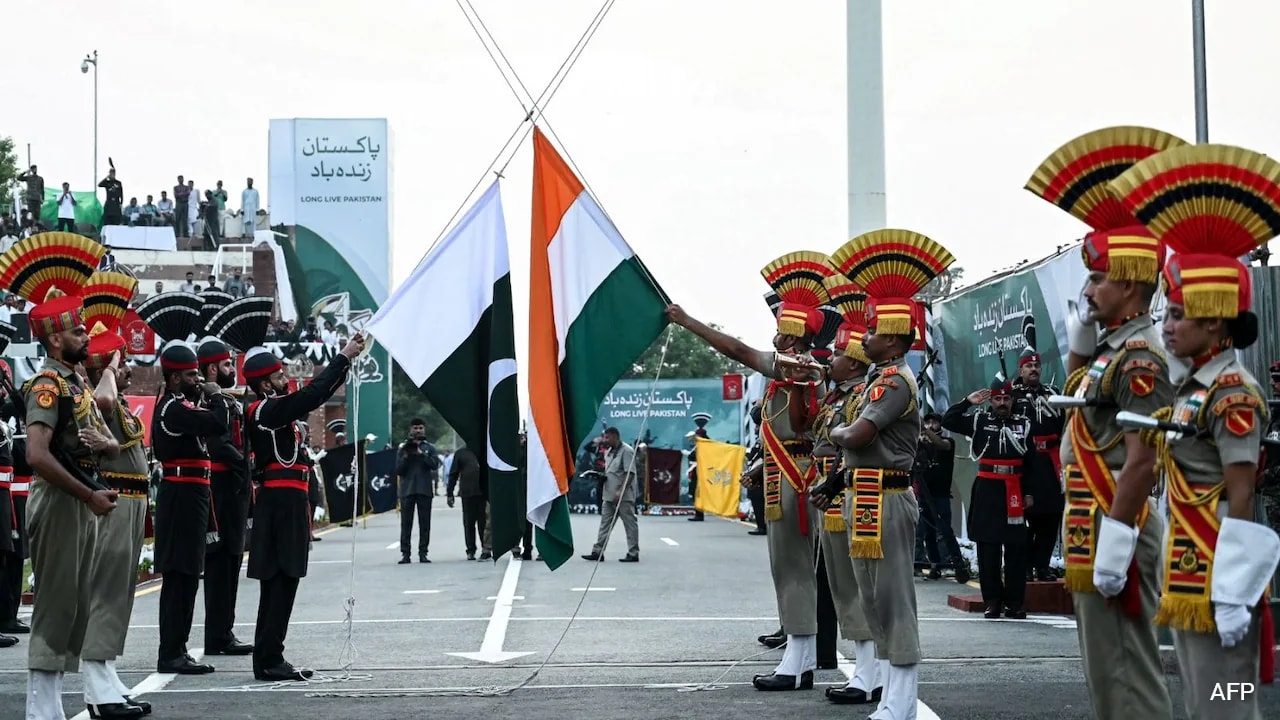
Eighty years ago, a line was drawn — one that cut a state not just into two halves but tore apart people sharing the exact same culture. Decades later, while the trajectory of the two countries remains miles apart politically, they still share a deep connection owing to their common cultural identity.
The key difference arguably lies in the manner in which the culture has manifested in both nations.
Therefore, decades after the Partition drew a line through their shared heritage, people on both sides remain on a quest to preserve the true essence of “Punjabiyat” — the Punjabi identity.
In India, ‘Punjabi’ has remained a beloved culture — one the country dances to, reads, recites, and relies on for support.
On the Pakistani side, the struggle to preserve this identity has not been a smooth ride, despite the nation inheriting a larger portion of the undivided state. Many Punjabis there have faced and continue to face marginalisation, being pushed to abandon Punjabi in favour of Urdu.
In fact, a viral video from Pakistan’s Parliament recently showed a leader directly challenging the speaker’s directive to switch from Punjabi to Urdu, “Why should I not speak it? It is my mother tongue.”
His words did not merely reflect an individual’s demand for cultural dignity; they also cast light on the larger debate surrounding Punjabiyat within the country.
To assess the depth of the issue, NDTV spoke to experts and citizens across the border to gather their perspectives.
Ahmad Raza Punjabi, president of the Punjabi Parchar organisation in Lahore, Pakistan — which advocates for the official use and recognition of Punjabi at various levels in the Islamic Republic — reflected on this marginalisation.
Ahmad noted, “The state of Punjabiyat in Pakistani Punjab has been in a very poor condition. Over the last five decades, the Punjabi language has suffered a significant decline. Various people keep working on this issue regarding the Punjabi language and culture; however, they were very few in number.”
To understand what led to this divide and context behind Ahmad’s remarks, one must go back in time to trace the issue historically.
Horrors Of History
The seeds of a fractured Punjabi identity were sown during the Partition of 1947, when British India was divided into two independent nations: India and Pakistan.
The Radcliffe Line, published on August 17, 1947, demarcated the historic and culturally rich province of Punjab, assigning the western portion to Pakistan and the eastern portion to India. These two regions were later popularised in the local language as Charda (Eastern) and Lehnda (Western) Punjab. This division left Pakistan with the larger share of agricultural land and vital irrigation canals, along with the historic city of Lahore as its centre. India, on the other hand, inherited agriculture and Amritsar as a centre.
The horrors of the Partition remain well known. Overnight, families packed up their lives and moved away from familiar soil to face an uncertain future. Partition displaced as many as 12 million Punjabis and claimed over a million lives.
The event not only scarred the landscape with permanent borders, but it also seeped into the hearts and minds of the victims as an irreparable loss — an estrangement from their own. Over the years, Punjabis on both sides have tried to reconcile and strengthen this identity, regardless of political developments in their respective countries.
This mechanical division was aptly expressed in a Coke Studio Pakistan song on Partition titled “O Yaara”, whose video describes the Radcliffe Line as one that tore through the hearts of the Punjabi people and distorted the idea of a Sanjha Punjab (United Punjab).
Dilution Of Punjabi in Pakistan
Ahmad narrated his experience in Pakistan, telling NDTV that after independence, both state media and private institutions focused heavily on promoting Urdu. “Major newspapers, such as Jang and Nawaiwaqt — which printed ‘Promote Urdu; our national language is Urdu’ on its top banner — promoted Urdu as the national language, pushing local native languages into the background. During the 1960s, 1970s, and 1980s, speaking up for Punjabi was extremely difficult.
Ahmad argued that political figures rarely included the promotion of Punjabi in their election campaigns. While politicians addressed rural crowds in Punjabi during rallies, they would ironically state — in Punjabi itself — that their official language was Urdu.
As Ahmad Raza Punjabi recalled: “Both the state media and private media were following a single agenda: to only promote Urdu… All this was happening under a deliberate design to suppress the identities of the local people — their nationalism, culture, and language.”
Grassroots Resistance: Legal Battles and Assembly Action
Despite the suppression of the language, grassroots resistance began to take shape. In 1989, a historic procession marched from Nasir Bagh to the Punjab Assembly in Lahore, marking the first major public demonstration for Punjabi linguistic rights in half a century. Although momentum slowed during the 1990s, the movement reignited around 2011 with the resurgence of International Mother Language Day rallies.
By late 2013, organisations such as Punjabi Parchar emerged to formalise the struggle, establishing chapters across universities to engage young students and dismantle the stigma surrounding their mother tongue. The movement took a major leap into the legal arena in 2016 when a private school system issued a circular asking parents to prevent students from using “foul language and Punjabi.” Activists filed a writ petition against the school system, resulting in a landmark court ruling declaring that no educational institution could ban Punjabi, backed by severe penalties for future violations.
This momentum culminated in February 2019, when Justice Karim Bakhsh of the Lahore High Court ruled in favour of another petition filed by activists, officially directing the government to enact legislation making Punjabi a compulsory academic subject.
Reflecting on the evolution of public support and institutional pushback, Ahmad Raza Punjabi noted: “Out of an estimated 120 million people in Pakistani Punjab, less than 10 million actively champion Punjabi language rights, while many still prioritise Urdu as the national language. Nevertheless, public engagement has expanded from a fraction of a per cent (0.1 per cent) in earlier years to an estimated 4-5 per cent today, actively advocating for Punjabi language education and development.”
The battle has also reached the halls of parliament, where provincial leaders have begun standing up to challenge the status quo. Over the past few years, resolutions supporting the cause were passed in the Punjab Assembly to draft formal legislation. Recent announcements by provincial leaders — such as commitments by Punjab’s Education Minister Rana Sikandar Hayat — have promised to introduce Punjabi and Shahmukhi instruction into the official school curriculum.
However, while announcements have been made, Ahmad noted that most promises have not translated from paper to ground reality: “The government has not provided substantial support to Punjabi anywhere. Last year, Maryam Nawaz, the current Punjab Chief Minister, made some statements regarding Punjabi culture and language, saying that our children should learn Punjabi. However, practically, no major work has been done on it yet.” Ahmad argued that while the government acknowledges the problem, it does little to address it.
Arts, Cinema, And Folk Heritage
Beyond the legal battles surrounding identity assertion in Pakistan, Punjabi activists in 2018 successfully persuaded the government to mark the 1st of Chet (March 13-14) — the beginning of the Punjabi calendar — as official Punjabi Culture Day. In Pakistani Punjab, cultural pride is deeply rooted in Sufi poetry, brought to life by the enduring legacies of Baba Bulleh Shah, Baba Farid, and Waris Shah. Timeless folk traditions like Heer Ranjha and Sassui Punnhun continue to offer a shared cultural vocabulary, highlighted annually at the Bulleh Shah Festival, the Punjab Festival, and the International Punjabi Conference.
As Tayyab Saleem, a voice from Sialkot, passionately articulated when reflecting on their deep-rooted heritage: “Regarding the Punjabi language, I feel it is not just a language — it is our identity, our soul, and the fragrance of our soil. Moreover, Sufi poetry — figures like Baba Bulleh Shah, Baba Farid ji, Waris Shah ji… These people earned a global reputation; wherever Punjabis reside around the world, everyone knows them. The sweetness we experience when speaking in Punjabi cannot be felt in any other language.”
Divided by Borders, United By ‘Punjabiyat’
Despite years of political churn, border standoffs, and tense diplomatic relations, the cultural resonance between Punjabis on both sides of the border remains strong.
This shared cultural soul has allowed music, cinema, and pop culture to naturally transcend physical borders and forge a direct connection between people. Classical icons like Ustad Nusrat Fateh Ali Khan and Reshma are regarded as national treasures in India, just as Indian legends like Gurdas Maan enjoy huge followings across Pakistan.
Contemporary artists like Karan Aujla and Sidhu Moosewala also win hearts, making the community united despite the border.
Even with the barrier of scripts — where Pakistan uses Shahmukhi and India uses Gurmukhi — the spoken language creates an instant bond.
Saleem from Sialkot, who vibes to Punjabi songs and even shows — off much of his skills, notes this seamless connection: “The greatest thing is that I feel this language connects us across both sides of the border. Even today, whenever I travel abroad and meet a fellow Punjabi who sits and talks with me, it feels like we have known each other for years… Modern contemporary singers… I personally really like Amrinder Gill, Satinder Sartaaj, and Sidhu Moose Wala. I really enjoy their music in today’s times.”
Saleem also remarks on how social media reels have allowed people on both sides to connect despite being unable to visit each other physically.
He notes that his social media feeds are filled with content romanticising Punjabi culture and showing people showering love on each other in the comments section. Saleem makes a valid point: numerous social media posts glorify pre-Partition Punjab and shared history, while countless humorous, relatable reels using regional slang help bridge the physical gap. From being discouraged to speak the language of the ‘uncouth’, Saleem says that more people now attempt to speak it.
The resistance mounted by Pakistani Punjabis serves as a stark reminder that while states may attempt to marginalise cultures, those cultures continue to thrive when deeply rooted in the souls of their people. Culture remains fluid and naturally transcends borders. Ultimately, preserving this heritage is the responsibility not only of the community itself, but also of governments, which must actively integrate language and culture into education and public life.