New Delhi:
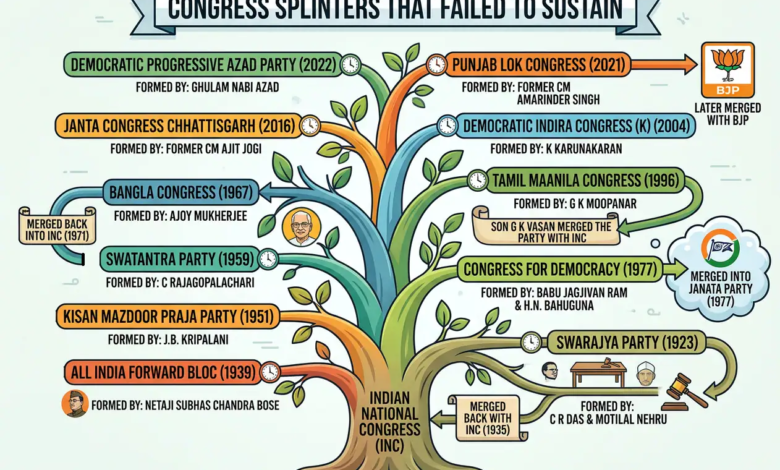
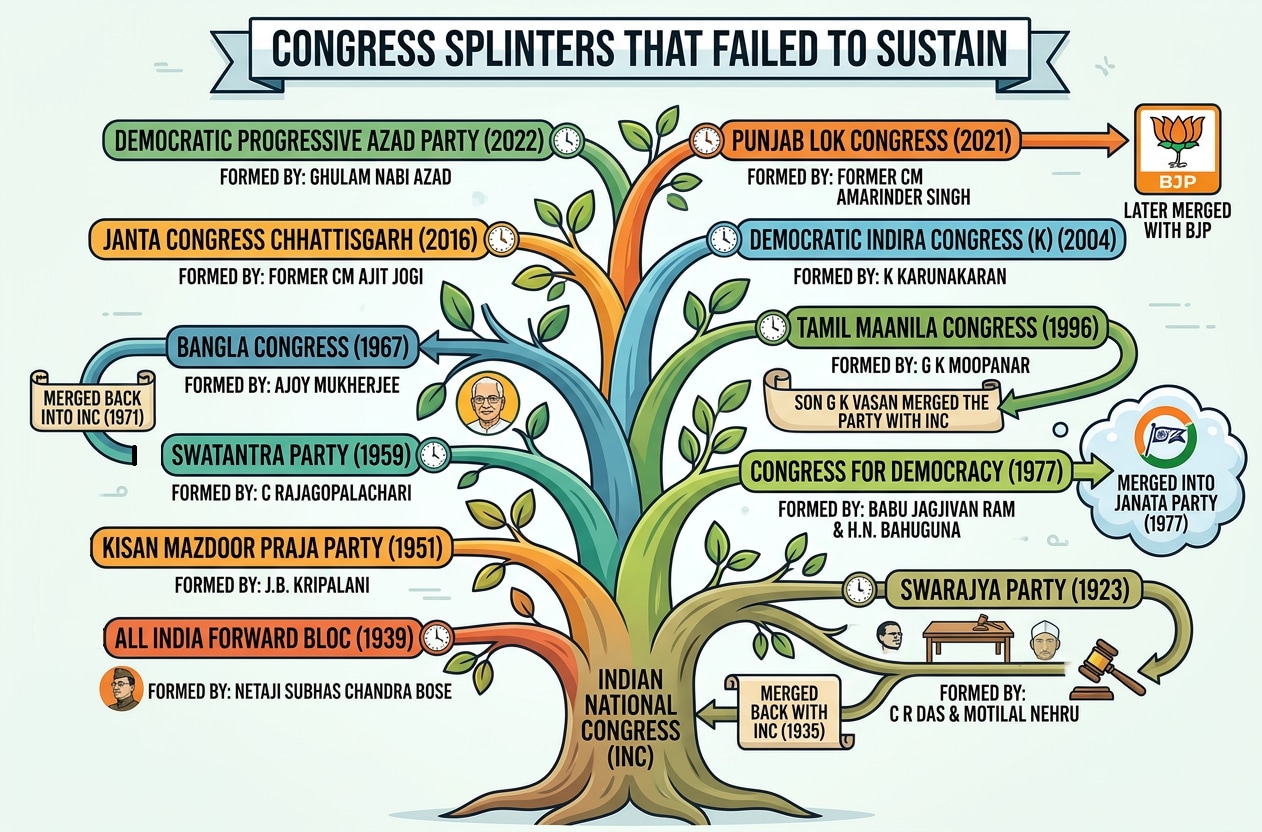
As fresh speculation swirls around opposition unity and the possibility of closer integration among parties against the BJP, a look at India’s political history reveals a pattern. Congress has repeatedly produced breakaway movements that grew into formidable political forces in their own right. The BJP, by contrast, has largely seen its rebels return home or fade from the political conscience.
The latest round of political speculation began with comments from Shiv Sena (UBT) leader Sanjay Raut, who suggested that regional parties such as the Nationalist Congress Party (NCP) and the Trinamool Congress should consider merging with the Congress to strengthen the opposition against the Bharatiya Janata Party.
The proposal was quickly dismissed by both Congress and the Sharad Pawar-led faction of the NCP. Yet the remarks sparked renewed discussion across political circles, particularly after NCP-SP leader Supriya Sule stopped short of rejecting the idea outright.
“Sanjay Raut is like an elder brother to me and has given a good suggestion. What will happen and how, only time will tell,” she said.
Whether such a merger is remotely feasible remains open to question. But the debate has brought attention to India’s two principal national parties that have dealt with internal dissent and political breakaways over the decades.
Congress has repeatedly produced splinter groups that went on to become influential regional powers and, in some cases, dominant political forces. The BJP’s rebels, meanwhile, have generally struggled to sustain independent political relevance, often returning to the parent party after brief experiments outside it.
Congress: A Party Shaped By Splits
Few political organisations in India have experienced as many internal ruptures as the Congress.
Since Independence, Congress has witnessed repeated breakaways driven by ideological disagreements, leadership struggles, regional ambitions and factional conflicts. Some vanished quickly. Others transformed the political map of entire states.
One of the earliest and most enduring examples was the Kerala Congress.
The party was formed in 1964 by KM George following political turmoil in Kerala. The roots of the split lay in a controversy that erupted in 1963. Then Chief Minister R Sankar removed Home Minister PT Chacko from his cabinet. Chacko died in 1964, and fifteen of his political associates, led by KM George, later joined forces to bring down the Sankar government through a no-confidence motion.
More than six decades later, Kerala Congress remains an active force in the state’s politics, though divided into multiple factions over time.
The Indira Gandhi Revolt
Perhaps the most consequential split in Congress history came in 1969.
A fierce power struggle emerged between Prime Minister Indira Gandhi and the party’s organisational establishment, commonly known as the Syndicate.
The confrontation culminated in a formal division of the party.
In the Lok Sabha, 220 Congress MPs aligned themselves with Indira Gandhi, while only 68 sided with the faction that became known as Congress (O), with the “O” standing for “Organisation.”
Indira Gandhi’s camp became Congress (R). The “R” initially represented “Requisitionists” and later came to signify “Ruling.”
The split fundamentally altered Indian politics. Congress (R) emerged as the dominant force and cemented Indira Gandhi’s position as the party’s undisputed leader.
The process continued nearly a decade later.
On January 1, 1978, Indira Gandhi launched the Indian National Congress (I), with the “I” explicitly standing for Indira. Following another internal rupture, her faction adopted the now-familiar hand symbol.
In 1981, the Election Commission formally recognised Congress (I) as the legitimate Indian National Congress, completing one of the most dramatic political reorganisations in modern India.
Rise Of Regional Congress Offshoots
While many Congress splinters disappeared, some evolved into political giants. Perhaps the most successful example is the All India Trinamool Congress.
Founded in 1998 by Mamata Banerjee, the party emerged from her growing dissatisfaction with Congress leadership in West Bengal and at the national level.
Banerjee believed Congress was adopting an excessively soft approach towards the Left Front, which had dominated Bengal politics for decades.
Her departure eventually produced a political movement that overturned one of India’s longest-serving elected communist governments.
A year later came another major split.
The Nationalist Congress Party was founded in 1999 by Sharad Pawar, PA Sangma and Tariq Anwar.
The breakaway centred on opposition to the prospect of Sonia Gandhi becoming Prime Minister because of her foreign origin. More than a quarter-century later, despite internal divisions and electoral setbacks, the NCP continues to be a significant player in Maharashtra politics.
The story repeated itself in Andhra Pradesh.
Congress returned to power in the state in 2004 under YS Rajasekhara Reddy. Following his death in 2009, a succession struggle emerged.
His son, YS Jagan Mohan Reddy, sought to inherit the political mantle but found himself sidelined as K Rosaiah became Chief Minister.
Jagan Reddy broke away from Congress in 2010 and formally launched the YSR Congress Party in 2011.
The gamble paid off dramatically. In the 2019 Assembly elections, the YSRCP swept to power, establishing itself as the dominant force in Andhra Pradesh politics.
A similar story unfolded in Puducherry.
The All India NR Congress was formed before the 2011 Assembly elections by former Chief Minister N Rangasamy.
Rangasamy had grown increasingly dissatisfied with Congress after being removed as Chief Minister in 2008.
The party went on to become a major political force and has governed Puducherry for substantial periods since its formation.
Pattern Of Survival
Breakaways from the Congress have often developed into durable organisations with independent identities, regional roots and electoral strength. Rather than disappearing, many succeeded in reshaping state politics and building long-term support bases.
The Trinamool Congress transformed West Bengal. The NCP became central to Maharashtra’s coalition politics. YSRCP emerged as Andhra Pradesh’s dominant party. The All India NR Congress established itself in Puducherry.
In each case, the splinter survived long after the original dispute that created it.
BJP’s Different Experience
The BJP’s history presents a contrasting picture.
Its origins lie in the Bharatiya Jana Sangh, which merged into the Janata Party in 1977 before re-emerging as the BJP in 1980 following internal disagreements.
Unlike Congress, the BJP has experienced relatively few major national-level schisms.
Political analysts often attribute this to two factors: a stronger ideological framework linked to the Rashtriya Swayamsevak Sangh and a more centralised leadership structure, particularly after 2014.
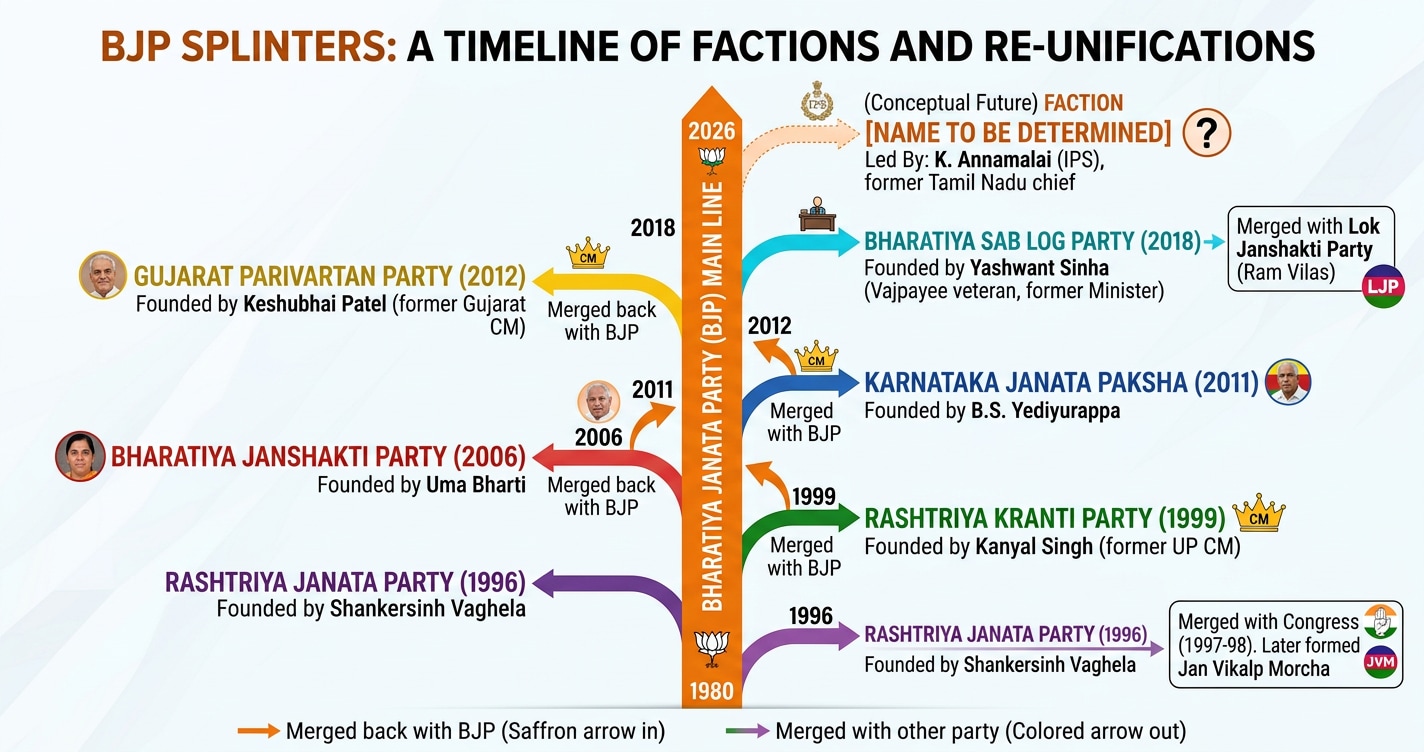
Most BJP breakaways have been state-specific rather than national in character. They have usually emerged from leadership disputes, factional rivalries or disagreements over ticket distribution.
Their record of survival has been notably weaker.
The latest example may soon emerge in Tamil Nadu, where former state BJP chief K Annamalai is preparing to launch a regional political party after leaving the BJP.
Whether that effort follows the path of Congress splinters or previous BJP breakaways remains uncertain.
History, however, offers some clues.
Shankersinh Vaghela’s Revolt
One of the earliest major BJP rebellions came in Gujarat.
In 1996, senior BJP leader Shankersinh Vaghela launched the Rashtriya Janata Party. The rebellion stemmed from disagreements over leadership after Vaghela opposed the BJP’s choice of Keshubhai Patel as Chief Minister.
A political crisis followed.
Although many MLAs backed Vaghela, the BJP eventually replaced Keshubhai Patel with Suresh Mehta rather than elevating Vaghela.
He responded by forming his own party with Congress’s support and became Gujarat’s twelfth Chief Minister.
The experiment lasted barely a year.
Vaghela eventually merged his party into Congress. Years later, he again broke ranks, cross-voting against Congress leader Ahmed Patel in the 2017 Rajya Sabha election before leaving Congress and launching Jan Vikalp Morcha.
Kalyan Singh’s Political Detour
Another important case involved former Uttar Pradesh Chief Minister Kalyan Singh.
A prominent face of the Ram Mandir movement and Chief Minister during the Babri Masjid demolition period, Kalyan Singh became embroiled in internal BJP conflicts following the fractured verdict of the 1997 Assembly election.
After being replaced amid factional struggles, he launched the Rashtriya Kranti Party in 1999.
Built around a Hindutva platform, the party won four seats in the 2002 Assembly election and sat in opposition alongside the Samajwadi Party.
The independent venture proved temporary.
In 2004, Kalyan Singh rejoined the BJP. He later launched another outfit, the Jan Kranti Party, in 2009. That experiment also ended when the party merged back into the BJP in 2013.
Other BJP Splinters
Former Madhya Pradesh Chief Minister Uma Bharti formed the Bharatiya Janshakti Party in 2006. The party secured only five seats in the 2008 Madhya Pradesh Assembly election. On June 7, 2011, Bharti formally returned to the BJP and the Bharatiya Janshakti Party merged with its parent organisation.
Former Gujarat Chief Minister Keshubhai Patel established the Gujarat Parivartan Party in 2012. The party failed to win significant support. Patel returned to the BJP in 2014.
A similar trajectory unfolded in Karnataka. Former Chief Minister BS Yediyurappa launched the Karnataka Janata Paksha in 2011. The party damaged the BJP’s Lingayat support base during the 2013 Assembly election, winning six seats and helping reduce the BJP’s tally to 40.
Yet even this comparatively successful rebellion proved short-lived. Yediyurappa dissolved the party in January 2014 and returned to the BJP.
Former Union Finance Minister Yashwant Sinha formed the Bhartiya Sab Log Party in 2018. The party contested 30 seats in 2020 but failed to win any. It subsequently merged with the Lok Janshakti Party (Ram Vilas) in 2022.
The Central Difference
The contrast between Congress and BJP breakaways is difficult to ignore. Congress has repeatedly generated offshoots that developed strong regional identities and durable electoral bases.
The BJP’s splinters have generally struggled to achieve comparable longevity.
Many achieved only modest electoral success. Several eventually dissolved. Others merged back into the BJP after a few years.
The result is two very different political traditions.
Congress’s history is filled with examples of rebels becoming regional power centres. The BJP’s experience is largely characterised by temporary revolts followed by reconciliation or political decline.
Why Merger Talk Faces Obstacles
Over the last two or three decades, major regional parties that have governed states or participated in government have shown little appetite for surrendering their independent identities. A formal merger almost always reduces a regional party’s bargaining power, visibility and organisational control.
What is commonly described today as a “merger” is often something different — individual MPs, MLAs or factions switching allegiance for political survival.
Full institutional mergers remain rare.
One notable example was the merger of the Praja Rajyam Party, founded by actor-turned-politician Chiranjeevi, with Congress in 2011.
Praja Rajyam was losing momentum and struggling to sustain itself independently. Congress, meanwhile, required additional legislative support to stabilise its government in Andhra Pradesh. The arrangement served the immediate interests of both sides.
Such conditions are largely absent today.
Regional parties such as the Trinamool Congress, NCP and others possess established voter bases, distinct political brands and organisational structures built over decades.
For many of them, merging into Congress would mean surrendering assets painstakingly accumulated through years of independent politics.
That is why, despite periodic calls for opposition consolidation, history suggests that a full-scale merger remains improbable.