New Delhi:
Artificial intelligence (AI) is opening up new possibilities for physics research, from improving laser experiments to accelerating cancer prediction and analysing massive scientific datasets, according to Professor G Ravindra Kumar, Distinguished Professor at Tata Institute of Fundamental Research (TIFR), Mumbai, and Infosys Prize Laureate.
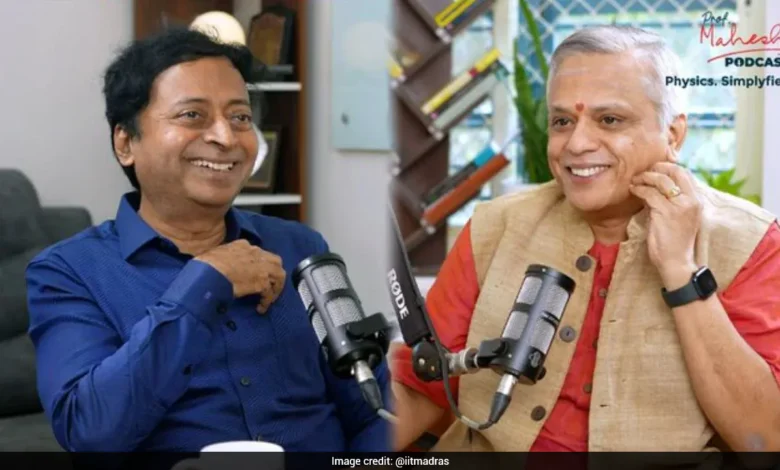
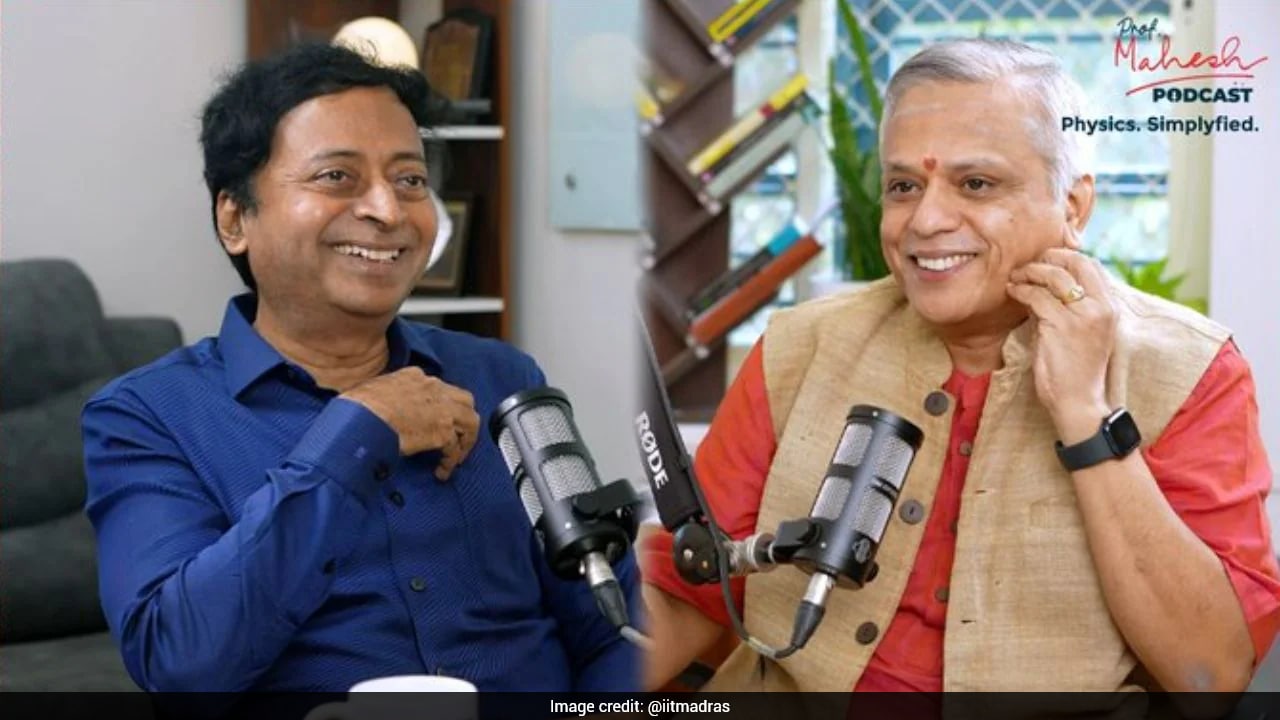
Speaking on the Professor Mahesh Podcast hosted by Professor Mahesh Panchagnula of IIT Madras, Professor Kumar discussed how AI is beginning to influence experimental physics and why its role is likely to expand rapidly in the coming years.
During the conversation, Professor Panchagnula referred to the growing intersection of AI and physics, noting that the 2024 Nobel Prize in Physics recognised foundational work behind modern machine learning. He then asked, “Where is AI interfacing with physics or what are some tangible benefits we can see there?”
Responding to the question, Professor Kumar described AI as “an exploding area”, while cautioning that developments are moving so quickly that predictions can become outdated in a short time.
“It’s again an exploding area. So, I think anything that we say will probably be proved wrong or will be very soon outdated. So there’s just no point in saying it. But I think the point is that AI is throwing up opportunities,” he said.
AI Can Solve Long-Standing Experimental Challenges
Drawing from his own experience in experimental science, Professor Kumar explained how AI could help address problems that researchers have been trying to solve for decades.
He cited the example of focusing high-powered laser beams that suffer from optical aberrations. Scientists currently rely on adaptive optics, a technique borrowed from astronomy, in which deformable mirrors containing multiple actuators are adjusted to correct the wavefront and produce the sharpest possible laser focus.
Explaining the challenge, he said each actuator has to be adjusted precisely so that the wavefront approaches the diffraction limit.
Recalling discussions from nearly two decades ago, he said researchers had wondered whether a system could automatically test every possible actuator combination instead of depending on conventional algorithms that provide only predicted values.
“Twenty years ago… we asked this question… why can’t we just have something which is just pushing it rather than go by some known algorithm… Suppose I give you all options to push every knob, every little actuator there on the mirror, and then maybe it can do all permutational combinations and give me the correct results.”
According to him, this is precisely the kind of optimisation task AI is now well suited to perform.
“Now that looks like something which artificial intelligence can easily do. We put all sorts of wavefronts, feed them, tell the actuators to go berserk, and it will come to the correct thing.”
AI Can Unlock Insights From Massive Scientific Data
Professor Kumar also highlighted AI’s growing importance in analysing enormous volumes of scientific data generated across disciplines such as astronomy, particle physics and biology.
“I think data-wise we have huge amounts of data which is coming up from various observational sources, particularly in areas like astronomy, particle physics… and biology is again a major revolution,” he said.
He pointed to TIFR’s involvement in the Extreme Photonics Innovation Centre, a collaboration with partners in the United Kingdom, where researchers are working with decades of cancer-related data.
According to him, scientists are analysing tissue samples collected over the last 30 to 40 years to identify patterns that could help predict when healthy tissue may develop into a cancerous state at a much earlier stage.
“They look at this cancer tissue… predict what kind of tissue are likely to evolve into a cancerous stage very early on. And that, I think, is going to be a huge benefit for predicting cancer and curing cancer well before it becomes unmanageable.”
He added that scientific datasets are ideally suited to benefit from advances in AI.
“Scientific data are as good as any to benefit from artificial intelligence.”
AI Could Eventually Operate Complex Scientific Hardware
Looking ahead, Professor Kumar said he believes AI could one day take over the operation of sophisticated laboratory equipment by automatically identifying the best experimental settings.
Referring again to laser systems, he said: “The laser has so many controls. Why doesn’t an AI machine just do this and give me the best possible beam? I’m sure one of these days it’ll happen.”
He said that combining AI with existing scientific hardware could significantly accelerate both fundamental research and technological innovation.
“If we intelligently use AI even in the hardware, which is already happening, I think we’ll be able to make huge strides in basic science and also technology.”