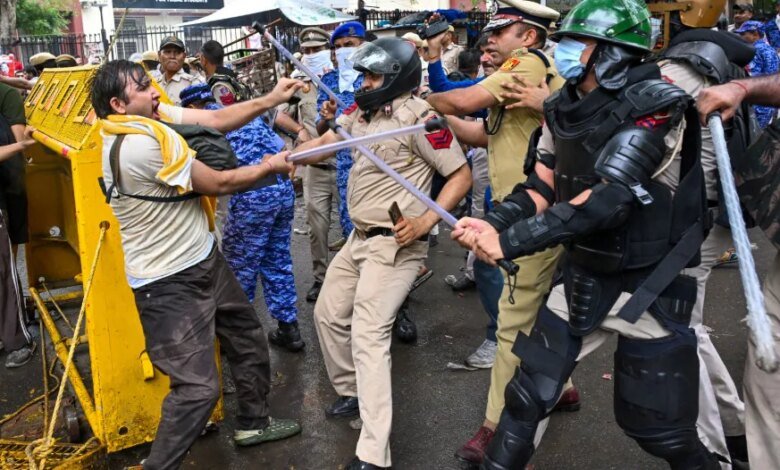
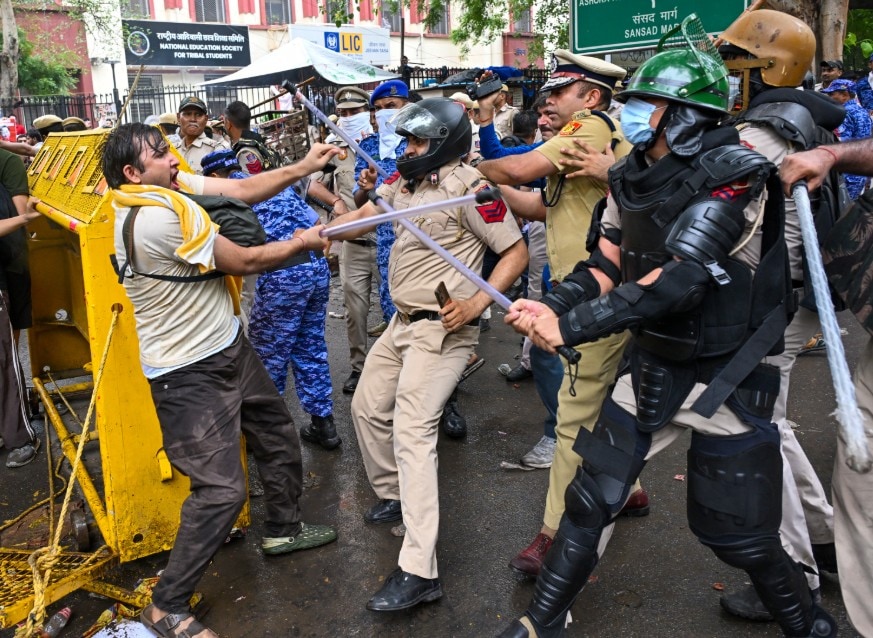
The Supreme Court on Thursday constituted a five-member High-Powered Expert Committee (HPEC) to examine allegations of excessive and disproportionate use of force by the police, paramilitary forces, and other security personnel against peaceful protesters assembled at Jantar Mantar in Delhi and other states against the NEET paper leak.
The committe is headed by former top court judge Justice R Subhash Reddy.
A bench of Chief Justice Surya Kant and Justices Joymalya Bagchi and V Mohana said the committee would also comprise former Punjab and Haryana High Court Chief Justice Ravi Shankar Jha, former Delhi High Court Judge Justice Shalinder Kaur, former CBI Director Rishi Kumar Shukla and retired Meghalaya DGP L R Bishnoi.
“This HPEC (High-Powered Enquiry Committee) has been constituted bearing in mind a wide variety of considerations, including the individual expertise and experience of each of its members, as well as the diversity of the Committee, among other factors.
“We are confident that the recommendations of the HPEC will be of invaluable assistance to this Court, and the Committee will be able to undertake a comprehensive assessment of all such issues as merit due contemplation,” the bench said.
The top court clarified that as a matter of abundant caution, the enquiry undertaken by the committee shall not be a one-time exercise.
It asked the Committee to undertake a continuous and periodic assessment of the issues and shall submit its interim findings periodically.
The top court has directed that allegations of harassment and molestation – particularly those involving female protesters – be treated as a priority. Additionally, an inquiry will be conducted into the serious and severe injuries sustained by protesters during police action.
The court has ordered the preservation of CCTV footage, drone recordings, body-cam footage, and PCR call records related to the protest to ensure that crucial evidence is not tampered with during the investigation and that the sequence of events can be examined independently.
Reiterating its earlier directive, the top court ordered the release of detained minors, with an exception made for those facing charges of serious and heinous crimes.
It also emphasised the protection of the protesters’ personal data. Restraining the police from making their private information public, directing that such data be safeguarded.
The court further clarified that departmental action against police officers would not be contingent upon the findings of the committee’s inquiry; competent authorities may independently initiate action against the police personnel.
The committee, the court said, will investigate the allegations regarding the use of excessive force by police and other security agencies against protesters.
This includes allegations concerning the use of pellet guns, electric batons, lathi-charges, and tear gas.
Consideration will also be given to whether the use of metallic pellets fired from pump-action rifles or other weapons should be banned, particularly in light of the severe and permanent injuries they cause.
The committee will examine how to strike a proper balance between maintaining law and order during protests and peaceful gatherings and upholding the constitutional right of citizens to protest peacefully.
The need for a system requiring police and security personnel to wear uniforms and clear nameplates during arrests or crowd control operations will be considered to ensure the identification and accountability of officers, the court said.
Allegations of police monitoring and surveillance of protesters will be investigated to determine whether such surveillance was consistent with their constitutional rights to privacy and peaceful assembly.