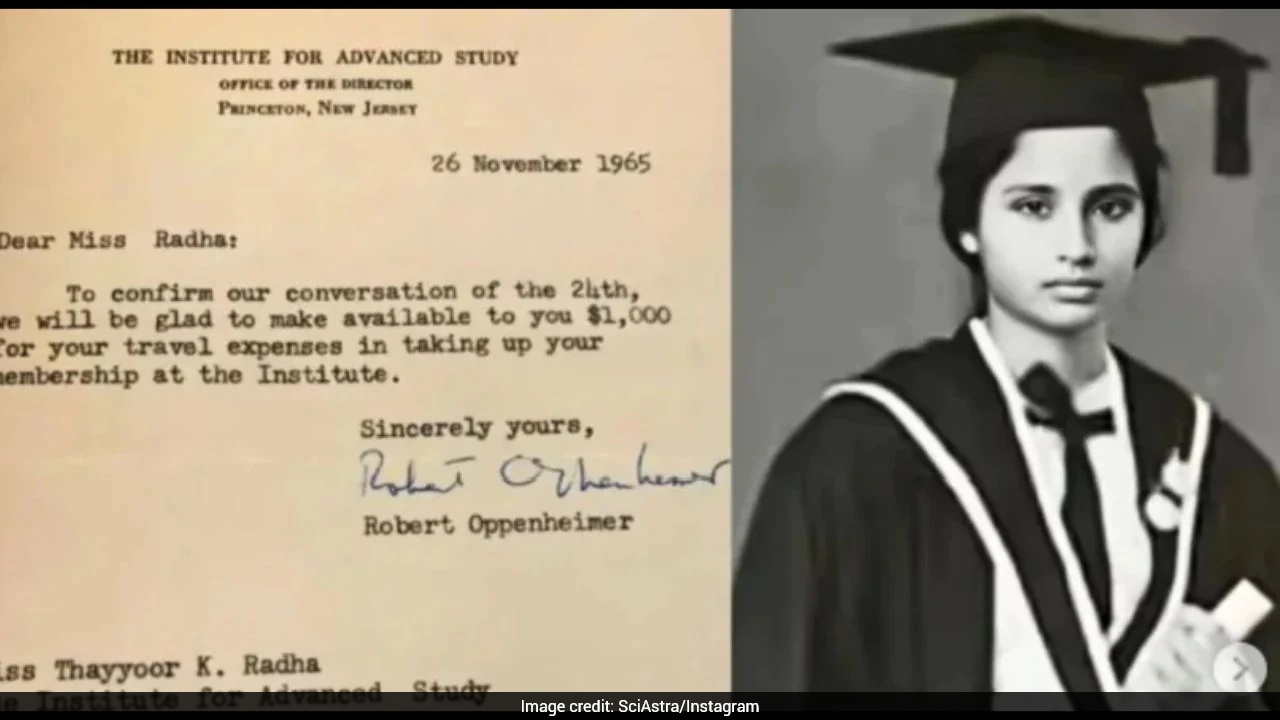
TK Radha, a trailblazing Indian woman physicist, was born in 1938 in Thayyur, a small village in Kerala that lacked electricity. She grew up during the British Raj and went on to earn a gold medal in Physics at Presidency College, Madras (now Chennai). Her exceptional talent eventually caught the attention of J Robert Oppenheimer, widely known as the father of the atomic bomb, who invited her to the Institute for Advanced Study (IAS) in Princeton in 1965.
According to Onmanorama, the English-language news portal of the Malayala Manorama group, the fourth of five children, Radha displayed exceptional academic ability from an early age. During the 1940s and 1950s, when relatively few girls in India pursued education beyond high school, she studied Physics at Presidency College, and later earned a master’s degree in Nuclear Physics from the University of Madras.
At a time when particle physics research was still in its early stages in India, Radha joined a pioneering research group at the University of Madras led by Alladi Ramakrishnan. She earned a gold medal for her academic performance and became part of his pioneering programme in theoretical physics.
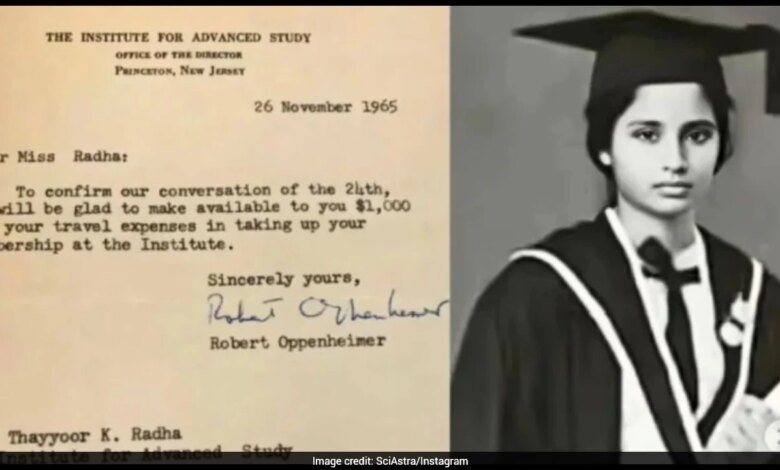
In June 1965, Radha received a letter from Oppenheimer, then director of the prestigious Institute for Advanced Study in Princeton, inviting her to join the institution for a year. The invitation recognised her exceptional research abilities and marked a significant milestone in her scientific career.
Radha continued to make significant contributions to theoretical physics, publishing 14 research papers on complex subjects, including Feynman propagators and particle interactions. Her work brought her into contact with leading scientists, including Freeman Dyson and Sergio Fubini, during her time at the institute.
However, her research career faced a major challenge when she moved to Canada. A lack of adequate childcare made it difficult for her to continue pursuing theoretical physics while raising her family, prompting her to step away from active research.
A decade later, Radha embarked on a new professional chapter. She learned computer programming and was soon hired by the University of Alberta.
Over the next 16 years, she applied her deep understanding of physics and computational skills to complex projects, becoming a valued contributor to the university’s work. Her career reflected her ability to adapt to new challenges and apply her scientific expertise in a different field.