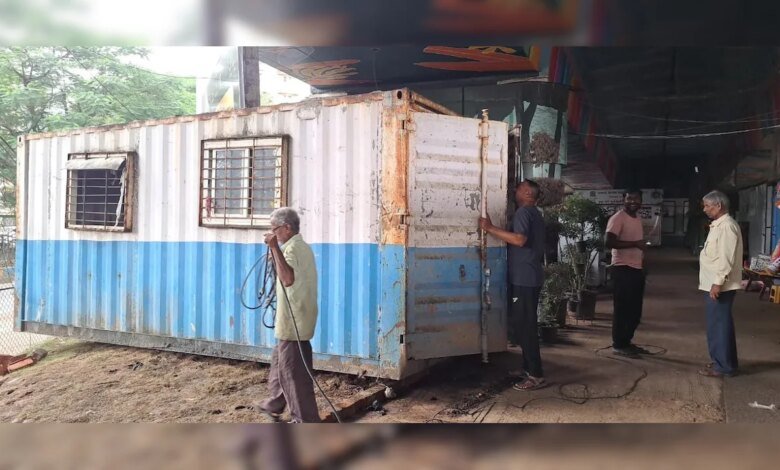
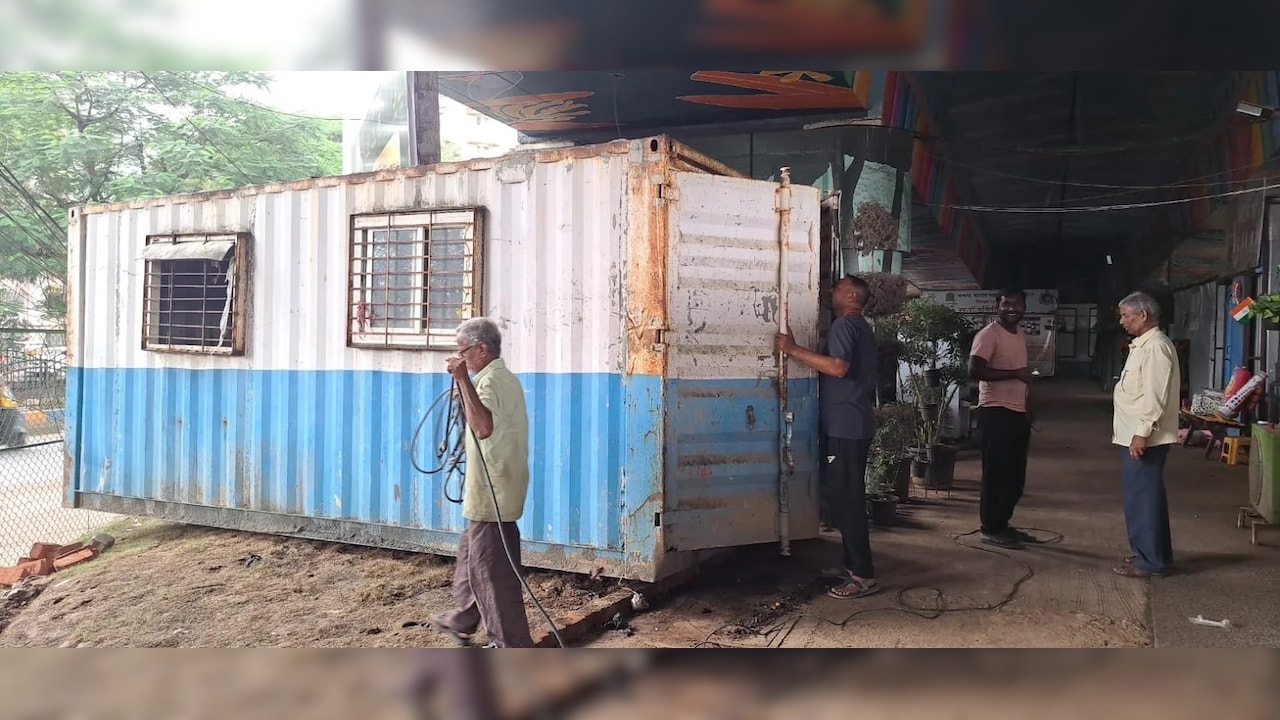
Every morning beneath a busy flyover in Thane, children walk into brightly coloured shipping containers carrying school bags, notebooks and dreams.
To a passerby, the containers might appear to be temporary structures. But inside them are classrooms. Here, children recite Marathi poems, solve mathematics problems, eat breakfast together and speak about becoming teachers, doctors and engineers.
For many of them, these aspirations would have been unimaginable just a few years ago.
The school, called Signal Shala, was established in 2015 by the organisation Samarth Bharat. Built inside repurposed shipping containers and located close to settlements under flyovers, it was designed for children who often remain outside the formal education system despite education being free in government schools. As of today, there are three such schools functional – Thane, Navi Mumbai, and Chembur.
The initiative began with a simple question: If corporation schools can give education for free, whats the need for such projects?
According to founder Bhatu Sawant, the answer lies in barriers that go far beyond school fees.
“Municipal schools provide free education. But for these children, the challenge is much bigger. Bathing itself is a luxury. Who will drop them to school? There is a language barrier and social isolation. Their grandparents came here years ago, and many of these children were born under flyovers,” he says.
Many of the children who attend Signal Shala belong to nomadic and migrant communities that moved to Mumbai decades ago, particularly from parts of Marathwada. While they live and work in the city, they often remain disconnected from its institutions. Some families speak Pardhi or other dialects at home, making the transition into Marathi-medium education particularly difficult.
For generations, survival took priority over schooling.
Children frequently accompanied parents to traffic signals, sold flowers, performed odd jobs or contributed to the family’s daily earnings. In many cases, formal education was never seen as a realistic pathway.
Sawant recalls that many children grew up seeing luxury cars pass them every day while standing at traffic signals.
“They saw Mercedes and BMWs, but they never imagined that world belonged to them. Their lives revolved around selling flowers or begging. They didn’t dream of becoming professionals because they believed that life was not meant for them. We wanted to ignite that dream in their eyes.”
The challenge, however, was not limited to enrolling children. Teachers had to develop methods suited to students whose experiences were vastly different from those of conventional classrooms.
Shaila Desle, who has been teaching at Signal Shala since 2017, says education here begins with understanding the child before opening a textbook.
“We don’t just teach from books. We first understand how they think and what language they speak. Their dreams and experiences are very different because they grow up on the roads,” she says.
To communicate better with students, teachers learnt elements of the Pardhi language spoken by many children at home. Lessons were adapted to their lived realities, with greater emphasis on conversation, songs and practical learning.
Some subjects came more naturally than others.
Desle says many students display strong mathematical abilities because of their experiences helping families sell goods on the streets.
“They already understand counting, profit and calculations because of their everyday lives,” she says.
The school’s role also extends beyond academics.
Teachers speak of introducing routines that many children had never experienced before: brushing their teeth regularly, maintaining personal hygiene, sitting together for meals and participating in structured activities.
“When they first came here, many did not know simple habits like brushing or bathing regularly. Earlier, they would eat wherever they found space. Today, they sit together, pray before meals and eat as a group,” Desle says.
Changing parental attitudes proved to be one of the biggest challenges.
Families dependent on daily earnings often viewed education as a long-term investment that came at the cost of immediate income. Convincing them that schooling could offer a different future took years of outreach and trust-building.
More than a decade later, the results are beginning to emerge.
According to the organisation, dozens of children who once spent their days at traffic signals have entered mainstream education. Several have passed Class 10 examinations, some have completed engineering diplomas, and others have gone on to participate in robotics competitions and national-level sporting events.
The impact is visible in the ambitions of the current students.
Janhvi, a Class 5 student, says she wants to become a teacher and educate children across Thane. Thirteen-year-old Sachin, who speaks Pardhi at home and Marathi at school, dreams of becoming a doctor.
“I want to treat patients,” he says.
Yet for Sawant, the existence of Signal Shala is not a sign of success. It is evidence of a gap that still exists.
“People ask me what success looks like. For me, the day this school shuts down will be the real success,” he says.
His reasoning is straightforward. A school under a flyover should not have to exist. The real measure of progress, he argues, would be a system capable of naturally accommodating every child, regardless of where they live, the language they speak or the circumstances into which they were born.
Signal Shala views education as a basic human right. Its classrooms inside shipping containers have helped bring hundreds of children closer to the educational mainstream. At the same time, they serve as a reminder that access to education is not only about building schools. It is also about designing systems flexible enough to reach those who have long remained invisible to them.