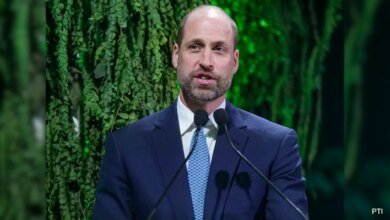
Hours after Jensen Huang was ousted as Nvidia CEO following the revelation of his relationship with the alleged Chinese spy Alice Huang, a campaign to reinstate him was already underway, backed by Elon Musk and other leading US tech figures in Silicon Valley. Even President Trump backed the call on Monday morning. Given the seriousness of the allegations against him, Huang may not get his job back, but the campaign underlines the stature and importance of the man in the United States who built the world’s most powerful AI company, which controls about 90% of the market for advanced AI chips.
US officials are now assessing how far its security has been compromised by what could be the biggest espionage scandal involving superpowers since the Cold War. Some may even compare it to the Klaus Fuchs scandal more than 80 years ago, when the German nuclear scientist, involved in developing the first atomic bomb, passed its secrets to the Soviet Union. That ended the West’s monopoly and supremacy in nuclear technology. Today, the race for AI supremacy can be compared to the nuclear race of eight decades ago. In recent years, China has been trying to outpace the US in AI, with Nvidia’s latest chips believed to be the biggest obstacle to Beijing’s goal.
Advertisement – Scroll to continue
Honest Idiot Or Willing Accomplice
It’s too early to know how much China has benefited from the espionage and how much the US has been hurt by it, or how much of a setback the scandal has inflicted on its AI aims. The vital question is whether Huang was merely an honest idiot who fell for a beautiful woman or he knowingly compromised US security. His ouster from Nvidia may end the global AI boom for which he was the single most important figure. Before The New York Times broke the story of Huang’s relationship with the alleged Chinese spy last month, Nvidia’s market valuation reached a record $5.7 trillion. The tech giant had also financed other AI companies, helping fuel the US stock market boom. His departure could damage not only Nvidia but also the entire US economy. Since the scandal was unveiled, the company’s value has fallen by more than 30%, eroding the wealth of many investors.
Taiwan-born Huang became one of Beijing’s most significant targets as China accelerated its AI boom to match the United States. It badly needed Nvidia’s advanced chips to do so. A UN report in July this year found that the US accounted for 75% of the computing power among the world’s top 500 AI supercomputers, with China accounting for just 15%. Even before the honeytrap scandal came to light, Nvidia was selling AI chips to China. Megaspeed, the Singapore-based company of the alleged Chinese spy and Huang’s mistress, Alice, arranged to send nearly $12 billion of top-of-the-line Nvidia chips to companies in China between March 2024 and June 2025, according to The Wall Street Journal. Culper Research, a US short-selling firm, assessed that more than 20% of Nvidia’s revenues last fiscal year came from China. The shipment records, according to WSJ, show orders for several hundred thousand chips, the very ones the US wanted most to keep out of Chinese hands through export controls.
Advertisement – Scroll to continue
Trump Under Scanner
The first photos of Jensen Huang with Alice appeared on social media in June 2024, when they were seen together at a bar in Taipei one evening during an annual computer industry trade show. It’s possible they were already in a relationship by then. Within months of that meeting in the Taipei bar, US authorities were investigating whether Megaspeed was illegally diverting Nvidia’s AI chips to China. A few months later, with Donald Trump’s administration firmly in the White House, State Department officials sent a memo to his team warning that a Chinese spy was in a close relationship with Nvidia’s CEO. US Secretary of State Marco Rubio reminded him of this on Air Force One in May during the visit to Beijing for the summit with President Xi. Trump has been very close to Huang and included him on that trip.
Huang successfully persuaded the president to sell Nvidia’s advanced H200 chips to China, reversing a ban from Biden’s time that had prevented the sale of such technology to Beijing. Questions are being asked about why the President decided to change US policy, which would help America’s main adversary. China had planned to overtake the US as the world’s AI leader by 2030; Huang’s work may have brought that target closer. The US Congress will investigate the whole affair and question the Nvidia chief under oath. Trump’s role will also come under scrutiny, as he has played down the spy scandal and defended Huang.
A Long Trail Of Chinese Spying
Beijing has long been accused of espionage by Western countries, allegations it has consistently denied. Before Alice Huang’s affair, similar cases involving honey traps and other forms of spying had occurred. In 2020, FBI Director Christopher Wray said his bureau was opening a new China-related counterintelligence case every 10 hours. In the same year, the US website Axios reported on a suspected Chinese spy who developed close ties with American politicians during Trump’s first term. The spy, identified as Fang Fang or Christine Fang, targeted politicians in California and engaged in romantic and sexual relationships with them. She also attended several Indian American political gatherings and even volunteered for Indian-origin Congressman Ro Khanna. This suggests China has also been targeting Indian-origin politicians in America.
In recent years, Chinese agents have been caught in several Western countries attempting to influence politicians in favour of Beijing. Two years ago, Han Dong, a member of the Canadian parliament, was accused of bringing a busload of high school Chinese students to vote for him in a party election. In 2024, an aide to then-New York Governor was charged with working for Beijing’s interests.
Shifting Focus On Commercial Spying
The Huang scandal is the latest example emphasising that industrial espionage is now at the heart of China’s intelligence operations. Since President Xi came to power in 2012, China’s spy agency, the Ministry of State Security (MSS), has become significantly more active. Its resources are reported to be even larger than the CIAs, indicating how important espionage has become. After Xi launched the Made in China programme in 2015 to achieve self-reliance in key high-tech industries, the focus has shifted to commercial espionage. The US Centre for Strategic and International Studies recorded 224 incidents of Beijing-sponsored espionage against Washington between 2000 and 2023, more than half of which targeted commercial technologies. Chinese spies and hackers have been accused of stealing designs for many high-end products from the West, including US fighter jets, solar panels, and commercial paint formulations.
Beijing is now frequently accused by the West of espionage to boost its AI technology. In March 2024, a Chinese national, Linwei Ding, who worked at Google, was charged with stealing the company’s artificial-intelligence trade secrets. In April, the White House accused China of stealing US intellectual property on an industrial scale, using tens of thousands of proxy accounts to extract information from American AI models. In September, Britain’s intelligence agency, MI5, discovered that more than 100 academics linked to the country’s institutions have unwittingly assisted China’s espionage operations against the UK via a front company working for its intelligence services. The research topics included AI and cyber security.
Challenge For India
The Nvidia scandal poses a particular challenge for developing powers like India. What additional measures should we take to protect our vital installations and industries? Can we rely on the West to help us counter Beijing? Can India trust the US when we know China doesn’t have a monopoly on economic espionage? In light of the Huang scandal, should India now be more cautious about its deepening relationship with companies from Taiwan, the region Beijing regards as its renegade province and has not ruled out using force to take the island? And could this scandal involving a Taiwan-born US businessman bring other foreign-born industry leaders in America, including those from India, under greater scrutiny?
The issue demands an active strategy by India to combat commercial espionage. Indian intelligence agencies have played an active role in safeguarding against terrorist and military threats. They have uncovered a number of honeytraps involving Pakistan in recent years, and there have also been arrests of suspected Chinese and Pakistani spies. Following the Galwan Valley conflict in 2020, India banned 59 Chinese apps for security reasons. India has also been careful to prevent its firms from entering critical security areas. However, Indian agencies have played a limited role in addressing economic threats, which are increasingly a national security issue.
Economic Vulnerabilities
In 2021, the then junior IT minister, Sanjay Dhotre, acknowledged in parliament that approximately one million CCTV cameras installed in government institutions were made in China. However, it took the government five years to introduce strict regulations on the sale of such cameras. That only happened after Delhi police busted a Pakistan-China espionage module in April. Police found commercially available, solar-powered Chinese CCTV cameras, connected via 4G SIM cards, near defence installations in Punjab, Haryana, Rajasthan, and Jammu and Kashmir. Most Western countries had banned Chinese CCTV cameras for security reasons years earlier.
Some may argue that India should also consider commercial espionage. Unlike Pakistan, China and others, India has refrained from such activities. However, what matters more for India is protecting its vital civilian and military infrastructure, including power and water plants, from espionage and cyber-attacks. India is now developing advanced semiconductor chips, drones and military systems with private-sector involvement. These are potential targets for attack or sabotage. Authorities must acknowledge that private-sector companies are equally vulnerable to commercial espionage and to hacking by foreign agents seeking to harm India’s economy. The Nvidia scandal should be a wake-up call for us.
(Naresh Kaushik is a former editor at the BBC and Associated Press. He is based in London)
Disclaimer: These are the personal opinions of the author