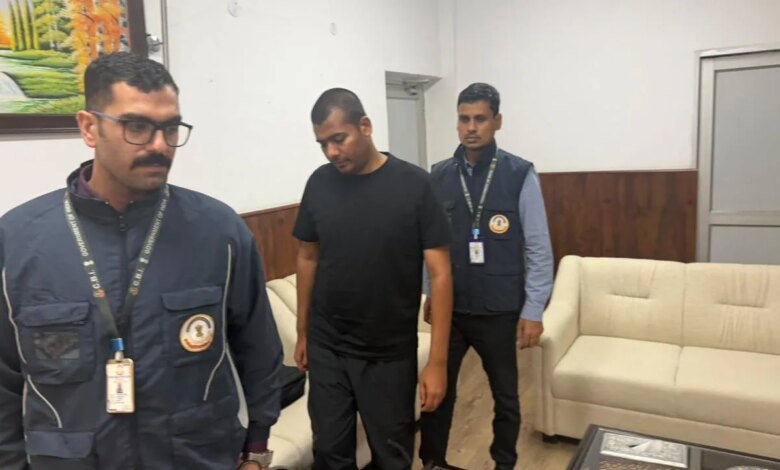
A wedding in Ras Al Khaimah in February 2023 is said to have cost about Rs 200 crore in cash. Private jets carried guests from Nagpur, and celebrity performers were flown in. Investigators now treat that wedding as a key piece of evidence in one of India’s largest alleged online betting cases.
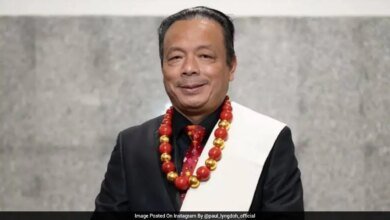
The groom, Saurabh Chandrakar, has now been brought back to India from Oman by a team from the Central Bureau of Investigation. He is the main promoter of the ‘Mahadev Online Book’ network and is listed as accused number one in the case brought by the Enforcement Directorate, the agency that probes financial crimes. A medical examination and transit remand formalities will come first. He is then due to be produced before a special court in Raipur.
Advertisement – Scroll to continue
Chandrakar is wanted in two cases registered by the Central Bureau of Investigation and one started by the Enforcement Directorate. Chargesheets have been filed in all of them.

He was taken into custody by the Royal Oman Police after Interpol issued a ‘Red Corner Notice’. India then began the extradition process. The Central Bureau of Investigation took up the case at the request of the Chhattisgarh government. Its statement says the probe found that betting earnings were passed through several layers of ‘mule’ bank accounts and then moved abroad through the hawala network. A portion of the money, it adds, was allegedly used to secure protection.
Advertisement – Scroll to continue
The Enforcement Directorate says Chandrakar and Ravi Uppal, both from Bhilai in Chhattisgarh, built the network together. They were initially small-scale businessmen, but their betting business grew quickly around 2019 and 2020. During the Covid-19 pandemic, when people were stuck at home and online activity surged, its reach widened further. Both men eventually moved to Dubai and ran Indian operations from there.
The agency says the Dubai headquarters monitored the websites, apps, user IDs, betting funds and the ‘panels’, which were the local operating units in different Indian states. The risk of running things inside India was passed to franchisees and panel operators. Control of the software, the users, the accounting and the revenue stayed with the promoters.
Inside The Intricate System
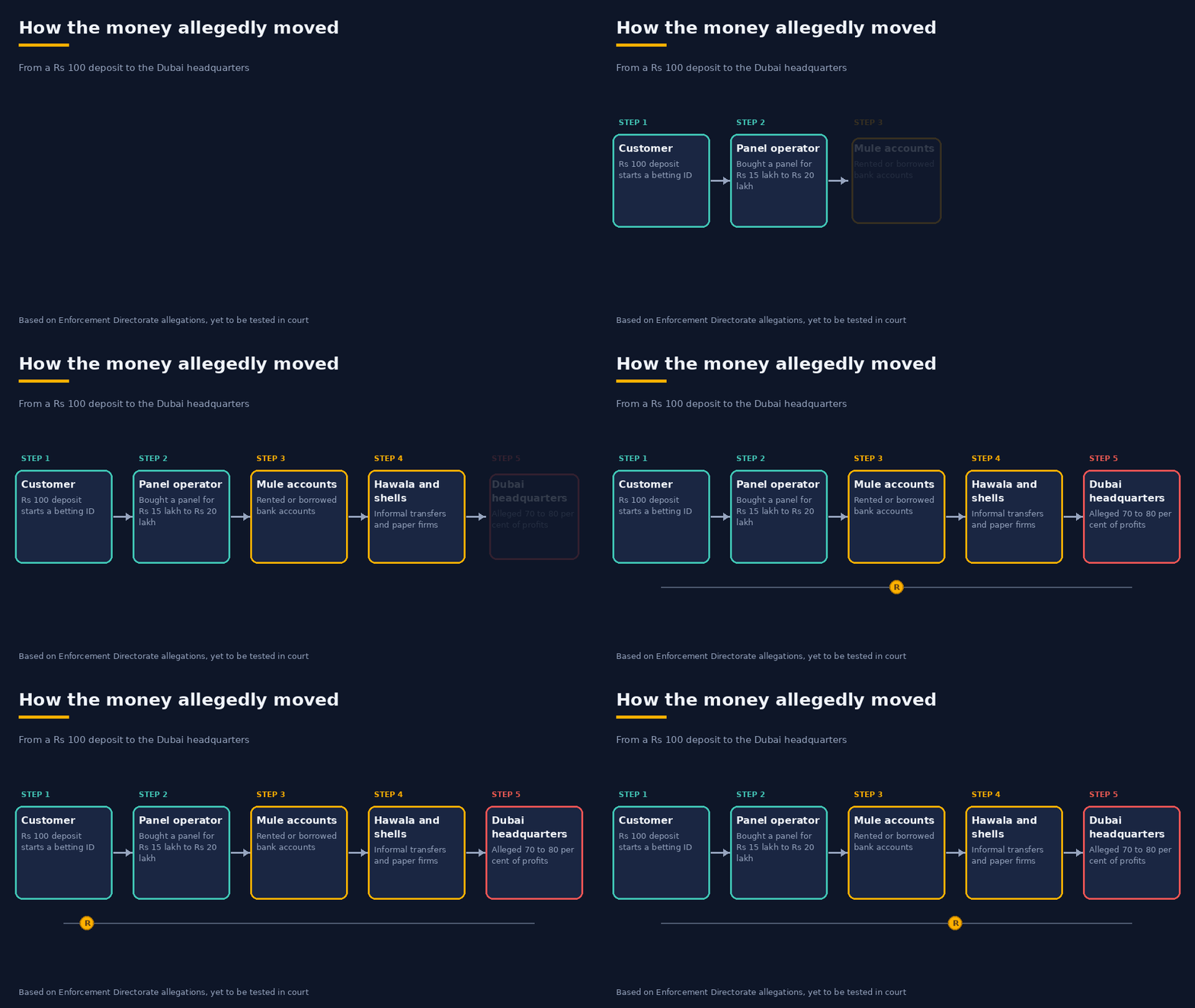
The agency says it found more than 3,200 panels and branches. An operator allegedly paid about Rs 15 lakh to Rs 20 lakh to buy one. After that, the operator arranged bank accounts, phones, internet connections and staff. The headquarters supplied a ‘master ID’ and login details, which the operator used to issue betting IDs to customers. Operators could also create ‘sub-panels’ beneath them, and some people ran more than one panel.
According to the agency, as much as 70 to 80 per cent of profits flowed back to the headquarters. In some panels, the rest was split between the operator and a local manager.
How Customers Were Drawn In
Social media, websites, WhatsApp and Telegram were used to bring people in, particularly during cricket and football matches. The agency also points to large events, celebrity endorsements, social media advertisements and images of a wealthy lifestyle.
Visitors to a website were given a WhatsApp number that connected them to a panel operator. Customers could start with a deposit of Rs 100, after which they received a user ID and betting credits. They could then bet on cricket, football, tennis, card games and other sports. Investigators allege that when a customer won a large sum, the ID was blocked or the payout was obstructed.
Panels reportedly submitted accounts to the headquarters every week, with settlement every Monday. A panel that failed to pay had its login access revoked. The agency says about 1,000 people worked as WhatsApp operators at the main call centre in Dubai. A team of ‘checkers’ worked 12-hour shifts to watch accounts, panels and payments. Many staff were reportedly young people from Chhattisgarh and Bhilai, housed in rented villas, with records kept of their lodging, meals and daily expenses.
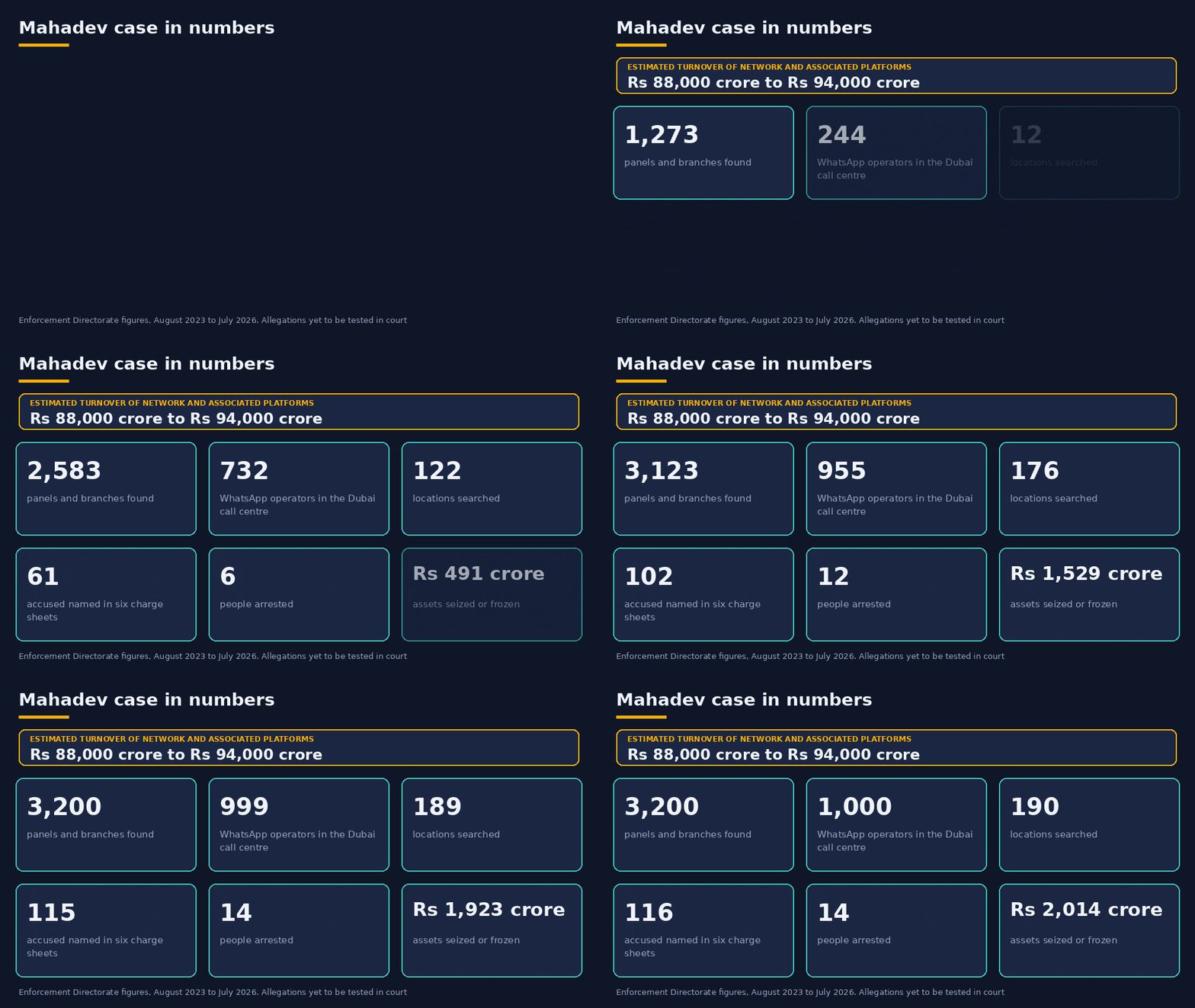
The Enforcement Directorate estimates betting linked to the ‘Mahadev Online Book’ at Rs 75,000 crore to Rs 80,000 crore. It attributes Rs 11,000 crore to Rs 12,000 crore to a platform called ‘SkyExchange’ and about Rs 2,400 crore to ‘Lotus365’. Together, that puts the estimated turnover of the network and its associated platforms at Rs 88,000 crore to Rs 94,000 crore.
The agency alleges that Rs 4,000 crore to Rs 5,000 crore was sent out of India to the United Arab Emirates and other countries. It has filed six charge sheets naming 116 accused and has arrested 14 people.
Mule Accounts And Hawala, Explained
The agency says betting money did not go straight to the promoters. It went through a large number of bank accounts, many opened in the names of people with no link to betting. Some accounts were rented. Some holders were paid a commission to allow their use, and some were allegedly deceived, with their documents used without their knowledge. Investigators call these ‘mule’ accounts. Money was moved between them repeatedly and passed through companies and shell firms, which are businesses that exist largely on paper, making the source and the final beneficiary hard to trace.
Cash was also fed into the formal banking system through mobile phone shops, small companies and other businesses. Some operators allegedly charged one to two per cent to deposit cash on behalf of others. In one instance, a bank account linked to Honey Singh showed credits of about Rs 48 lakh between May 2019 and November 2021, and a payment bank account belonging to his father was also used, according to the investigation. The agency says it found about 886 mule accounts in Navi Mumbai, with transactions of nearly Rs 84 crore, and 431 in Raipur.
Banks and companies were initially used to send money abroad. The agency alleges that hawala use rose in 2023, after scrutiny of formal channels increased. Hawala is an informal money transfer system in which cash is handed over in one country and an equivalent amount is made available in another, with no money crossing a border through a bank. The Dammani brothers allegedly played a key part, charging about Rs 100 for every Rs 1 lakh transferred. The agency says records of these transactions were destroyed daily.
Travel Agents, Hotels And Villas
Settlement also allegedly ran through travel bookings. The agency says a Bhopal firm, Rapid Travels, collected cash from panel operators and paid travel and hotel costs for the Dubai-based promoters. Its records reportedly carried entries labelled ‘MD Dubai’ and ‘MD Kenya’. The agency puts the firm’s annual ticketing turnover at about Rs 55 crore. It also points to freight payments of nearly Rs 300 crore to shell companies in Asia, which it suspects were meant to hide the true source of the money and the real beneficiaries.
Betting earnings were also allegedly used to buy luxury villas, plots and apartments in Dubai, often in the names of associates, relatives and companies. Another route went through the Foreign Portfolio Investor channel, which lets overseas entities invest in Indian shares, and through shell companies set up in Kolkata.
The Wedding Ledger
The agency says about Rs 112 crore was sent to an event management company through hawala for the wedding, and about Rs 42 crore was spent in cash on hotel bookings. It says it recovered a document from an event management company listing wedding expenses of about Rs 112.05 crore, along with records of cash payments. Guest lists were sorted into groups such as ‘team’, ‘business’ and ‘friends’. Raids on the organisers led to action against the hawala operators they named, and about Rs 2.37 crore in unaccounted cash was seized.

The agency also mentions a large event in Dubai in September 2022. A second event at the Dubai World Trade Centre, planned for September 18, 2023, was cancelled after the agency stepped in. Such events, it says, were used to promote the network and attract new clients and panel operators.
The Other Names In The Case
Ravi Uppal is described as a co-controller of the network. He is alleged to have arranged the transfer of crores into India through hawala and to have built a network to reach government officials and political contacts. His brothers, Rohit and Rahul, are also named in connection with the hawala network. In January 2026, assets worth about Rs 21 crore linked to him were attached. He is reported to be in Dubai, where a separate extradition process is under way.
Shubham Soni, also known as Pintu, is said to have overseen cash deliveries and payments from Dubai. In an email to the Enforcement Directorate on November 2, 2023, he identified himself as a promoter of the Mahadev app. The agency says he claimed that commissions were regularly paid to political office-bearers. He further alleged that about Rs 508 crore reached the then Chief Minister, Bhupesh Baghel, through a person called ‘Verma Ji’. These claims have yet to be independently verified by a judicial authority.
Vikas Chhaparia is described as the network’s financial manager in Dubai. In September 2023, the agency froze securities worth about Rs 236.3 crore linked to him and attached bank accounts holding about Rs 74.29 crore.
Hari Shankar Tibrewal, known as ‘Hari Sky’, is named as the owner of SkyExchange. The agency says he built a system of ‘master IDs’ and ‘cash points’. Raids on February 28, 2024, produced laptops that allegedly showed a weekly betting profit of about Rs 22.68 crore. The agency alleges that foreign companies linked to him were used to move money into Indian firms through share purchases, preferential allotments, warrants and block deals. It says it has gathered KYC documents (identity checks done by firms), declarations of beneficial ownership (who truly owns and benefits from a company), records of directorships and chat logs to show he controlled these entities. It has attached or frozen assets linked to him in several phases, from Rs 388 crore in December 2024 to Rs 207 crore in September 2026.
The Ebix Link
Another strand of the case involves Vikas Garg and the American company Ebix Inc., which was in bankruptcy proceedings under Chapter 11 in the United States. The agency arrested Garg on July 14, 2026 under the Prevention of Money Laundering Act and named him accused number 75 in its fifth supplementary complaint, filed on September 10, 2026. He is in judicial custody.
The agency alleges that about Rs 765.77 crore reached his group companies from foreign entities controlled by Tibrewal, through routes including Qualified Institutional Placements, Foreign Portfolio Investment, Foreign Direct Investment and bonds. It adds that about Rs 175 crore more came through shell accounts, bringing the total to about Rs 940.77 crore. A consortium that included Garg’s companies proposed a net cash bid of about $200 million for Ebix under an agreement of May 24, 2024.
READ | Ebix Group Chairman Vikas Garg Arrested In Mahadev Betting App Case
On June 5, 2026, the agency provisionally attached assets worth about Rs 941 crore, including Eraya’s stake in Ebix, valued at about Rs 893 crore. It has told the court that Garg later tried to sell the Ebix headquarters in Johns Creek, Georgia, to put it beyond the investigation’s reach. A final decision on these allegations will come through the judicial process.
A Network That Kept Changing Names
The agency says the network also took stakes in other platforms. ‘Reddy Anna’ was brought in during 2020, and a 50 per cent stake in ‘Fairplay’ was held. Chandrakar’s brother, Gitesh, is alleged to have helped run platforms such as ‘Reddy Anna’, ‘Laser Book’ and ‘Ambani Book’ alongside the Mahadev network.
The Ministry of Electronics and Information Technology blocked the Mahadev websites on November 5, 2023. The agency says operations continued under new domains and brand names, using the same panels, bank accounts and operators. It calls this a ‘continuing offense’.
Fourteen Arrests, Most Of Them Now On Bail
Between August 2023 and July 2026, the agency arrested 14 people. They include local operators, hawala operators, a police constable, financial managers and people linked to betting platforms. Chandrabhushan Verma, an Assistant Sub-Inspector at the time, is alleged to have collected about Rs 81 crore from Uppal over roughly two and a half years and passed it on to various people. Satish Chandrakar is said to have controlled four panels. Both were granted bail by the Supreme Court on July 23, 2025.
Most of the others have also been released on bail by the Supreme Court or the Chhattisgarh High Court. These include the Dammani brothers, Bhim Singh Yadav, Asim Das, Nitin Tibrewal, Amit Agrawal, Nitish Diwan, Girish Talreja, Suraj Chokhani, Govind Kumar Kedia and Sandeep Fogla. Garg, the most recent arrest, remains in judicial custody.
The Most Sensitive Allegation
The agency says a network this large could not have run without political and administrative patronage. It alleges that people in the network paid ‘liaisoning money’ to prevent police or administrative action.
On March 1, 2024, the agency shared its findings with the state under Section 66(2) of the Prevention of Money Laundering Act. On March 4, 2024, the Economic Offences Wing in Raipur registered an FIR (first information report, the document that starts a criminal case) naming Bhupesh Baghel, who was then Chief Minister, along with the promoters and others. The Central Bureau of Investigation registered its own case on 18 December 2024 and searched Baghel’s residence on March 26, 2025. On June 24, 2026, it filed a charge sheet against Asim Das and five others while continuing to look into senior officials and political figures. The Enforcement Directorate began further investigation on August 14, 2026, based on that case.
In a statement dated August 22, 2023, Satish Chandrakar gave an account of how Rs 81 crore was distributed. He said Rs 20 crore went to the Chief Minister’s residence, Rs 15 crore to a business owned by the son of Vinod Verma, who was the Chief Minister’s political advisor, Rs 36 crore to police officers and Rs 10 crore to law enforcement agencies. He also said Uppal told him that Rs 65 crore was given to Vinod Verma on behalf of the Chief Minister’s residence. A search at Vinod Verma’s home on August 23, 2023 reportedly recovered about Rs 2.55 lakh in cash and jewellery worth Rs 16.22 lakh.
These allegations rest on statements recorded by the agency. Their accuracy, and any individual’s criminal liability, will be decided by the court.
Cash, A Hotel Room And An Election
Asim Das was arrested just days before the first phase of the Chhattisgarh Assembly elections on 2 November 2023. The agency seized about Rs 5.39 crore from room 311 of the Triton Hotel in Raipur, a vehicle and a house in Bhilai. According to the agency, Das said Soni had summoned him to Dubai on 25 October 2023 and told him to return and deliver cash. At around 2:15 PM on November 2, five bags were placed in the vehicle, and he was told to wait for instructions.
The agency says it recovered a voice message from his phone that mentioned delivering Rs 8 crore to Rs 10 crore to someone named ‘Baghel’. It says Das identified the voice as Soni’s.
The case also includes retractions. In December 2023, Chandrabhushan Verma and Satish Chandrakar said they were taken to a different building after being jailed and made to hand-write retraction applications on instructions they believed came from higher authorities. On December 12, 2023, Das said he had been influenced by a person and a lawyer to hand-write a prepared document. The agency has included both the statements and their retractions in its investigation, and the court will weigh their credibility and the circumstances in which they were made.
190 Raids And Rs 2,014 Crore
Between August 2023 and July 2026, the Enforcement Directorate searched about 190 locations across Chhattisgarh, Madhya Pradesh, Uttarakhand, Delhi, Maharashtra, West Bengal and Bihar. It says assets worth about Rs 2,014 crore were seized or frozen, including cash, gold, jewellery, bank balances and shares.
It has issued 11 provisional attachment orders worth more than Rs 2,000 crore, with a current market value it puts at about Rs 3,500 crore. That is said to include about Rs 1,800 crore of foreign assets and Rs 1,700 crore of Indian assets. Seven orders have been confirmed. Twenty-two properties in Dubai are covered, with 12 linked to Chandrakar and his associates, worth about Rs 1,500 crore. They include apartments in Dubai Hills Estate, Business Bay, SLS Hotel & Residences and Burj Khalifa.
The agency alleges that Chandrakar got a Vanuatu passport on May 6, 2022, while still holding an Indian one. It says he later claimed to have given up Indian citizenship, which it calls false. It says Ravi Uppal, Vikas Chhaparia and Hari Shankar Tibrewal also held Vanuatu passports, and alleges that the passports were used to avoid Indian investigative and legal processes.
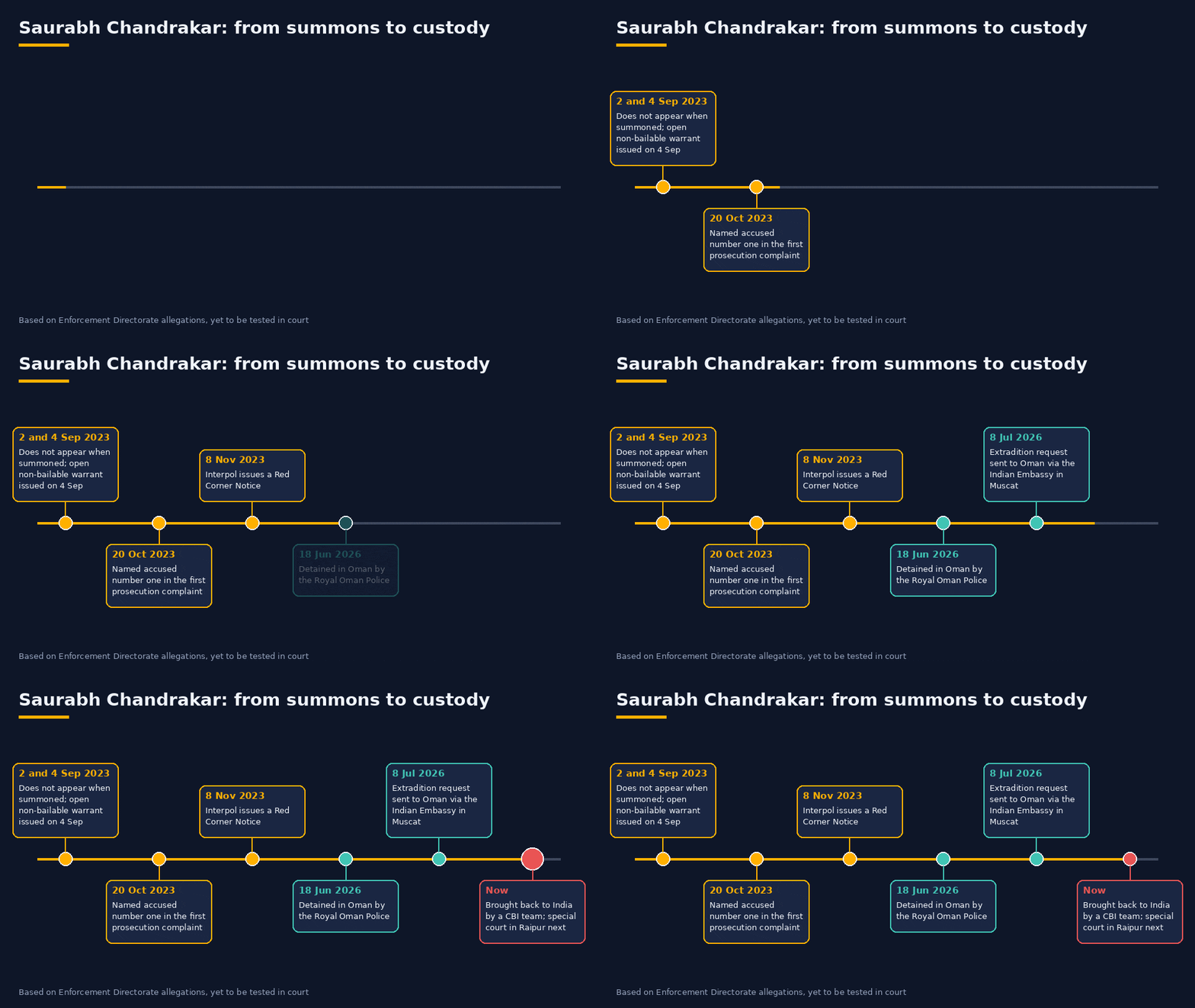
Chandrakar did not appear when summoned on 2 and 4 September 2023. An open non-bailable warrant was issued on September 4, 2023. He was named accused number one in the first prosecution complaint on October 20, 2023, and Interpol issued a Red Corner Notice on November 8, 2023. An application to declare him a fugitive economic offender was filed on November 6, 2024. He was detained in Oman on June 18, 2026, and an extradition request went to Oman’s Foreign Ministry on July 8, 2026, through the Indian Embassy in Muscat.
The agency says it relied on far more than bank records. It gathered phones, laptops, emails, WhatsApp chats, Telegram groups, hotel invoices, ledgers from Rapid Travels, wedding guest lists, voice messages and even grocery bills from a Dubai villa. Its case is that the network was a web of panel operators, hawala operators, travel agents, event managers, foreign entities and stock market investors, not a single app.
With Chandrakar in India, investigators can question him about the betting operation, the Dubai headquarters, the panel franchises, the mule accounts, the hawala channels and the overseas assets. The central question is who ultimately received the money: who got what, whose accounts it reached, who set up the companies and who, if anyone, helped secure government protection. Investigators will have to answer those questions in court, backed by documents and statements.