New Delhi:
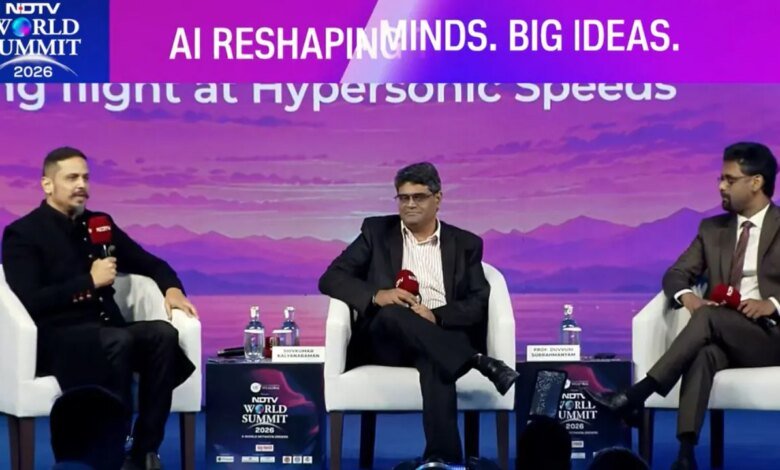
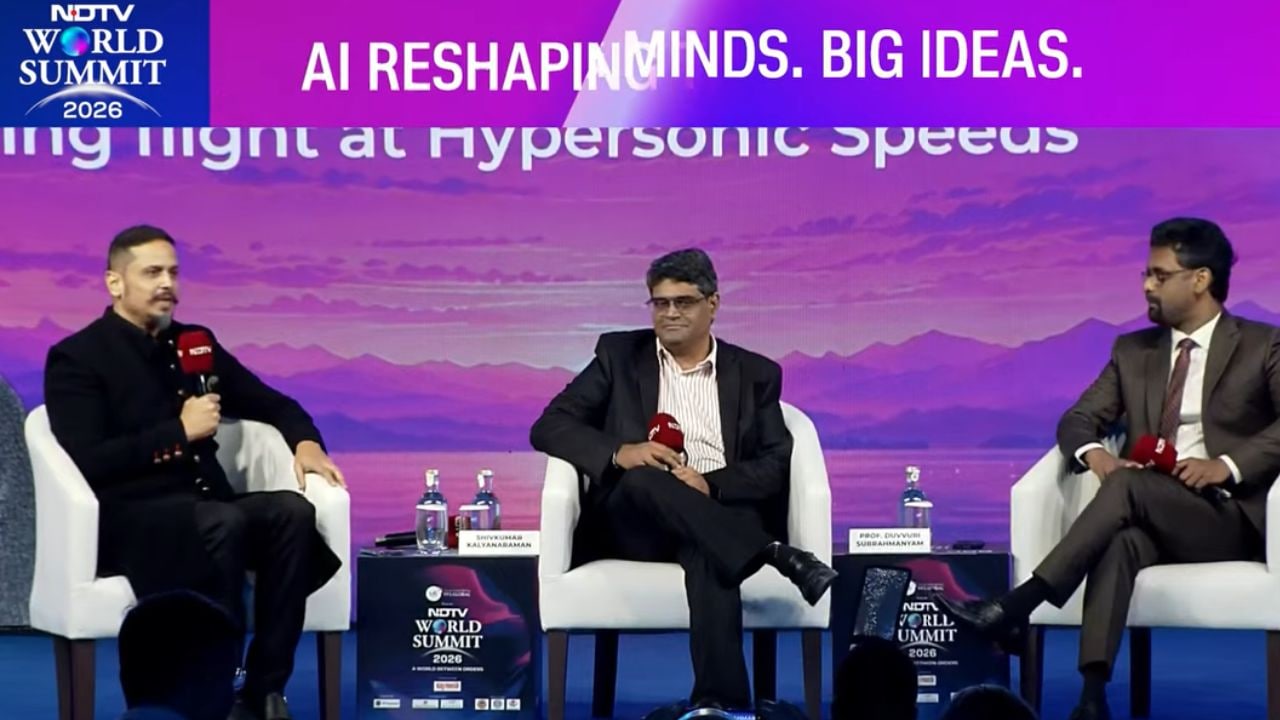
Shivkumar Kalyanaraman, CEO of the Anusandhan National Research Foundation (ANRF), on Friday said India had the talent and potential to emerge as a global research and innovation powerhouse, highlighting the government’s efforts to strengthen domestic research and develop strategic technologies.
Speaking at the NDTV World Summit 2026 during a session titled India And The Making Of A Research Superpower, Kalyanaraman said, “India has no shortage of talent, hum kisi se kam nahi hai.” Referring to a famous dialogue from Bollywood superstar Shah Rukh Khan’s films, he added, “Picture abhi baaki hai.”
Responding to a question from NDTV Managing Editor Shiv Aroor about India’s dependence on imports for aircraft engines and other critical technologies, Kalyanaraman said the government was pursuing several initiatives to address these vulnerabilities under Prime Minister Narendra Modi’s vision of Atmanirbhar Bharat.
“Different parts of the government are focused on various activities to address that,” he said, adding that NITI Aayog was working on a list of critical technologies to guide investments in areas such as aero engines.
Kalyanaraman said ANRF’s missions were designed to identify areas requiring focused research and innovation efforts. These include programmes covering drones, their components and subassemblies, critical raw materials, and societal innovation.
Similarly, under the Research, Development and Innovation (RDI) initiative, the government was identifying priority areas to drive innovation, he said.
Kalyanaraman said strategic sectors would receive support and pointed to developments in space technology. He added that ANRF would soon partner with IN-SPACe to announce the ‘Maha Space Tech’ research programme.
“We want to double down on these areas,” he said, adding that potential vulnerabilities arising from dependence on critical technologies were being examined carefully.
India To Invest More In Research, Deep Science
Kalyanaraman said significant investments would be made to strengthen India’s research and innovation ecosystem and reduce the country’s dependence on other nations for critical technologies.
“India is on the rise. We are moving our investment up in research, we are creating an environment where researchers can thrive, innovators can thrive, people will want to make a choice to build in India, build in India for India,” he said.
He said the government’s vision was to develop solutions to India’s challenges, including making healthcare and medical technology more affordable, and subsequently take these solutions to international markets.
“Prime Minister wants us to solve India’s problems, let’s say in affordable healthcare, or affordable MedTech, and then take it to the world. Build in India for the world,” he said.
According to Kalyanaraman, India’s research ecosystem was improving, with capital being directed towards various areas and efforts underway to boost productivity beyond financial investment alone.
He said ANRF was supporting hundreds and thousands of research projects and enabling researchers to collaborate as part of a broader research ecosystem.
Kalyanaraman also referred to Saral AI, an initiative aimed at simplifying research and facilitating the dissemination of research findings across the ecosystem. The objective, he said, was to connect a wider community of researchers beyond the limited number of institutions currently engaged in such work.
He added that stronger links between academia and industry could encourage more collaborations and help India develop solutions for domestic and global markets.
Emphasising the importance of fundamental research, Kalyanaraman said India needed to support deep science to build capabilities in deep technology.
“Because without deep science, there is no deep tech,” he said, adding that India had a long history of great scientists and engineers. He said the aim was to make India a leading destination for scientific research and engineering.
‘India Is Not Very Far Behind’ In High-Speed Flight
Professor Duvvuri Subrahmanyam, associate professor of aerospace engineering at the Indian Institute of Science (IISc), described the current period as an exciting time for scientists and called ANRF one of the most significant developments in recent years.
“The vision is directly coming from Prime Minister Modi. He is a very capable man here to execute the vision. NRF is leading the charge in terms of supercharging scientific research, and in the coming years, we’ll see the impact of that,” he said.
Responding to a question about the technological development gap between India and China and whether India was investing in projects to develop indigenous sovereign technologies, Kalyanaraman said ANRF was investing in mission-mode programmes across multiple sectors.
“We are placing multiple bets,” he said.
Discussing India’s progress in high-speed flight compared with countries that had been working on the technology for years, Subrahmanyam said the field was highly specialised but that India was not far behind leading nations.
“High-speed flight is a very niche area, and on that front, there is actually good news because I think we are not actually very far behind,” he said.
He added that only a handful of countries, around three or four or fewer than five, were attempting to develop some of these technologies, leaving room for further advances.
“This race is still wide open, and we are not very far behind,” he said, adding that he was optimistic about the prospects for high-speed flight technology over the next three, five, and 10 years.