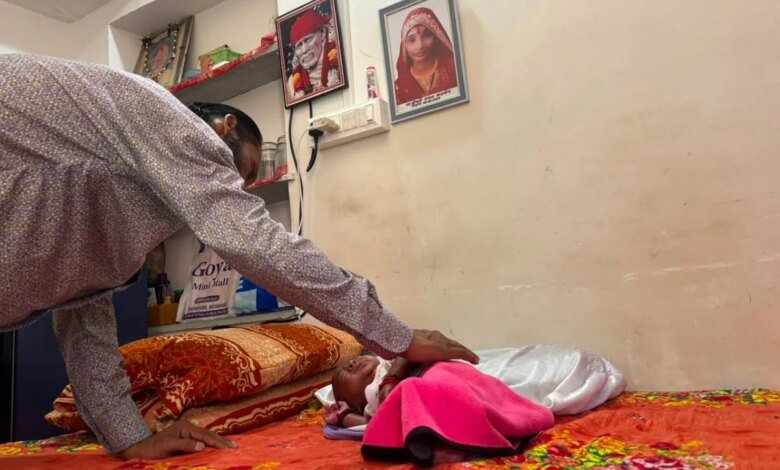
Barely two months old, he cries, searching for the one voice that will never answer again. Above his bed hangs a photograph of his mother. His father and aunt try to soothe him, but nothing calms him. Finally, his aunt lifts him into her arms and feeds him a bottle of milk.
His mother’s embrace is gone. So is the warmth of her touch. “This is his life now,” said his father, Pawan Malviya, adding, “A mother’s love and her milk were never meant to be part of his destiny.”
Advertisement – Scroll to continue
His wife, Payal, died at the New Medical College Hospital in Kota after giving birth to their child. Following her sudden deterioration, other women in the same ward also fell critically ill.
A day after delivering her son through a caesarean section, Payal died in the hospital. Doctors attributed her death to a pulmonary embolism – a blood clot in the lungs.
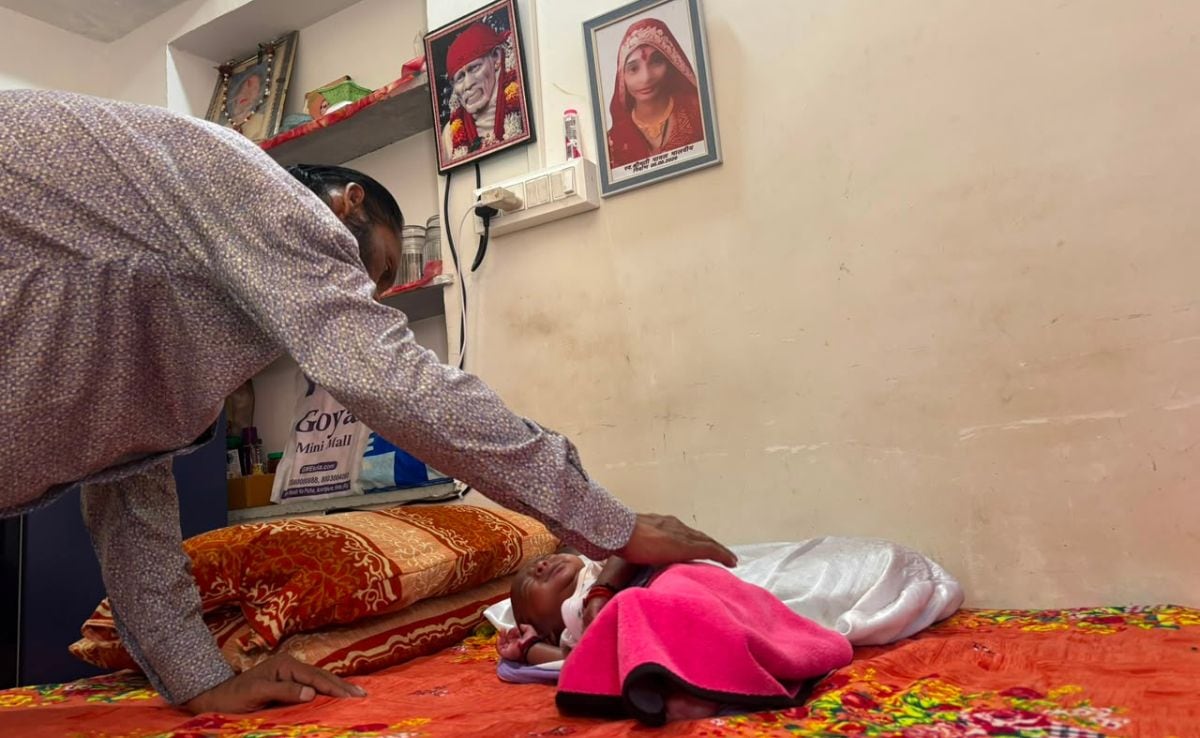
Pawan Malviya tries to soothe his newborn. Payal’s photo hangs on the wall.
But Payal was not the only casualty.
More women died after undergoing C-section deliveries in Kota. Several others developed severe complications and are now dependent on repeated dialysis, some having undergone as many as 26 sessions. While certain drug reports are awaited, the review committee has flagged inadequate monitoring of key health indicators.
Their deaths have brought about more questions than answers even as officials aware of the investigation attribute different causes behind the deaths of these five women – three were in the New Medical College Hospital, Kota, and two who were initially admitted in the JK Lone Hospital, Kota.
The investigation is being conducted by an eight-member expert committee set up by the Rajasthan government and an expert team from AIIMS, New Delhi. Additionally, the New Medical College Hospital in Kota has launched an internal inquiry led by its principal, Dr Nilesh Jain.
For this three-part series, NDTV travelled across several districts of Rajasthan to investigate maternal deaths and severe post-delivery complications reported across government hospitals.
This story focuses on Kota, where the team visited hospitals and spoke to bereaved families, survivors, doctors, officials and investigators. Part 2 would explore cases in Jodhpur, followed by Part 3 in Bikaner.
Speaking exclusively to NDTV, Rajasthan Health Minister Gajendra Singh Khimsar, however, maintained the incidents in Kota, Jodhpur and Bikaner were separate cases and should not be viewed as part of a single statewide pattern. The minister said the inquiry has not identified any single cause behind the deaths and complications but has instead pointed to multiple contributing factors.
Cluster of Tragedies
When Payal’s lifeless body was wheeled out of the ward, another woman, Jyoti Verma, was fighting the same battle.
Ravi Nayak and Jyoti Verma had married just last year, after years of love that finally culminated in their wedding. They were eagerly waiting to welcome their first child. But that joy was short-lived.
When doctors discovered that the baby had passed stool inside the womb, Jyoti was rushed in for an emergency cesarean section. What was meant to be a race to save two lives soon turned into a tragedy that left an entire family shattered.
“Doctors told us she needed an emergency C-section. She was shifted to another ward. There were six women there, all put on drips. After the delivery, she seemed fine. But the very next morning, her condition suddenly worsened. Her blood pressure dropped, she was panicking. We kept asking the doctors what was happening, but they only told us to wait. She was shifted to the ICU. She was bleeding heavily. On May 6, she was referred to the new building (super speciality) and put on dialysis. But the bleeding never stopped,” Ravi Nayak said.
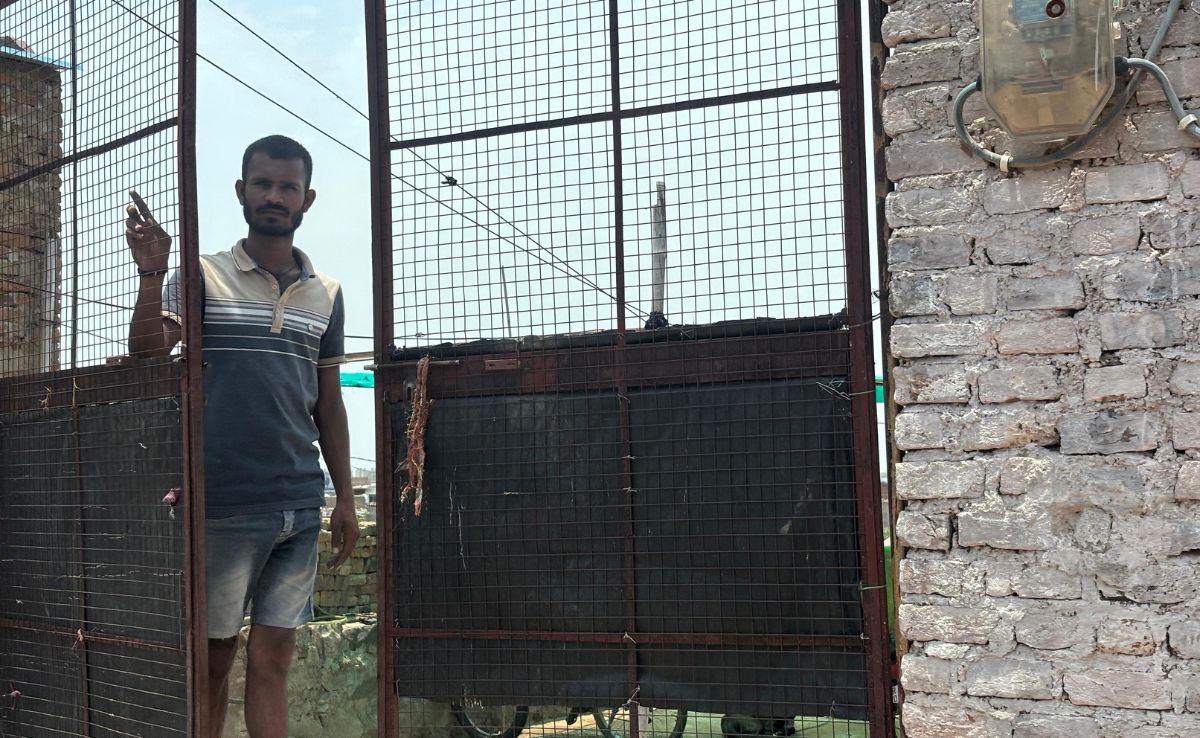
Ravi Nayak stands at the door of his house in Kota. His wife Jyoti died after giving birth.
As he spoke, Ravi flips through a thick file of Jyoti’s medical records, holding on to the only evidence he believes proves that his wife was perfectly healthy before she walked into the hospital to deliver their first child.
Jyoti’s post-mortem report, accessed by NDTV, states that the exact cause of death is awaiting forensic laboratory (FSL) findings. However, doctors treating her said she developed acute kidney failure and multiple organ failure following severe, excessive bleeding.
“I can’t even go to work anymore because I have to look after my child. We haven’t received any support from either the government or the hospital,” Ravi Nayak said.
For these families, the loss did not end with the deaths. It has become a daily struggle to raise newborns without their mothers, while waiting for answers and accountability. They said they have been denied their complete medical records, a claim disputed by the state’s health minister.
Where was the monitoring?
The spotlight of the probe in these cases now also sticks on post-operative monitoring. Sources told NDTV that investigators found gaps in tracking urine output-a critical indicator after delivery in some patients at the Kota’s New Medical College Hospital.
The review committee also flagged inadequate monitoring of blood pressure, ECG readings, hydration, and liver and kidney function tests.
“Several issues were found in documentation as well as monitoring at regular intervals,” a source said.
Investigators have also identified significant discrepancies in recordkeeping at the hospital.
“The hospital on some days handles nearly 100 deliveries a day. With such a heavy workload, the monitoring required every two hours may not have been tracked consistently in every case,” a senior doctor said.
Speaking to NDTV, Dr Nilesh Jain, principal of the New Medical College Hospital, Kota, said, “On May 4 and 5, around 12 emergency surgeries were performed, including 10 C-sections. Four women recovered normally, but six suddenly fell critically ill. Payal was one of them and later died. The others had to be shifted to the Super Speciality Hospital.”
“Drawing a distinction with another government hospital, Dr Jain said the complications at the JK Lone Hospital appeared unrelated. “On May 8 and 9, 12 C-sections were performed there. Six women recovered, while six developed different complications. One woman with a cardiac condition died, two suffered liver complications and were discharged, and two developed kidney failure and were shifted to the Super Speciality Hospital. Those were high-risk pregnancies with a different etiology (cause),” Dr Jain added.
According to doctors at the JK Lone Hospital, Kota, while Priya Mahawar died due to heart failure, Pinky Mahawar died due to postpartum haemorrhage.
But at the New Medical College Hospital, Dr Jain said, the pattern is harder to ignore.
“Only two of the women were high-risk pregnancies. The rest were healthy before surgery. That is why we believe these cases may have a common etiology.”
The emergency operation theatre where six of the deliveries took place in the New Medical College Hospital, Kota, has been shut and is being renovated. The labour room here had seepage. However, officials say bacteriological cultures from the OT showed no signs of contamination.

Seepage in a labour room in the New Medical College Hospital, Kota
In the aftermath of the Kota maternal deaths, investigators also found that some Oxytocin vials contained water instead of the drug. Doctors and investigators now believe Oxytocin is unlikely to have caused these deaths.
Dr Jain added that the OT is being renovated as per suggestions from the AIIMS review team.
Sources said reports on surgical items, IV sets and IV cannulas are still awaited, while tests on samples of the used antibiotics and several other medicines have come clear. Fresh samples of medicines linked to patients developing symptoms such as shivering, etc, have also been sent for analysis.
However, sources said investigators increasingly believe the tragedy may have been multifactorial – involving a combination of patient condition, environmental factors as well as a variety of other factors. As the probe continues, there is still no clear answer. Two doctors – Dr BL Patidar (head of the gynaecology unit in the New Medical College Hospital, Kota) and Dr Shradha Upadhyay (a contractual doctor in the hospital’s gynaecology department) – have been suspended.
Many More Lives Upended
In Shivpura, however, there is no cry of a newborn-only silence.
Five months pregnant, Shereen had gone to the New Medical College Hospital, Kota, for what was meant to be a routine sonography. During the examination, the gynaecologist found that her cervix had opened prematurely and immediately performed an emergency cervical stitch in an attempt to save the pregnancy.
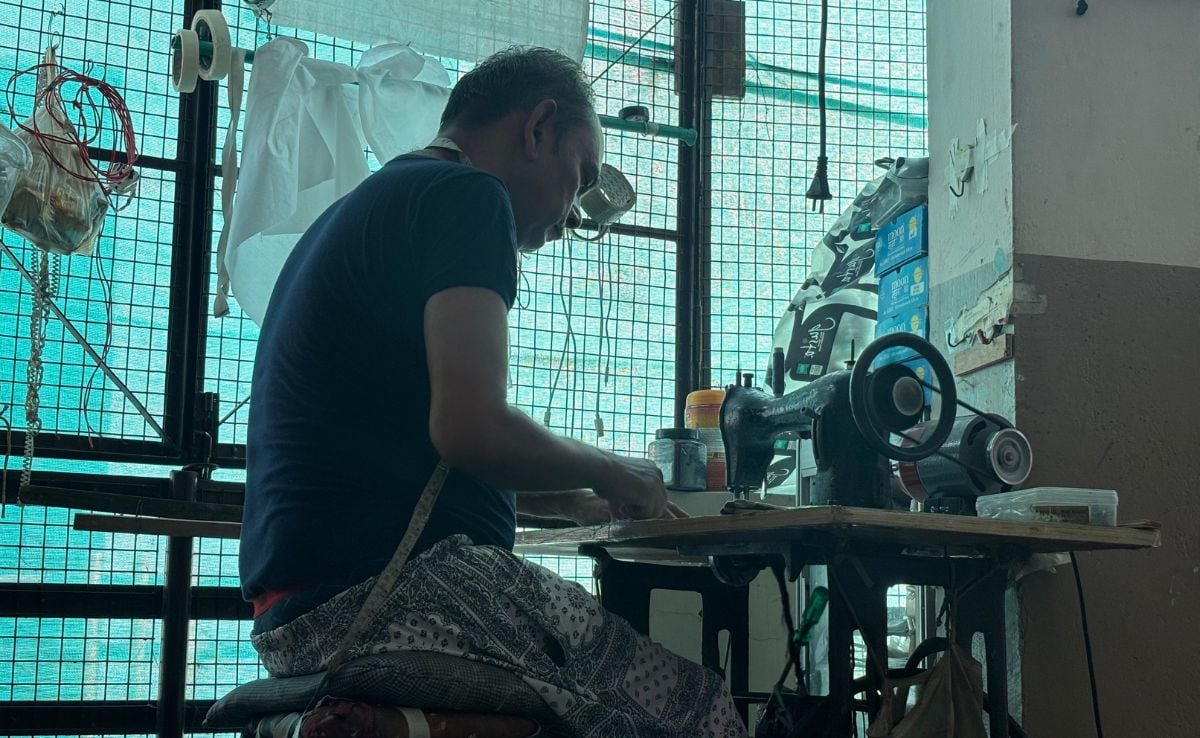
Shereen’s father-in-law said the family had taken a loan against their house to pay for her treatment. They are now in debt.
But Shereen’s condition continued to deteriorate. Desperate to save her, her family shifted her to a private hospital, where they spent nearly Rs 3 lakh on treatment. When the money ran out, they had no choice but to return to the Kota Medical College Hospital.
It was there that Shereen lost her life. “This is murder. This is two murders. Now my house is on mortgage,” said her father-in-law Abdul Wahab.
But the story doesn’t end with these deaths.
When NDTV visited the Super Speciality Building in the New Medical College Hospital campus last week, it found several other women still admitted, many undergoing repeated dialysis.
“She was normal after the delivery. We kept telling the staff she was bleeding, but no one paid attention. The doctors operated on her again, yet the bleeding started all over again. By evening, her body had turned yellow and was badly swollen. She was put on a ventilator for four days. Then her kidneys stopped producing urine,” said Mogan Lal, husband of Dhanni Bai.
To keep her alive, he says, he sold the taxi he drove for a living. “She has to undergo dialysis every third day. So far, she’s had nearly 20 to 25 sessions,” he said. Sitting beside him, a visibly frail Dhanni Bai struggles even to feed herself. In a faint voice, she says, “Just two days ago, I was in the ICU.”
Dhani isn’t the only one, there’s Ragini, Sushila, Aarti and Pinky too on repeated dialysis. Some women have, however, also recovered and left.
“Her blood pressure and sugar levels keep fluctuating. It all began in May. Our baby was born on May 3. We’ve already spent Rs 50,000 and now we have nothing left. Today, even my elder daughter fell ill. I don’t know what to do anymore,” said Om Prakash, Sushila’s husband.
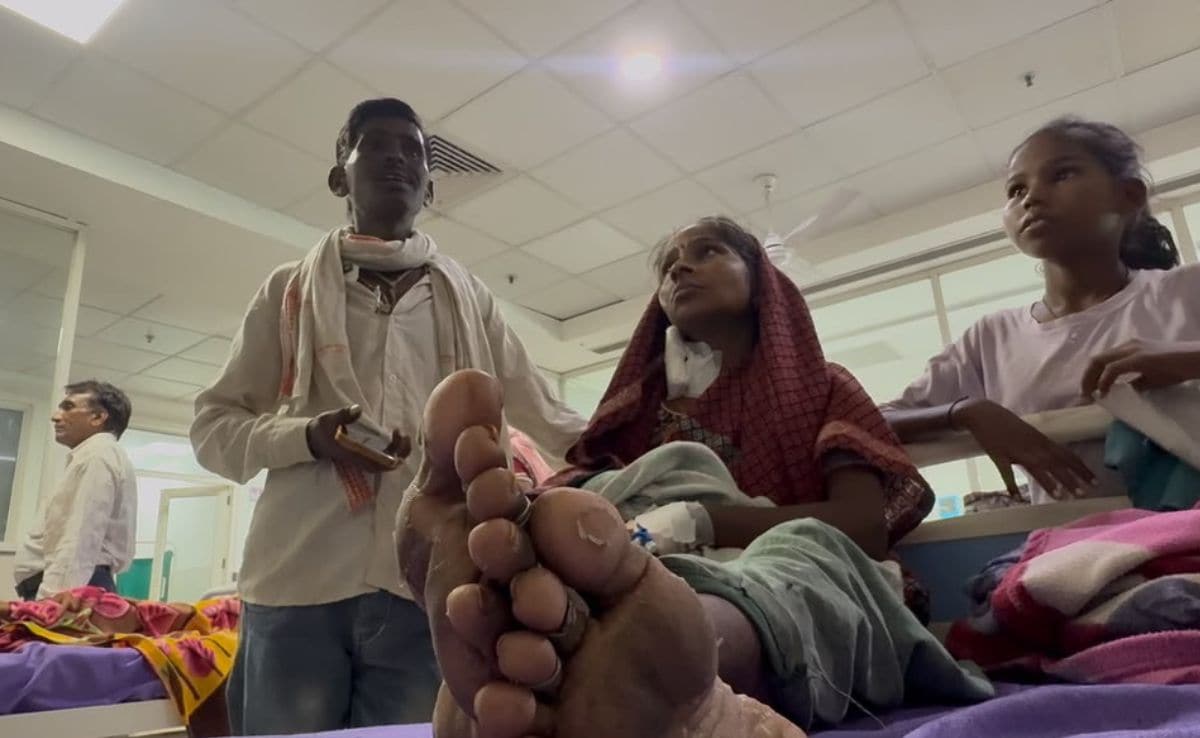
Sushila and her family at the Super Speciality Hospital, Kota. Several women, including Sushila, have been undergoing repeated dialysis.
Some of these women have been advised by doctors to return home. But their families are terrified. They fear that if their condition worsens, they may not survive the long journey back for dialysis.
For many, home is several kilometres away and every trip to the hospital is a battle in itself.
Heat, Dehydration And Hidden Risks
Senior doctors also said many of the women they treat have had multiple pregnancies, are anemic, or arrive severely dehydrated. However, they agreed that monitoring of hydration levels when they were first admitted too may not have been adequate.
They also said underlying health conditions, coupled with heat, poor nutrition and socio-economic factors, can increase the risk of serious complications during and after childbirth.
Dr Nirmala Sharma, Head of the Department of Gynaecology and Superintendent of the JK Lone Hospital, said multiple factors can contribute to life-threatening complications during pregnancy and childbirth.
“In regions like Kota, Bikaner and Jodhpur, extreme heat often leads to dehydration because many women do not drink enough water. If they also have conditions such as high blood pressure, these factors can compound. During delivery, women can enter a hypercoagulable state, which in severe cases may progress to disseminated intravascular coagulation (DIC), often a life-threatening condition that is extremely difficult to reverse,” she said.
Dr Sharma stressed the need for round-the-clock laboratory support. “We need 24-hour laboratories that can provide rapid renal and liver function tests. Everything changes during pregnancy, and timely monitoring is critical.”
According to Rajasthan Health Minister Gajendra Singh Khimsar, extreme heat during the heatwave, dehydration among pregnant women and the fact that many patients were already high-risk referrals who arrived in critical condition may all have contributed to the adverse outcomes.
He also said investigators are examining whether high temperatures during transportation and storage could have affected the efficacy of certain medicines and injections.
Khimsar stressed that Rajasthan’s maternal mortality ratio is below 48 deaths per 100,000 live births, lower than the national average, and argued that the state’s government hospitals continue to manage an enormous patient load while delivering specialised care.
“The New Medical College Hospital, Kota, alone sees nearly 14 lakh OPD patients every year, while the JK Lone Hospital conducts around 6,000 deliveries annually. Government hospitals handle the most complicated and high-risk cases, many of them referred from other facilities, while providing treatment free of cost. That is why they have greater expertise than private hospitals,” the minister said.
Khimsar said the review conducted by the AIIMS team recommended stricter Standard Operating Procedures (SOPs), better refrigeration and temperature control, and stronger infection control and hygiene practices across hospitals. He added that the Rajasthan government has decided to strengthen these SOPs, improve cooling and storage infrastructure, and continue accepting critically ill referral patients despite the higher risk of poor outcomes.
Meanwhile, the families in Kota are still searching for accountability and for the truth. Some returned carrying death certificates, and unanswered questions. But for the children growing up without their mothers, and the families left to piece together what happened inside those hospital walls, every passing day is another reminder of the tragedy.
(With inputs from Harsha Kumari Singh)