New Delhi:
Amid New Delhi’s deepening ties with the European Union, India and the four Visegrad Group (V4) countries — Poland, Hungary, Slovakia, and the Czech Republic — have agreed to deepen cooperation in political, economic, technological, and defence and people-to-people ties, according to Foreign Minister S Jaishankar. The group has also backed India’s call for a permanent seat at the United Nations Security Council (UNSC).
The move followed Jaishankar’s first meeting with the leaders of the V4 group on the margins of the 81st session of the UN General Assembly.
What Jaishankar Said
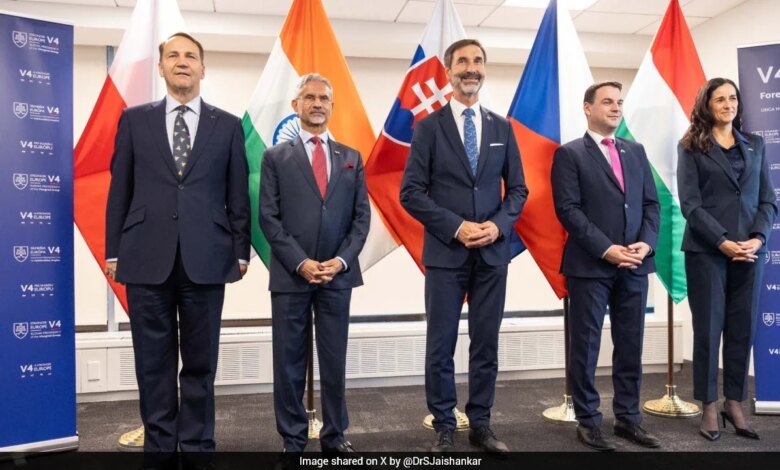
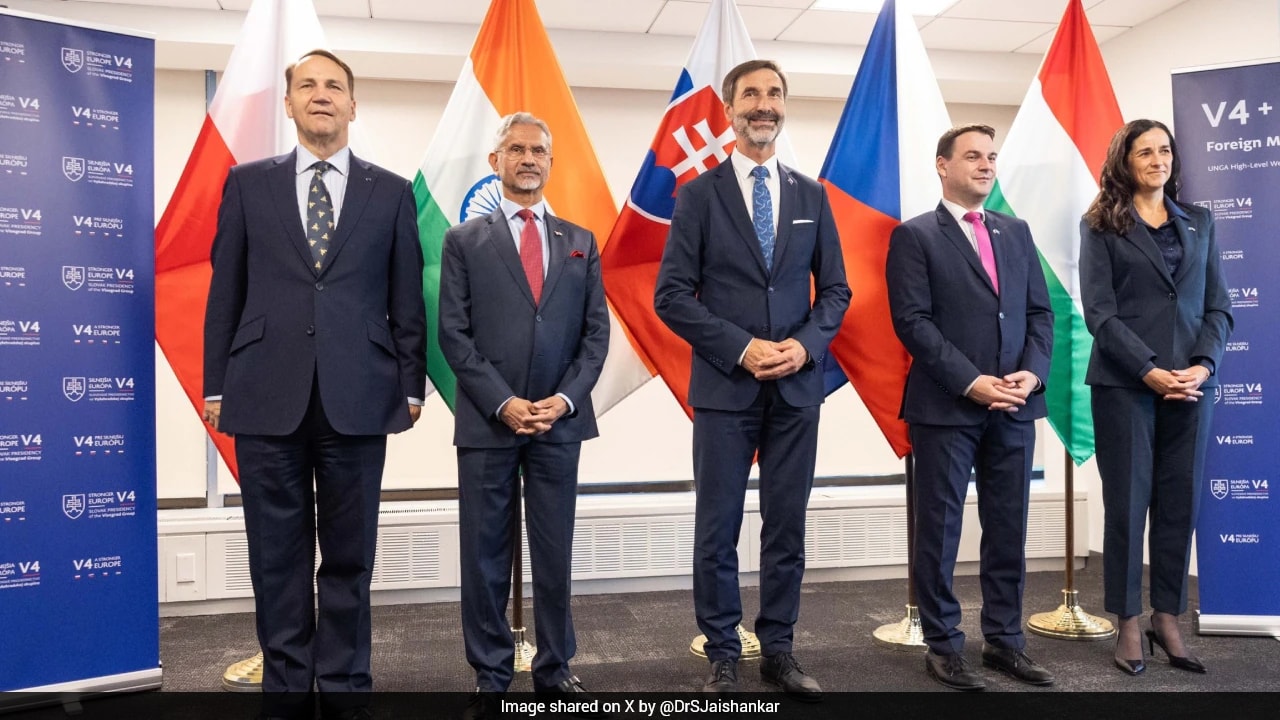
“It was, in a sense, a new historic occasion,” Jaishankar said in remarks after the meeting, where he was joined by Poland’s Deputy Prime Minister and Minister of Foreign Affairs Radek Sikorski, Hungary’s Deputy Prime Minister and Foreign Minister Anita Orban, Slovak Minister of Foreign and European Affairs Juraj Blanar, and Czech Foreign Minister Petr Macinka.
“It was a very, very productive meeting. What we agreed was that since India’s relationship with the European Union itself is deepening, with the V4 we would take some special initiatives to create an annual business forum,” he said, adding that there was “consensus” that the foreign ministers of the five nations in the group would meet annually.
Jaishankar said the group, along with India, would also work together in the fields of technology and innovation, space, connectivity, and people-to-people mobility. He stressed that India has “very good” relations with the V4 countries.
“We have a very strong history with all the V4 countries in defence. We want to refresh and take forward that record and that cooperation,” he said.
According to the minister, the meeting was “very worthwhile” and “very productive”, with discussions focusing on cooperation as well as major global crises, including the Ukraine conflict and developments in the Gulf.
“It was really a very, very worthwhile, very productive meeting. I’m very pleased about it,” he said in remarks to reporters after the meeting.
In a post on X, Jaishankar said the first meeting in the V4+India format agreed to closer political cooperation, including annual meetings of foreign ministers, and deeper economic cooperation, including the Annual Business Forum.
Delighted to join the Visegrád Group DPM & FM @radeksikorski #Poland DPM & FM @_OrbanAnita #Hungary FM Juraj Blanár #Slovakia and FM @petr_macinka #Czechia on the sidelines of #UNGA81. Our first meeting in the V4+India format agreed to:
✅ Closer political cooperation including… pic.twitter.com/mBqMTkC6QN
— Dr. S. Jaishankar (@DrSJaishankar) September 21, 2026
The countries also agreed to strengthen technology, innovation, research and education partnerships; reinvigorate defence cooperation; further develop cultural cooperation and people-to-people relations and work together to support multilateralism, he said.
“These are countries with a very strong, very distinctive capability. These are industrial economies, economies with great innovation and technology talent, and I think how the V4 come together is for them to decide. But we certainly welcome the opportunity to work with the V4 together,” he told reporters.
V4 Support to India’s UNSC Push
Slovakia’s Foreign Minister Juraj Blanar, who convened the meeting, called India an “upcoming superpower” and said on behalf of the group that they supported India getting a permanent seat at the UN.
“We all agree, the four countries, that India, as a part of the Global South, an upcoming superpower in the Indo-Pacific region, must be at the table as a permanent member of the UN Security Council,” Blanar told reporters.
The backing came amid New Delhi’s repeated call for a permanent seat in the UNSC while also bidding for its expansion to make the body more representative of today’s world, with greater participation from Asia, Africa, and Latin America.
UNSC was established in 1945, in the aftermath of World War II. Since then, its permanent membership has remained unchanged, with China, France, Russia, the United Kingdom, and the United States holding the five permanent seats, each with veto power.
About V4
The group of four Central European countries is a cultural and political alliance that aims to advance co-operation in military, economic, cultural, and energy affairs. It is named for the Hungarian city of Visegrad, where the leaders of the countries first met in 1991, emerging from the shackles of the Soviet Union that collapsed.