New Delhi:
Chief Election Commissioner Gyanesh Kumar, whom the Opposition has twice tried to remove from office, would be an ex officio member of the commission set up to redraw India’s electoral map under the delimitation bills to be introduced in Parliament on Monday, unless he nominates another Election Commissioner in his place. The Opposition has made that the centre of its attack on the bills.
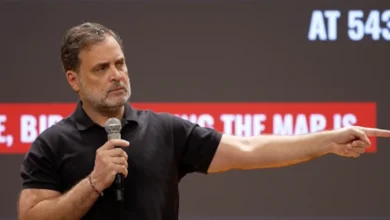
“Gyanesh Kumar will oversee delimitation too,” Leader of the Opposition Rahul Gandhi said on Saturday, alleging that the Election Commission had been “captured already” and Gyanesh Kumar was “again” involved. He alleged that PM Narendra Modi was helped by the CEC and Home Minister Amit Shah to win the 2024 Lok Sabha elections. The BJP has called his assertions “rantings of a frustrated loser”.
READ | ‘Escape Plan’ vs ‘Anti-Women’: Rahul Gandhi, BJP Trade Barbs On Delimitation
READ | Asked Why Not Boycott Polls If ‘Rigged’, Rahul Gandhi Offers “Some Nuance” And A 2014 Claim
Two days earlier, Congress president Mallikarjun Kharge, speaking at the party’s Samvidhan Raksha march in Lucknow on Constitution Day, said, “There is an alliance between PM Modi and Gyanesh Kumar; there cannot be free and fair elections in this country till the time they leave.”
The Election Commission has previously rejected the Opposition’s “vote chori (theft)” allegations as “incorrect and baseless”. Now the allegation is “seat chori” and “Sansad chori”, an alleged plan to “steal the Parliament”.
What The Bill Says
Under Section 3 of the Delimitation (Second) Bill, 2026, the Delimitation Commission will be chaired by a person “who is or has been a Judge of the Supreme Court, to be appointed by the Central Government”.
Its other members will be the CEC or an Election Commissioner nominated by the CEC, and the State Election Commissioner of the state concerned — both ‘ex officio’, which means on account of holding that post. One of the EC’s secretaries will be the ex-officio secretary of the Delimitation Commission.
Gandhi described the arrangement with his interpretation: “Apart from Gyanesh Kumar, the other members of the Delimitation Commission will be decided by Modi and Shah. In other words, they will have complete control.”
READ | The History Of Delimitation In India: How The Electoral Map Took Shape
The Delimitation Commission is to be constituted “as soon as may be” after the law comes into force. Its term will be set by the Centre and can be extended at the Commission’s request. Government sources have said the exercise is expected to be completed within two years, ahead of the 2029 Lok Sabha elections.
Gyanesh Kumar’s term as CEC runs until January 26, 2029, which means his tenure would cover most or all of the exercise.
When Two Fights Converge
So far, the Opposition’s campaign against Gyanesh Kumar has centred on the Special Intensive Revision (SIR) of electoral rolls. In March, 193 Opposition MPs, 130 from the Lok Sabha and 63 from the Rajya Sabha, submitted notices seeking his removal. The notices alleged bias and disenfranchisement through the SIR exercise. Multiple notices have been rejected by the Rajya Sabha Chairman, CP Radhakrishnan, and Lok Sabha Speaker Om Birla, reportedly because of a lack of valid reasoning.
The “vote chori” and anti-delimitation campaigns of the Opposition have converged before too. After the government’s original delimitation plan was defeated in the Lok Sabha on April 17 due to a lack of two-thirds Special Majority, Opposition leaders were buoyed and planned a fresh removal notice against Gyanesh Kumar.
READ | No Change In Tech Chief Seema Khanna’s Reporting Line: Poll Body On New Work Order Amid Row
Alleging that they were not being heard, on October 31, about 250 Opposition MPs took part in a symbolic “public impeachment” of Gyanesh Kumar at Mallikarjun Kharge’s residence.
On Saturday, Rahul Gandhi went further: “Gen Z should listen to this number: 140 million people (14 crore), who supposedly voted for Mr Narendra Modi in 2024, were not legal voters, should never have voted, either do not exist or are fake voters. So the 2024 election was a fake election. Narendra Modi is a fake, illegal PM. And he’s been put in place, helped by that Gyanesh Kumar.”
The EC says these are people who had died or shifted, or there were other definite reasons for their names’ deletion. There is no proof that these 14 crore voted, and for the BJP, if at all.
Gyanesh Kumar, a retired 1988-batch IAS officer of the Kerala cadre, became an Election Commissioner on March 15, 2024, and Chief Election Commissioner on February 19, 2025. He was the first CEC appointed under the 2023 law that replaced the Chief Justice of India with a Union minister on the selection committee. Gandhi, a member of that committee, submitted a dissent note on his appointment, arguing that the government has a 2:1 majority.
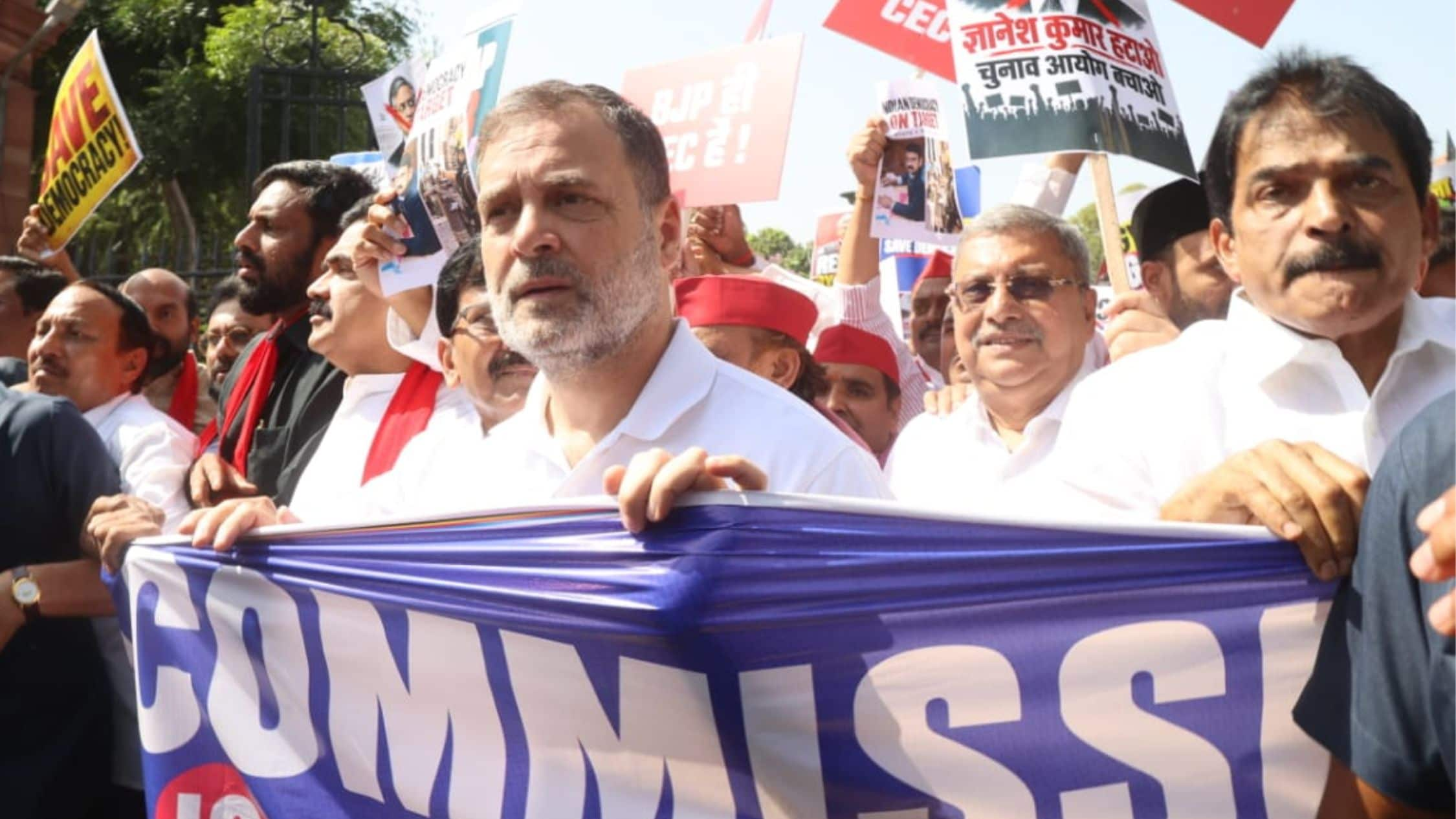
Rahul Gandhi and others at a protest in October seeking Gyanesh Kumar’s resignation. Photo: PTI
Himself Or A Nominee?
As for the delimitation bill now, it does not require the CEC to serve on the Delimitation Commission himself. For instance, along similar lines, when a Delimitation Commission was set up for Jammu and Kashmir, the UT, in 2020, the then CEC Sunil Arora nominated Election Commissioner Sushil Chandra to it. Chandra later became CEC and remained a member until the final order was signed in May 2022.
On the nationwide commission to be constituted under the new plan, Gyanesh Kumar could take the seat himself or nominate one of the two Election Commissioners, Sukhbir Singh Sandhu or Vivek Joshi. Those two have written internal letters of objection related to the process of SIR and related activities of the EC, though the final decisions have been unanimous over the past two years. A report by The Indian Express in September on those objections fuelled the most recent protests on the issue by the Congress and even the youth group Cockroach Janta Party.
Commission’s Powers, Opposition’s Fears
Who sits on the Delimitation Commission matters also because of the powers the bill gives it. Under Section 11(2), the commission’s orders “shall have the force of law and shall not be called in question in any court”. The commission, however, must first publish its proposals, along with any dissent by associate members, invite objections, and hold public sittings in each state, the bill adds. Five MPs and five MLAs from each state will be associate members, but they will have no vote.
As for whether the decisions can be challenged, the Supreme Court has held in the recent past that Article 329 does not completely bar judicial review of delimitation orders, and that courts can step in where an order is manifestly arbitrary.
The Opposition’s objection goes beyond the membership. It has accused the government of using the women’s quota to redraw constituencies to its advantage, and cites recent exercises in Assam and Jammu and Kashmir, where boundaries were redrawn and where Opposition parties said the new maps worked against them. The government has denied the charge.
The revised bills provide for a uniform 50 per cent increase in each state’s seats, keeping their relative share, and freeze the arrangement “until the year 2051”. Gandhi said that was not the issue. “There’s a lot of talk about state share of Lok Sabhas, that our state share should not be reduced. That is not the question here. The question here is giving BJP a blank slate to reshape [the constituency boundaries],” he said.
Parliament’s special sitting begins in the Lok Sabha on Monday.