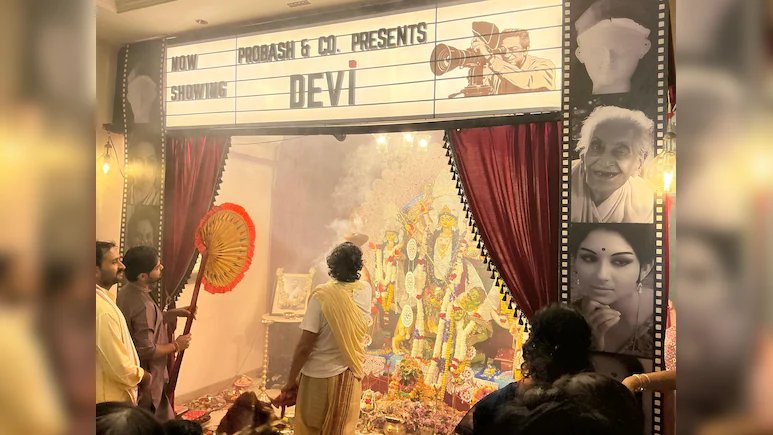
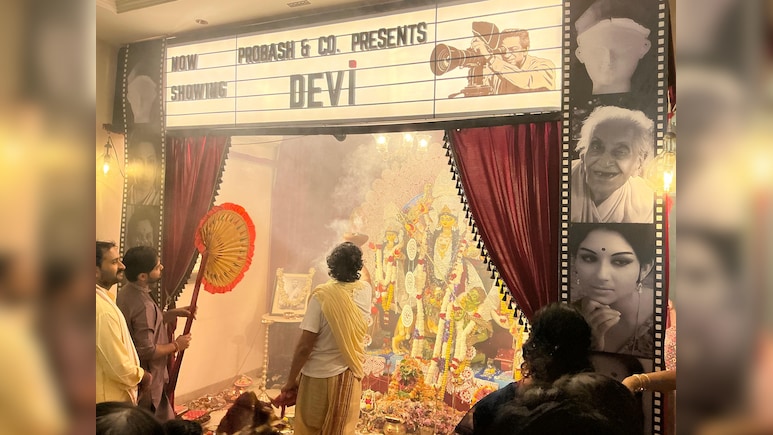
The idol at Probash & Co.
NDTV
Probashi is a term coined for Bengalis who reside outside their native homeland of Bengal. Four years of living in Delhi and I’m already resonant with the likes of this term.
When you’re a Bengali living away from home, you’re always on the lookout for tiny pieces of home. Be it the Bengali girl you moved into a rented flat with, or the corner shop uncle who speaks your language, or especially those five days of the year of pure joy and Pichhutan during Durga Pujo.
Much is the same for a group of friends, lawyers by profession who got together in Delhi, away from their homes in Kolkata, and began Probash & Co.- a Barir Pujo in the quieter lanes of Chittaranjan Park.
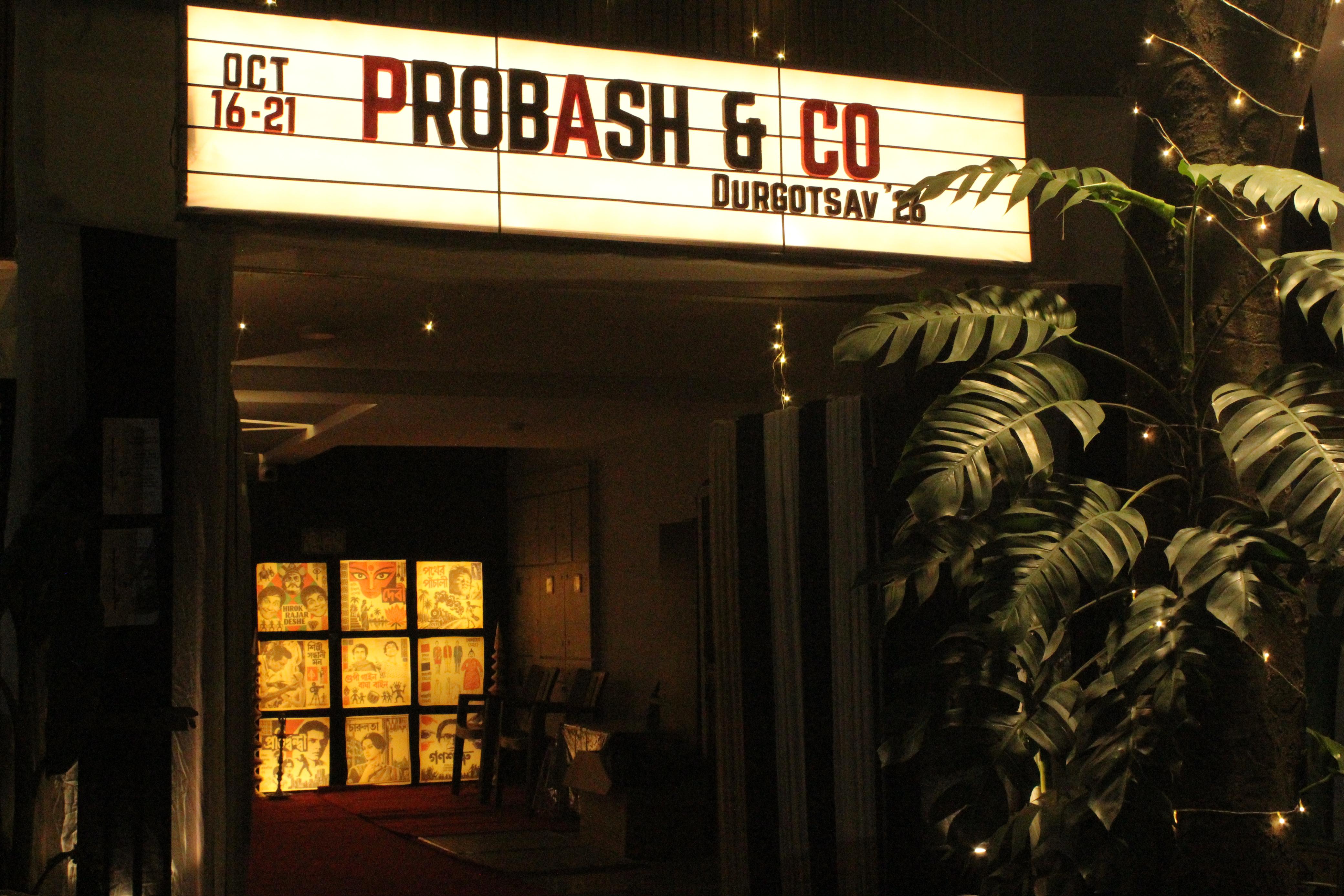
The entryway to the Puja house
Away from the crowded hustle bustle of CR Park pandals, lies this homely Durga Puja, quite literally at Priyadarshi Banerjee’s rented apartment in I-Block. He fondly told me, “The Pujo moves with us, wherever we go, the Pujo will happen there. The whole intention is that Maa stays at home with us, and renting a community hall is just not the same.”
Banerjee, a practicing lawyer, is a part-time Purohit (Priest) who learnt to conduct rituals through years of observation, reading and practice, rather than formal training. “Having watched priests perform pujas since childhood, I grew curious about their mantras, gestures and the reasoning behind each ritual. I read their manuals and sought explanations from senior priests,” he said.
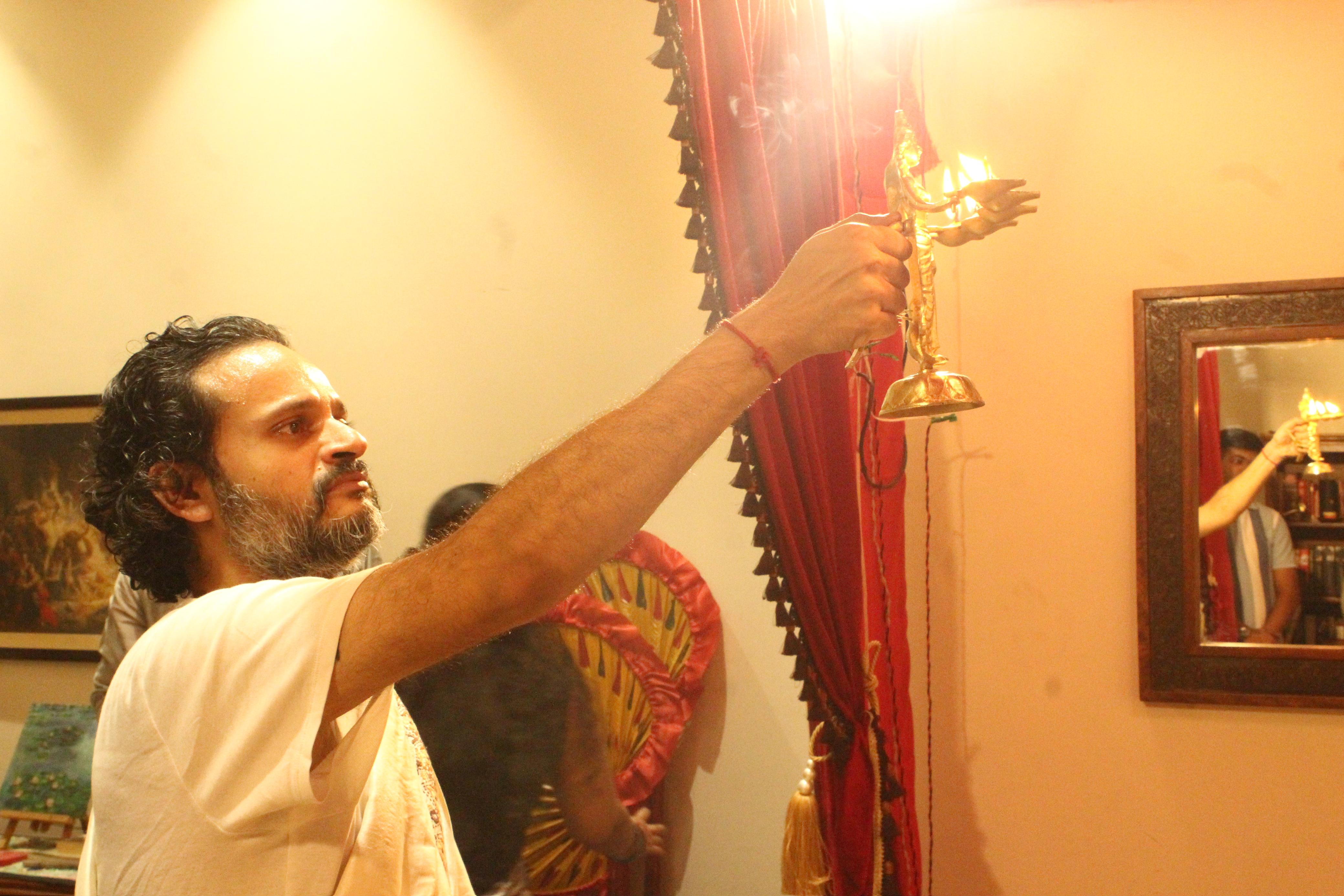
Priyadarshi Banerjee conducting Aarti of the Goddess.
He alongside his law-school batchmate Snigdhaneel Satpathy, always talked about the idea of a Puja at home. “We came to Delhi and realised that we really missed home,” said Satpathy. Banerjee and Satpathy had wanted to organise a Durga Puja but, as Banerjee recalls, law school left them with little time, money or space to make it happen. After graduating, some friends scattered across the country; others eventually found their way back to Delhi. The plan resurfaced, but it took time to turn it into a reality.
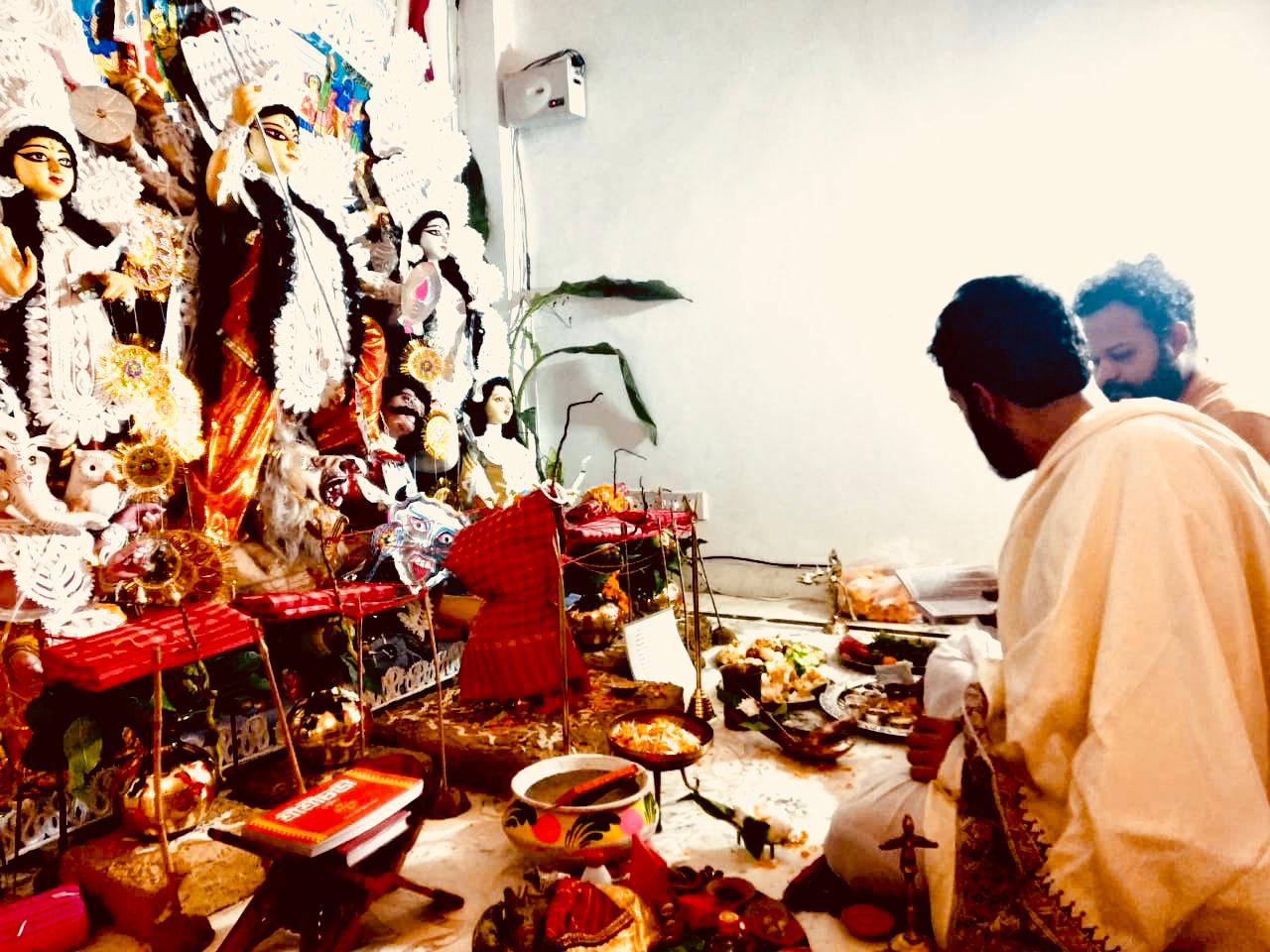
The first Puja conducted by Priyadarshi and Snigdhaneel.
The first puja was held in 2018, on a modest scale. Satpathy remembers the gap between what they hoped to raise and what they actually managed, “the budget was estimated at 60 to 70 thousand rupees, but we could raise only nearly Rs 25,000.”
They went ahead anyway.
What followed was not simply the organisation of an annual religious event. It was the gradual making of a household out of a group of friends. The work extended beyond the rituals: from planning and preparing for the puja to arranging the decor and cooking the bhog. “You need a village to raise a child; you need to have a village to have a Durga Puja,” said Banerjee, describing an effort that was never meant to rest on one person.
The group has grown, but the demands have not necessarily become easier. The five days of the puja mean early mornings, late nights and a great deal of coordination. Satpathy says the core group that started off with four to five people now includes around 18 individuals and their kids too. “Friends have today become family,” said Banerjee.
In the five days of festivity, this home in CR Park becomes a community that has travelled different distances to get there. For some, it is a way to reconnect with Kolkata, the city they left behind. For others, it is an introduction to a culture they did not grow up with. And for those who put the puja together, it is an undertaking that begins months before the rituals and brings friends, partners and families into the same fold.
For Banerjee, the name Probash & Co. reflects that intention. The group wanted to retain a connection to its Bengali roots without choosing a name that might make others feel they did not belong. The “and Co.” was a way of signalling that the puja was not only for Bengalis, but for everyone who wanted to be part of it.
Ananya Ghosh, another batchmate from law-school who has seen the pujo since its inception said, “We always wanted to have the puja in a way where we tried to welcome each and every person. It doesn’t matter who you are.”
The way Ghosh puts it, one doesn’t need to sign up, be invited through a member or pay a hefty donation to become a part of Probash & Co. “If you are working for the puja, you are not working to gain blessings for yourself, you are working for the community”, she said.
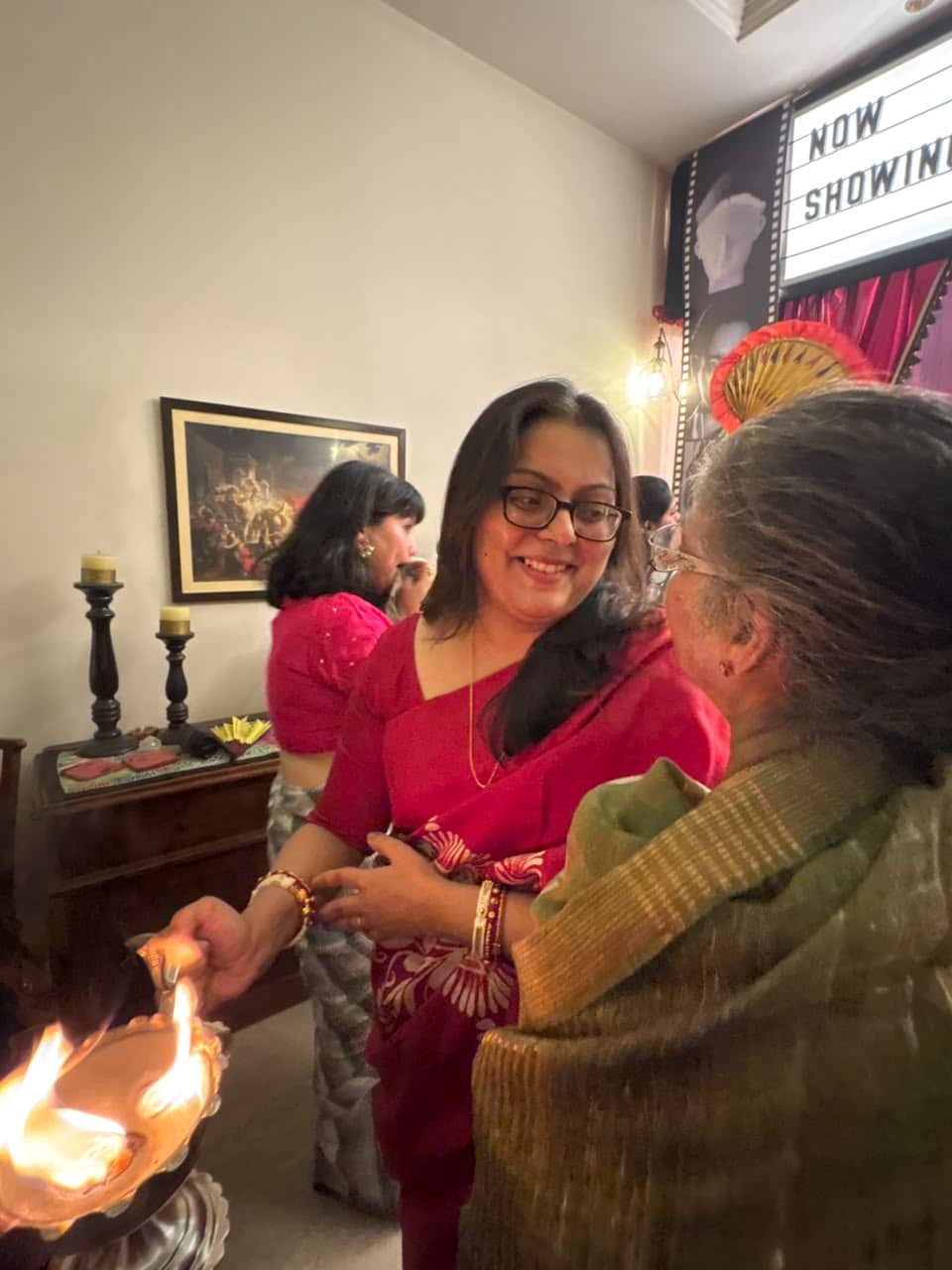
Ananya Ghosh tending to the guests.
That sense of family also explains why the puja has remained open to everyone, irrespective of similar linguistic or cultural background. Many members have partners who are not native Bengali speakers; some, like Pranav Malhotra, who helps lead the art and decor work, are not Bengali themselves.
For Malhotra, that connection has deepened over time. When he first joined, he said, he did not even know what a Barir Pujo was and now Malhotra can’t help but feel this “gaping hole” in his heart as “Maa Durga is leaving again and we’ll have to wait one full year to welcome her back to our home.”
Dawning on this year’s theme-The Rayverse-Malhotra said honours the versatile and dynamic female characters in Satyajit Ray’s iconography. The Durga idol occupies a space designed to resemble an old cinema hall, complete with a marquee announcing ‘Now Playing Devi’–a play on Ray’s 1960 film, he explained.
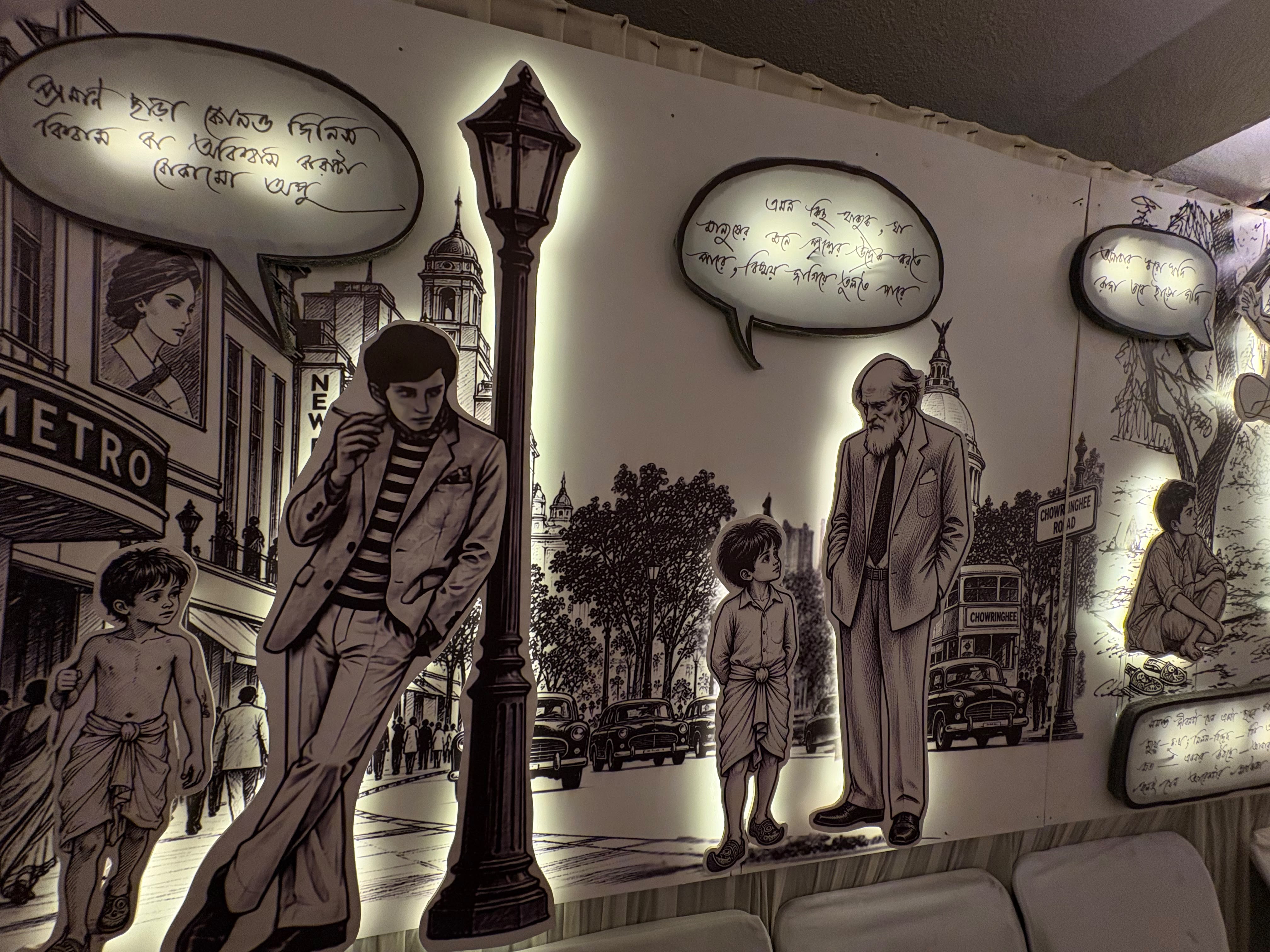
The Rayverse reimagined.
The entry to the house begins with an installation of Apu from Pather Panchali near the entrance. A three-dimensional comic strip follows the character through scenes and encounters drawn from Ray’s films. Elsewhere, handmade light boxes recreate memorable frames from the filmmaker’s work, while magazine covers of Sandesh draw attention to his lesser-known work as an illustrator.
The significance of Durga Puja has grown more personal with time for Banerjee. He speaks of welcoming the Goddess not merely as a religious ritual, but as the return of a daughter to her parental home. “With a greying beard and greying hair, that becomes kind of a raging sentiment,” he said. Unmarried and without children of his own, Banerjee finds a deeply personal resonance in the celebration of the daughter’s homecoming.
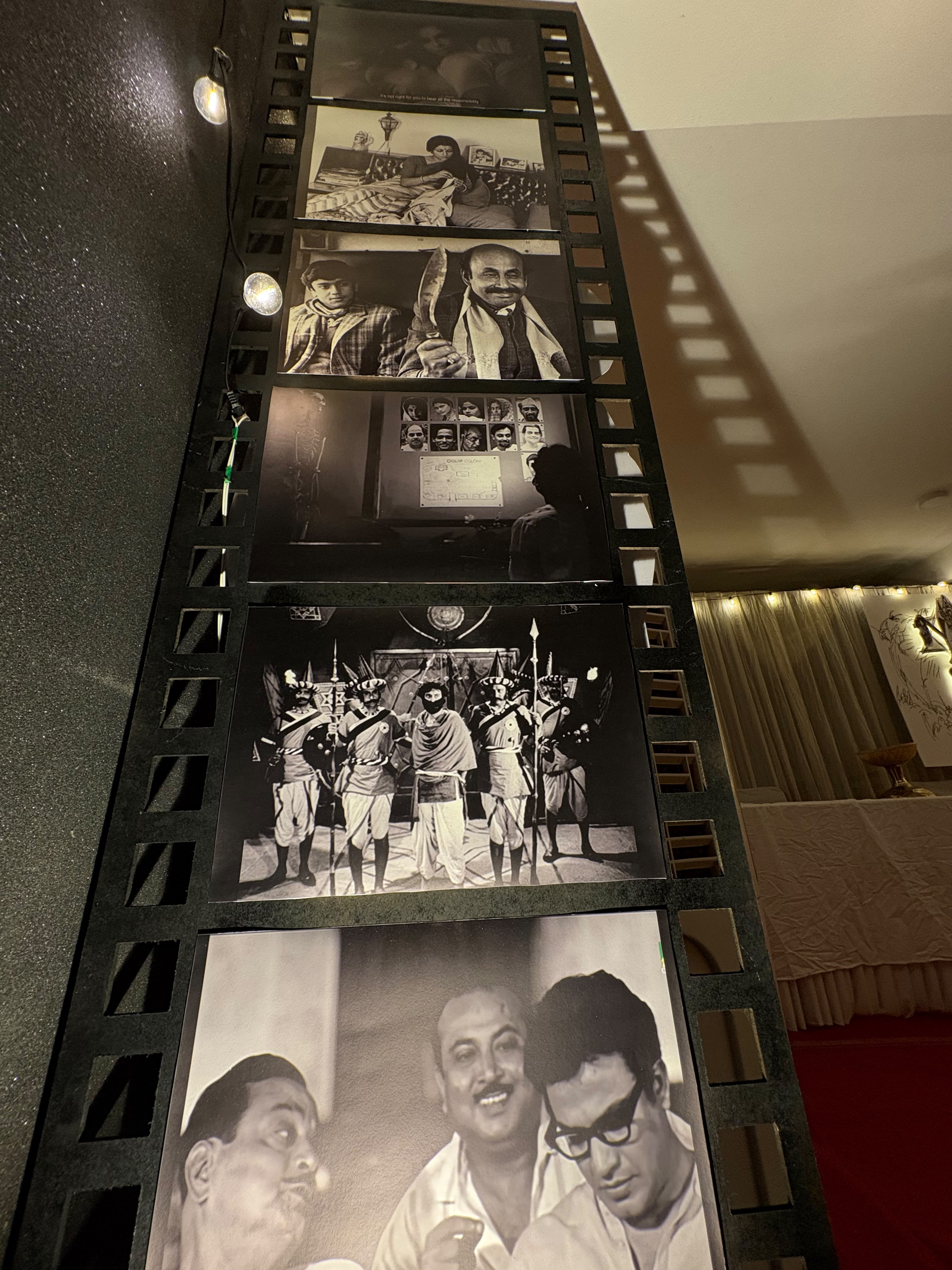
Comic strips from Satyajit Ray’s iconography.
Despite the growing number of visitors, Satpathy says the organisers have no desire to move the puja to a larger venue. “The point is not to accommodate a bigger crowd at any cost, but to preserve the intimacy of a shared home”, he said. He paints this picture of the night winding down, when all the work is done, people have left and their home is quiet again. It’s just the friends and Maa in their living room. “I don’t think you get that feeling if it’s a community hall,” he said. “And you can only get that if it’s your home.”