Chandigarh:
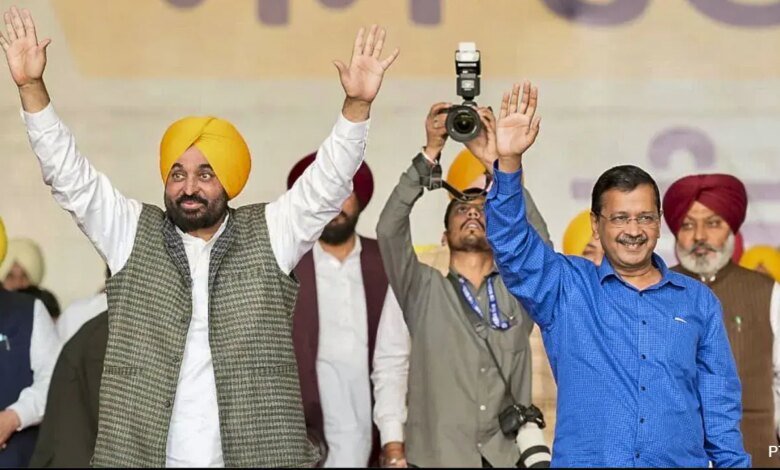
Arvind Kejriwal told a Moga rally that the AAP government spent four years filling Punjab’s “sarkari khajana”. The fiscal record points the other way. Between March 2022 and March 2026, the state’s net outstanding debt rose by approximately Rs 1.35 lakh crore, from Rs 2.73 lakh crore when AAP took office to roughly Rs 4.08 lakh crore by the end of FY 2025-26. Gross borrowings look larger still because budget documents include short-term Ways and Means Advances from the RBI and rollover repayments. The treasury was not filled. It was leveraged.
A ruling party that funds its doles with fresh loans and then presents the arrangement as a filled treasury is not merely campaigning. It is asking voters to treat borrowed money as earned surplus. On its foundation day, the AAP government chose this path: protect an inflated image of plenty, keep the monthly transfers flowing, and leave the rising interest burden for later. Whether that bargain produces a khushhaal Punjab or simply postpones a darker reckoning is no longer a question of accounting. It is a question the electorate will answer when it decides if the immediate gain is worth the deferred cost.
Economists say freebies retain electoral pull because most voters experience them as immediate cash or free power, not as entries in the state budget. Delayed salaries and unpaid arrears affect a limited set of government employees; the wider electorate sees the monthly transfer or the zero electricity bill. AAP’s promise to continue these schemes therefore converts fiscal strain into a simple choice: keep the benefit or risk losing it. With interest payments already taking 17.2 per cent of expenditure and new women’s cash transfers budgeted at Rs 9,300 crore, committed liabilities crowd out capital spending. The political calculation is that short-term household relief will outweigh long-term development shortfalls at the ballot box.
Welfare and subsidy bills explain much of the rise. The power subsidy stood at roughly Rs 19,657 crore in FY 2025-26 and is budgeted above Rs 20,000 crore for FY 2026-27. Over four years the cumulative power outlay reached Rs 76,000-Rs 78,000 crore. Free agricultural tubewell electricity accounted for about Rs 10,413 crore a year. The 300-unit free domestic power scheme, covering nearly 90 per cent of households, cost Rs 6,859-Rs 7,614 crore annually. Industrial concessions added another Rs 2,384 crore. Social security pensions for 33-35 lakh beneficiaries formed the second-largest recurring outflow at Rs 6,132 crore a year, or Rs 23,500-Rs 24,000 crore over four years. Subsidised ration and nutrition kits cost Rs 800-Rs 900 crore annually. Zero-ticket bus travel for women cost the exchequer Rs 2,042 crore across the term. Cashless healthcare top-ups and Aam Aadmi Clinics absorbed Rs 1,046 crore in FY 2025-26 and Rs 3,500-Rs 4,000 crore over four years, rising to Rs 2,000 crore in FY 2026-27. The Mukh Mantri Maavan Dheeyan Satkar Yojana, offering Rs 1,000 a month to women and Rs 1,500 to Scheduled Caste women, was budgeted at Rs 9,300 crore from FY 2026-27 after remaining unlaunched through the first four years.
AAP raised more loans in four years compared to SAD-BJP’s 10-year rule
Comparisons with earlier governments sharpen the picture. AAP’s four-year net addition of roughly Rs 1.35 lakh crore already exceeds the approximately Rs 1.31 lakh crore added across the full ten-year SAD-BJP term from 2007 to 2017. Stripping out the one-off UDAY power-bond takeover of about Rs 15,628 crore brings the SAD-BJP ten-year figure down to roughly Rs 87,000 crore. Against that adjusted total, AAP’s four-year borrowing is higher by about Rs 48,000 crore. Projected forward to the FY 2026-27 Budget Estimate of Rs 4.47 lakh crore, AAP’s five-year net addition reaches Rs 1.65-Rs 1.74 lakh crore. Congress added roughly Rs 91,000-Rs 1 lakh crore over its five years from 2017 to 2022. The annual pace under AAP averages about Rs 33,750 crore, compared with Rs 18,200-Rs 20,000 crore under Congress and Rs 13,100 crore under SAD-BJP (or Rs 8,700 crore excluding UDAY).
At the same Moga rally, Kejriwal framed existing schemes-women’s cash transfers, free power, health cover, pilgrimage trips and free bus travel-as guarantees that would continue only under AAP. He warned that rivals would roll them back. Charanjit Singh Channi has indicated that welfare schemes would continue. Amrinder Singh Raja Warring has argued for ending free power for better-off households while keeping targeted support for the poor.
The split gives AAP an opening to warn beneficiaries of cutbacks. The fiscal habit itself is older. Targeted concessions under SAD-BJP became a political compulsion under Congress and expanded further under AAP through universal power relief and the new Rs 9,300 crore women’s scheme. Public debt is projected to reach Rs 4,47,754 crore by the end of 2026-27. Interest payments alone will take Rs 28,755 crore, or 17.2 per cent of total expenditure. Competing on larger handouts leaves narrow room for long-term assets.
AAP’s campaign pledges remain under scrutiny
AAP made eradication of the drug menace, a core 2022 poll plank. Enforcement drives, seizures and property demolitions have not ended arguments that narcotics availability and substance abuse continue. A legal or assured MSP guarantee across crops was a pre-poll flashpoint and remains unresolved friction between cultivators, the state and the Centre. Decisive accountability in the 2015 sacrilege and Behbal Kalan police-firing cases was central to AAP’s moral pitch; slow or contested legal progress keeps the issue open. Aam Aadmi Clinics were rolled out, yet the total count has fallen well short of the 16,000-clinic benchmark associated with pre-poll trackers. The Rs 1,000-per-month cash assistance for women stayed deferred through much of the term before entering the budget frame in 2026, allowing rivals to ask why beneficiaries waited years. Beyond the headline figure of 77,182 government jobs, broader employment expectations and secondary manifesto items such as Rs 5 canteens and student laptops have given opposition parties material to accuse the administration of overpromising.
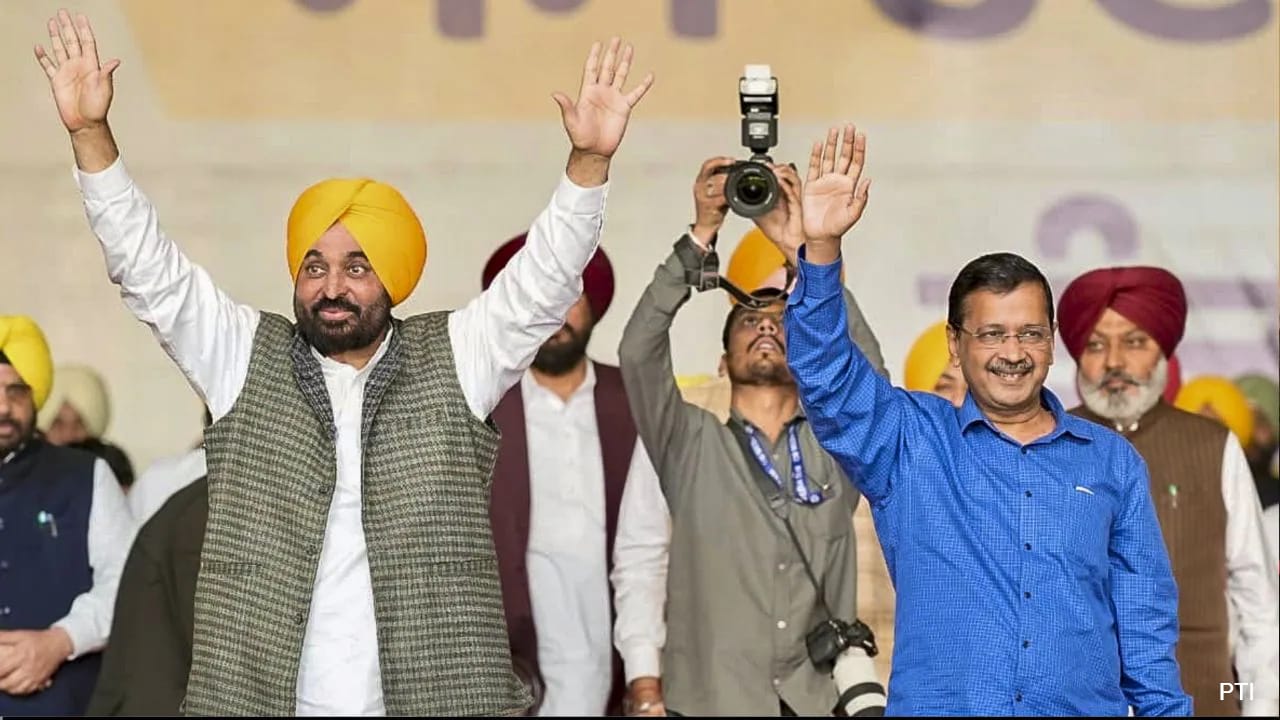
AAP formally opened its 2027 campaign on 26 November 2026 with the Khushhaal Punjab Maha Rally at Matwani village in Moga, timed to the party’s 14th Foundation Day and Constitution Day. Kejriwal and Mann presented a five-year report card that included free electricity, Rs 10 lakh health coverage, school upgrades and financial support for women, while claiming the Centre had withheld funds. The rally also launched smart ration cards aimed at up to 10 lakh families, with nearly six lakh targeted in the first phase. Mann highlighted the induction of 77,182 youth into government posts on merit without bribery or political clout. AAP leaders contrasted their party with established political families and internal factionalism in Congress and SAD.
Days after the BJP and SAD revived their coalition, Mann accused both of political convenience and pressed the BJP over shared stages with Akali leader Bikram Singh Majithia despite past drug-related allegations. Claiming a turnout of more than two lakh people and 71 already-announced candidates, AAP used Moga to stake an early claim in Malwa ahead of Prime Minister Narendra Modi’s scheduled 8 December visit for a joint alliance rally. The event drew a legal challenge. A public-interest petition in the Punjab and Haryana High Court alleged that over 2,500 state transport buses were pulled off regular routes, disrupting corridors such as Barnala-Moga and Mansa. The state government defended the deployment by citing a 12 November protocol order that classified the event as an official State-Level Function handled by the Food and Civil Supplies Department for smart ration card distribution. Opposition figures, including Leader of the Opposition Partap Singh Bajwa, Punjab Congress chief Pargat Singh and BJP leader Sunil Jakhar, accused the ruling party of using public resources and taxpayers’ money for a partisan launch.
The Moga rally presented four years of welfare expansion as proof that the treasury had been filled. The debt numbers, the annual borrowing velocity and the unfinished pledges on drugs, MSP and sacrilege cases sit beside that claim. Whether voters weigh the cash transfers and free power more heavily than the rising interest burden and the still-open campaign promises will decide if the fear of rollback outweighs the fiscal record when polling begins.