The artificial intelligence boom has cemented US and Chinese tech dominance and created fortunes across North Asia’s chip supply chain. Now, India’s billionaire family offices and wealthy investors are betting on homegrown startups to gain ground in the global AI race.
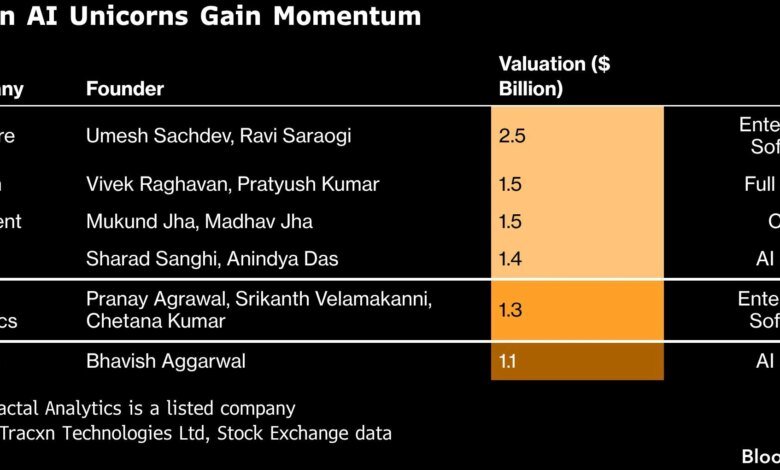
At least six homegrown companies have amassed valuations of more than $1 billion, underscoring the emergence of a new generation of technology firms as AI adoption accelerates among Indian consumers and businesses.
Billionaire tech founder Azim Premji’s family office, WhatsApp Inc.’s Chief Executive Officer Kunal Shah’s QED Innovation Labs and Manipal Group Chairman Ranjan Pai’s family office are among the investors leading the push into such startups.
India still faces a significant funding shortfall. Private investment in its AI economy totaled more than $15 billion between 2013 and 2025, according to Stanford University’s AI Index Report. This compared with $757 billion investment in the US and nearly $132 billion in China’s AI ecosystem. That has left an opening for billionaire families, conglomerates and venture investors to fund a homegrown AI industry.
“Several family offices and angel investors now are keen on investing directly as they get comfortable with how India’s AI ecosystem is coming into place,” said Riddhiman Jain, head of investments at Indian wealth manager Waterfield Advisors. “AI needs patient capital, which is scarce, and the investing universe is still at a very early stage.”
Premji Invest has emerged as the biggest Indian family office investing across the AI landscape globally. Most recently in June, it invested in a $27 million round in AI verification platform Pramaana Labs, founded by alumni of the Indian Institute of Technology Madras (Chennai).
The investment firm’s portfolio ranges from multibillion-dollar AI and technology platforms globally such as Databricks and Canva to generative-AI startups Spotdraft and Writer, according to Tracxn.
Billionaire doctor-turned-entrepreneur Pai’s family office, Claypond Capital, has stepped up its investments this year. It participated in content startup Flam’s $40 million round in September and backed vibe coding platform Emergent’s $130 million round in July.
The influx of capital is helping create a new crop of firms spanning AI models, enterprise software, coding and other applications.
“We are at the start of a major upswing on AI investments in India,” said Anirudh Damani, managing partner at Artha Venture Fund.
He said India still had a cost advantage on AI in terms of tech firms providing software to global companies or building AI applications and services.
Mumbai-based Fractal Analytics Ltd. raised $313 million in an initial public offering in February, becoming India’s first AI unicorn to go public.
Uniphore, which builds AI models and applications, was valued at $2.5 billion last year after a $260 million late-stage funding round backed by chip makers Nvidia Corp. and Advanced Micro Devices Inc., among others. Founders Umesh Sachdev and Ravi Saraogi teamed up at the IIT Madras and started the company in 2008 before moving its headquarters to Palo Alto, California.
Sarvam, founded in 2023 by researchers Vivek Raghavan and Pratyush Kumar, is the second-most valuable AI startup. It was valued at $1.5 billion after it raised $345 million this year, supported by investors including HCL Technologies Ltd. Bengaluru-based Sarvam is building AI models on voice, documents, coding and other use cases in 22 Indian languages.
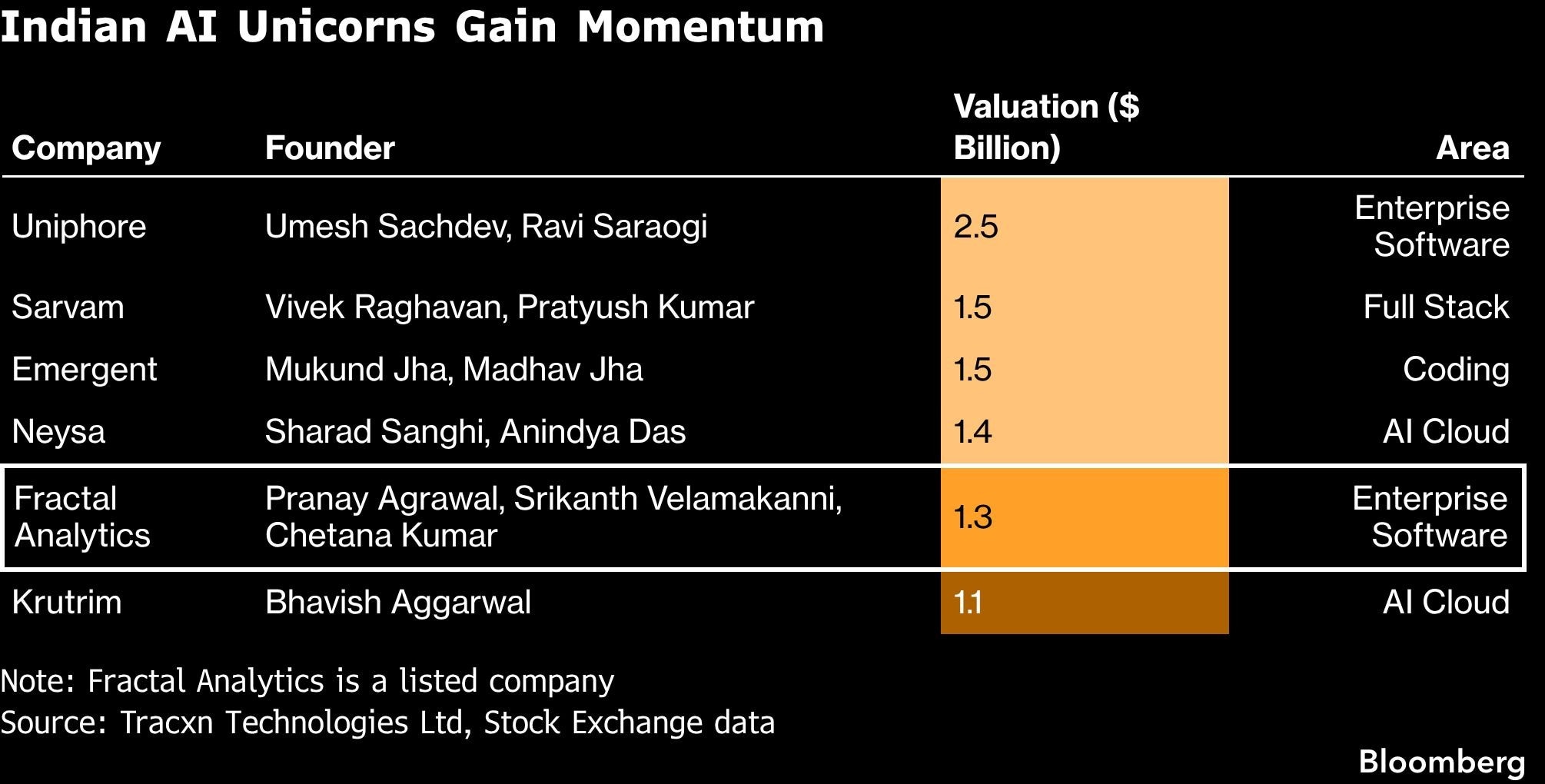
Photo Credit: Bloomberg
The growing appetite from family offices and wealthy investors is helping India build a new generation of AI companies. But as a lower-middle-income economy, it faces constraints on capital, computing infrastructure, specialized research talent and other resources, according to a report by the World Bank Group.
While the private sector has led AI investments in the US, the Chinese government has been the primary driver of investments in the world’s second-largest economy. Beijing is preparing to spend around 2 trillion yuan ($300 billion) over the next five years on building data centers across the country.
In New Delhi, the government’s 103.7 billion rupee ($1.1 billion) IndiaAI Mission focuses on computing capacity, datasets, sovereign AI models and other public infrastructure, leaving private investors to bankroll much of the country’s broader AI buildout.
India’s two richest tycoons, Gautam Adani and Reliance Industries’ Mukesh Ambani, have committed about $210 billion in investments in data centers, semiconductors and other AI-related services.
Tata Group’s software services arm has partnered with OpenAI on data centers, while its electronics unit is investing about $12.5 billion in two semiconductor plants. The group is also developing an $11 billion AI Innovation City near Mumbai.
Google Inc., Amazon.com Inc and Microsoft Corp. have separately announced about $45 billion of data-center investments in India.
“India adapts and adopts new technologies much faster than most developed countries,” said Damani of Artha Venture Fund. “I have no doubts that we will also catch up quickly when it comes to AI applications and adoption.”
(This story has not been edited by NDTV staff and is auto-generated from a syndicated feed.)