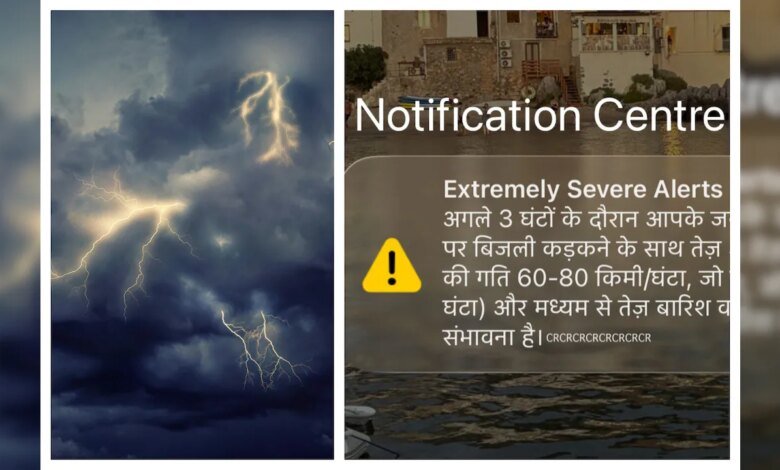

It usually starts with a loud siren.
Your phone vibrates violently. A bright message flashes across the screen. Conversations stop. Meetings get interrupted. For a few seconds, many people assume something serious has happened.
Then they read the message.
- Thunderstorm warning.
- Rain expected.
- Strong winds possible.
Over the past few weeks, residents across Delhi-NCR have become familiar with these alerts. The warnings have arrived during office hours, late at night and even in the middle of routine days when the weather outside appears perfectly normal.
Advertisement – Scroll to continue
The technology itself is not the problem. Follow Live Weather Alerts
In fact, most experts agree that India has built something commendable — a nationwide emergency communication system capable of reaching millions of people within seconds. Such systems are used in countries like Japan, where earthquake risk is higher, and Israel, where security threats are likely.
However, the bigger question Delhi-NCR residents are asking is whether a channel designed for disasters and life-threatening emergencies should be used so frequently for routine weather advisories.
Because when every alert feels urgent, people may eventually stop paying attention. And that could become a problem when a genuinely dangerous situation arrives.
Emergency Alert For Severe Weather: How The Tech Works
The alerts are powered by India’s disaster warning infrastructure developed by the National Disaster Management Authority (NDMA), the Department of Telecommunications (DoT) and the Centre for Development of Telematics (C-DOT).
At the heart of the system is a platform called SACHET, India’s integrated alert network, which distributes warnings across multiple channels. Recently, authorities have begun expanding the use of Cell Broadcast technology, which allows alerts to be sent instantly to all mobile phones connected to specific cell towers in a defined geographic area. Unlike SMS, these alerts do not depend on internet connectivity and can reach millions of users simultaneously.
This makes the system particularly valuable during disasters such as earthquakes, cyclones, floods, lightning strikes, tsunamis or industrial accidents, when every second matters and telecom networks may be congested.
The technology is widely regarded as a major upgrade in India’s disaster preparedness framework.
Why Are People Complaining?
Because many of the recent alerts have not been linked to disasters. They have been weather advisories.
And they have often arrived with the same loud, attention-grabbing urgency that one would associate with a life-threatening emergency.
The result is a growing concern among experts: alert fatigue. The term refers to a simple behavioural phenomenon. When people receive too many warnings, especially for events that do not directly affect them, they begin to tune them out.
What initially grabs attention eventually becomes background noise. That is precisely what worries disaster communication specialists.
A System Runs On Trust, Not Just Technology
Dikshu C Kukreja, environmentalist, climate change expert and Managing Principal at CP Kukreja Architects, says the issue is less about technology and more about credibility.
“Every public warning system operates on a finite reserve of public attention. The success of such systems is not measured by how many alerts they issue, but by whether citizens instinctively trust and act upon them when it matters most.”
“In urban systems design, credibility is a form of infrastructure. Once urgency becomes routine, it loses its communicative power. The challenge, therefore, is not technological capability but institutional calibration, ensuring that the intensity of a message corresponds to the level of risk it seeks to convey.”
Kukreja adds, “As India strengthens its digital public infrastructure, we must recognise that resilience depends as much on behavioural response as on technological reach. The architecture of trust is ultimately what determines whether an alert system succeeds during moments of genuine crisis.”
The concern is echoed across the technology and climate-risk sectors.
Anupam Shrey, Founder of Plutas.ai, calls India’s rollout of the Cell Broadcast system a significant milestone in disaster resilience. However, he says effectiveness depends on more than simply reaching people.
“The ability to instantly reach millions of people during earthquakes, cyclones, floods, heatwaves, and other extreme weather events can significantly improve emergency response and save lives. However, the effectiveness of such a system depends not only on its reach, but also on the relevance and accuracy of the alerts being delivered.”
According to Shrey, using the same high-priority channel for both routine advisories and life-threatening emergencies risks weakening public responsiveness.
“The goal should not be to send more alerts, but to send the right alert to the right people at the right time. Preserving trust in emergency communications will be as important as the technology itself.”
Severe Weather Alerts: IMD Response
The India Meteorological Department (IMD) argues that weather alerts serve an important public purpose and are often misunderstood.
Explaining how weather alerts are issued, CS Patil, scientist at the India Meteorological Department (IMD), said the decision is based on multiple factors and not just rainfall forecasts.
Responding to concerns about alerts being issued even when severe weather is not experienced everywhere, Patil said forecasts are issued at the district level and cannot pinpoint impacts within a narrow 5-10 kilometre radius.
“Alerts are issued for an entire district. It may not be possible to specify weather conditions for every small pocket within that district. Rainfall and weather impacts can vary significantly from one location to another,” he said.
Addressing concerns around “alert fatigue”, Patil said people often overlook the details contained in weather advisories.
“We clearly mention whether rainfall is expected to be light, moderate or heavy. People need to read the advisory carefully. Rainfall can vary greatly from place to place, and many people misunderstand what the alerts are actually saying,” he said.
Patil also stressed the need for greater public awareness about meteorological measurements and weather terminology. “There is often a gap between what meteorologists communicate and what people understand… Online educational videos may be required to understand meteorological terms,” he said.
According to Patil, weather forecasts have practical value far beyond disaster preparedness. “Forecasts are useful in everyday life. They help farmers, fishermen and many other professionals make decisions. Even simple choices, such as what clothes to wear or whether to carry an umbrella, can benefit from accurate weather information,” he added.
His comments point to another challenge: communication.
Meteorologists may see value in issuing advance warnings, but many citizens experience only the disruption of a loud alert without fully understanding the severity level attached to it.
Is India Missing A Classification Layer?
Several experts believe the issue lies not in issuing weather alerts but in how they are delivered.
Dr Kanishk Agrawal, Chief Technology Officer at Judge Group India, says cell broadcast remains one of the most effective public safety technologies available because it works even when internet services fail or networks become congested.
But he believes the system needs clearer alert categories. “Emergency communication systems work best when users recognise them as a source of urgent, actionable information.”
He warns that if the same high-priority channel is used repeatedly for routine weather updates, people could become desensitised and ignore future alerts.
To avoid that, he recommends a structured hierarchy distinguishing informational notices, advisories, watches and emergency warnings, each with a different level of urgency and disruption.
A similar view comes from Kumar Rajagopalan, Vice President, Strategic Initiatives and Country Head India at Dexian. He notes that many countries with mature emergency alert systems use multiple classifications for different levels of risk.
“The main problem with this is that the alert classification and alert communication protocols are not consistent… If individuals receive routine weather alerts using the same urgency and disruption level as they do for an emergency alert, then the emergency alerts will lose their significance.”
Rajagopalan argues that the most intrusive notifications should remain reserved for severe threats to life and safety.
The Behavioural Challenge
The debate ultimately comes down to human psychology. People respond to urgency when it is rare. When it becomes common, attention declines.
Hrishit Panthry, co-founder of Envirocare Foundation, says his organisation has seen this pattern repeatedly in environmental awareness campaigns. “Effective communication is not just about sending a message — it is about ensuring people understand its importance and respond appropriately.”
He warns that emergency alerts are specifically designed to interrupt daily life because they are meant for situations where safety is at immediate risk. “When the same mechanism is used too frequently for non-emergency communication, there is a genuine risk of creating alert fatigue.”
“Once you start using that channel for day-to-day updates, you’re slowly teaching them it’s okay to dismiss these kind of things.”
Panthry acknowledges that India has made major advances in forecasting through satellites, Doppler radars and advanced weather models. But, he says, preserving public trust remains equally important.
“The technology is strong, but preserving the credibility of the message is equally important. Once trust begins to erode, even the best systems may struggle to achieve their purpose.”