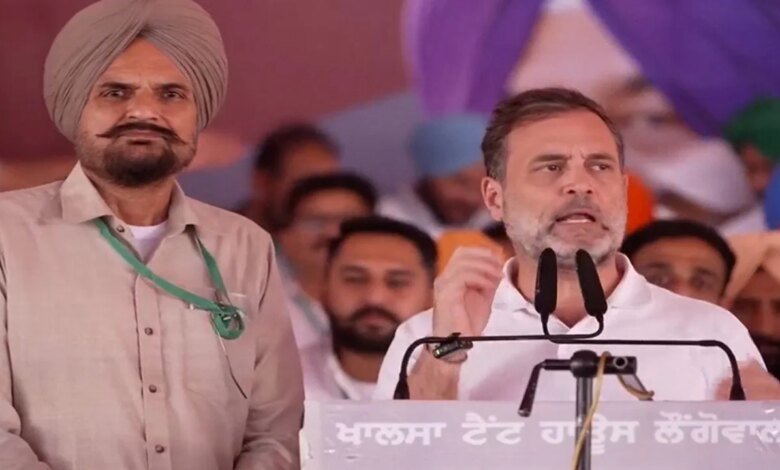
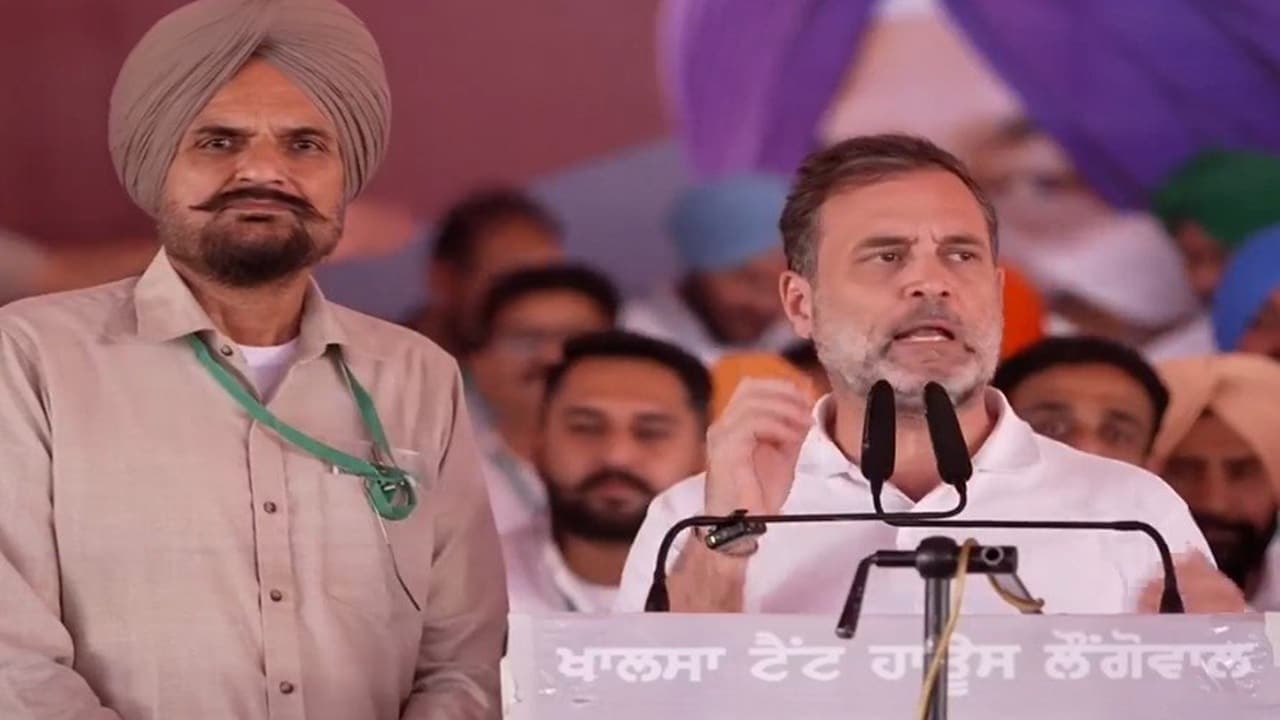
Rahul Gandhi was addressing the Congress rally in Sangrur when he paused to call out to a man seated towards the rear of the stage. It was Balkaur Singh Sidhu, the father of Sidhu Moosewala. Gandhi invited him forward. A chair was brought, and Balkaur Singh was seated beside him. For several minutes, the campaign address turned into a recollection of a young singer, a father’s grief and a life cut short.
The gesture gave Balkaur Singh a place at the centre of the proceedings. It also brought the question he has carried for more than four years – justice for his son – back into Punjab’s election campaign.
Gandhi said his meeting with Moosewala’s father had prompted him to change the direction of his speech. He recalled the singer’s visit to his office before joining Congress: A talented, energetic young man whose music Gandhi had not yet heard. He subsequently listened to his songs, including “295”.
The scene illustrated Moosewala’s unusual political afterlife. He lost the only assembly election he contested. Yet his name continues to command attention at rallies, and his father remains a public voice which political leaders cannot easily overlook.
The Young Man Gandhi Remembered
Rahul Gandhi’s recollection focused on the distance between Moosewala’s artistic confidence and his relative unfamiliarity with politics.
Rahul remembered feeling that the singer was entering difficult political territory and wanting to provide him with political protection. That distinction is important: He was describing support for a newcomer navigating politics, rather than claiming to have arranged physical security.
Gandhi also recalled the anguish Balkaur Singh had expressed after losing his son. The speech then moved from personal remembrance to a wider argument about gangsterism, intimidation and the vulnerability of people seeking to make something of their lives in Punjab.
Politically, the transition was significant.
A debate about law and order can disappear into statistics and competing government claims. A father seated beside the speaker gives that debate a recognisable human presence.
But political pundits maintain that the emotional force of the scene also creates an obligation and once a party invokes a family’s grief to make its case for power, it must explain what it would do differently.
The Songs That Still Speak
Moosewala’s continuing relevance cannot be understood solely through his brief Congress career. His music travelled beyond Punjab and beyond India. More importantly for politics, some of his songs gave listeners a language for expressing their own frustrations and attachments.
“295” deals with controversy, public judgement and the consequences of speaking out. “The Last Ride”, released shortly before his murder, acquired a haunting significance after his death. In ‘295’, Moosewala warned of people seeking fame by using another person’s name. That warning offers a useful lens through which to examine the political use of his legacy.
“Kuchh ethe chaandi chamkauna chaunde ne, Kuchh tainu fad thalle launa chaunde ne, Kuchh ke ne aye ethe bhukhe fame de ,Naam laike tera agge auna chaunde ne”. (“Some here want to cash in. Some want to drag you down. Some are hungry for fame – They want to get ahead by using your name.”)
His posthumous “SYL” addressed Punjab’s disputed river-water rights.
These songs explain part of his lasting presence in public debate. His audience encountered questions of identity, power and Punjab’s future through music before hearing politicians address them from election platforms.
That connection gives parties an incentive to invoke his name. It does not give any party ownership of his listeners.
The Killing And The Questions It Left Behind
On May 29, 2022, Moosewala – whose full name was Shubhdeep Singh Sidhu – was shot dead at Jawaharke village in Mansa district. He was 28.
He was travelling in a Mahindra Thar with two companions when gunmen intercepted the vehicle and opened fire. His killing came a day after his security cover was reduced. Two security personnel remained assigned to him, but they were not accompanying him that evening.
According to the Punjab Police chargesheet, Goldy Brar -designated a terrorist by India under the UAPA in January 2024 -informed the shooters of the reduction in security and urged them to act. The timing, and the public disclosure of the security decision, became central to the family’s demand for accountability.
Investigators alleged that Brar coordinated the killing with Lawrence Bishnoi and other accused to avenge the murder of Youth Akali Dal leader Vicky Middukhera.
That is the prosecution’s account of the alleged motive. It must not be presented as proof that Moosewala participated in Middukhera’s murder, or as a justification for killing him.
At Sangrur, Gandhi connected this killing to a broader concern: That the mentality behind such violence was spreading through Punjab. His argument sought to move Moosewala’s death beyond an individual criminal case and into a debate about the state’s capacity to protect its people.
What Happened To The Promised Inquiry?
Balkaur Singh’s demands were specific.
Immediately after the murder, he sought an inquiry by a sitting High Court judge, assistance from the CBI and NIA, and accountability for officials involved in reducing and publicising his son’s security. He also demanded an apology over the police’s initial description of the killing as linked to gang rivalry.
On May 30, 2022, Chief Minister Bhagwant Mann announced that the government would request an inquiry by a sitting judge. The DGP subsequently clarified that he had not described Moosewala as a gangster or claimed he had gangster links.
The proposed judicial inquiry did not proceed as announced. The Punjab and Haryana High Court declined the request, citing its inability to spare a judge. An announced inquiry therefore cannot be treated as a completed investigation or a published finding.
The criminal investigation did advance. The police filed the first chargesheet against 24 accused in August 2022. A Mansa court framed charges against 27 accused, including Bishnoi, on May 1, 2024.
Reporting in April and May 2026 documented continuing witness examination and the family’s frustration with delays.
It would be inaccurate to say that nothing happened. It would be equally inaccurate to suggest that these developments fulfilled all the family’s demands.
As recently as October 20, Balkaur Singh said the assurances he had received about a CBI investigation and action against gangsters had not produced the outcome he expected. His criticism extends beyond the state government.
A Following Is Not A Vote Bank
The obvious electoral interpretation of Sangrur, Chief Minister Bhagwant Mann’s home district, is that Congress hopes to connect with younger voters through Moosewala’s memory.
That is a reasonable assessment of the opportunity. It is not evidence that the strategy will succeed.
In the 2022 Mansa assembly election, Moosewala contested on a Congress ticket and received 36,700 votes, or 21.12 per cent. AAP’s Vijay Singla won with 100,023 votes, a margin of 63,323.
His fame delivered attention. It did not deliver a majority in an election.
A listener could admire his music and prefer another party. His death changed the emotional context, but it did not turn a diverse audience into a single political constituency.
Nor did Gandhi’s association with the family begin at Sangrur. Balkaur Singh joined his Bharat Jodo Yatra in Jalandhar in January 2023.
Personal sympathy and political advantage can coexist; neither should automatically be treated as the whole explanation.
Family’s Congress Connection Before Moosewala’s Political Debut
The family’s association with Congress predates Moosewala’s own entry into the party. His mother, Charan Kaur, won the sarpanch election in Moosa village, Mansa district, in December 2018, with Moosewala actively campaigning for her.
Contemporary reporting identified her as a Congress-backed candidate, rather than establishing that she contested on a formal party ticket. Their connection with Congress therefore has roots in village politics, preceding both his assembly candidature and the family’s campaign for justice after his death.
From Moosewala To Jhota: Security Takes Centrestage
The killing of anti-drug activist Parvinder Singh ‘Jhota’ in Mansa on October 13, 2026, revived painful memories of Moosewala’s murder in the same district of Punjab’s Malwa region. The circumstances of the two cases differ, and their geographical proximity does not establish a common criminal conspiracy. But the renewed public anger reveals how closely concerns about drugs, violence and personal safety have become intertwined.
Congress, the BJP and the Shiromani Akali Dal have challenged the government’s record, while Chief Minister Bhagwant Mann has promised strict punishment – each seeking to convince Punjabis that it can safeguard their lives.
Against this backdrop, Gandhi’s decision to invite Balkaur Singh Sidhu beside him and move from remembering Moosewala to confronting gangsterism carried a clear political message: The Congress wants public safety at the centre of the electoral debate. The gesture demonstrated the importance the party attaches to the issue; whether it can offer credible protection requires a more demanding test – specific policies, institutional accountability and results.
Internal Politics
The Congress’s internal politics adds another layer to this relationship. Balkaur Singh Sidhu has publicly criticised former Punjab Congress president Amrinder Singh Raja Warring’s style of functioning and was among those present at a gathering of leaders seeking his removal. His appearance alongside the leadership now headed by Pargat Singh therefore invites political interpretation.
Yet the alignments require careful description. This provides context for speculation about Balkaur Singh’s political proximity to Pargat Singh, but does not establish that he has formally joined a “Pargat camp” or weakened Warring’s electoral position. His differences with individual Congress leaders and his continuing demand for justice should be examined separately, even where they intersect.
Beyond The Stage
Balkaur Singh and Charan Kaur welcomed Moosewala’s younger brother, Shubhdeep, on March 17, 2024. Named after the singer, he deserves the freedom to build his own identity.
For the Congress, the real test begins after the tribute. How would it protect people facing threats, tackle criminal networks and deliver justice?
By inviting Balkaur Singh to sit beside him, Gandhi showed respect and highlighted the family’s struggle. But a place on the stage cannot replace answers. Moosewala’s name can draw attention. The Congress must now show why that attention should become trust – and whether that trust can become votes.
From Public Grief To An Electoral Test
Gandhi’s Sangrur address suggests that he recognises how closely Punjab’s drug crisis is connected, in the public mind, with the question of everyday safety. Union Home Minister Amit Shah has made a drug-free Punjab the BJP’s principal election plank, while AAP is seeking another mandate on its claims of development and promises fulfilled.
Gandhi has made no equivalent declaration that Congress will fight on law and order alone. Yet his decision to foreground Moosewala’s killing suggests that public safety could become a central part of its challenge to the government.
By inviting Balkaur Singh to sit beside him, Gandhi gave that argument a human face. But a chair on a stage can acknowledge a father’s grief; it cannot fulfil his demand for justice.
Moosewala’s name can stir emotion. Turning that emotion into votes will require a credible promise of safety and convincing answers about how it will be delivered. Whether Congress can earn that trust is a question the people of Punjab will answer at the ballot box in 2027.