New Delhi:
The Jamia Millia Islamia administration on Thursday set a timeline to restore its students’ union, finally putting dates on the process of returning to an elected body after two decades. This led to the two-week-old protest finally ending as students celebrated the university order as a “victory for our rights”. Not setting specific dates for the process was a sticking point in the earlier settlement attempt.
On what happened to be its foundation day, the university also announced that classes and exams will move back to the campus from November 8, having been restricted to the online mode amid the agitation.
Thursday’s order issued by the Registrar’s Office said the Jamia Millia Islamia Students’ Union (JMISU) constitution would be approved and implemented by May 15, 2027, and elections would then be held within about six weeks of the start of the new academic session expected around July 16, 2027.
The order also said the university will withdraw all show-cause notices and disciplinary proceedings started against students involved in the protest. It added that orders on expulsion and suspension, as well as restrictions on campus entry, would be revoked.
Protesting groups celebrated almost immediately. Many also gathered during the day to mark the 106th Foundation Day of the central university, originally founded in Aligarh during the freedom struggle.
#WATCH | Ebin Basil, a student who was on a hunger strike for the past 18 days, says, “This is a great victory for the students…This will be written in Golden words in Jamia’s history and legacy.” Rehan Mewati, a student who was on hunger strike for the last 15 days, says, “Truth has triumphed. This is the victory of students. I was on a hunger strike for the last 15 days. My health was deteriorating. But Jamia administration accepted our demands and sided with truth. We were fighting for truth. Inquilab Zindabad.”
— ANI (@ANI) October 29, 2026
Ebin Basil, a student who was on a hunger strike for the past 18 days, said, “This is a great victory for the students; it will be written in golden letters in Jamia’s history.” Rehan Mewati, another student who was on hunger strike for the last 15 days, told news agency ANI, “The truth has triumphed.”
Why There Was A Stalemate
Earlier, on October 26, the registrar’s order said the election “will be held after 15 days from the date of approval of the constitution of the students’ union”. The hunger-striking students rejected that order and continued their protest, saying it left the timeline open-ended.
The students had demanded that the constitution be drafted and approved by December 20, with elections held within 15 days after that. As per Thursday’s timeline, polling would take place around mid-August 2027.
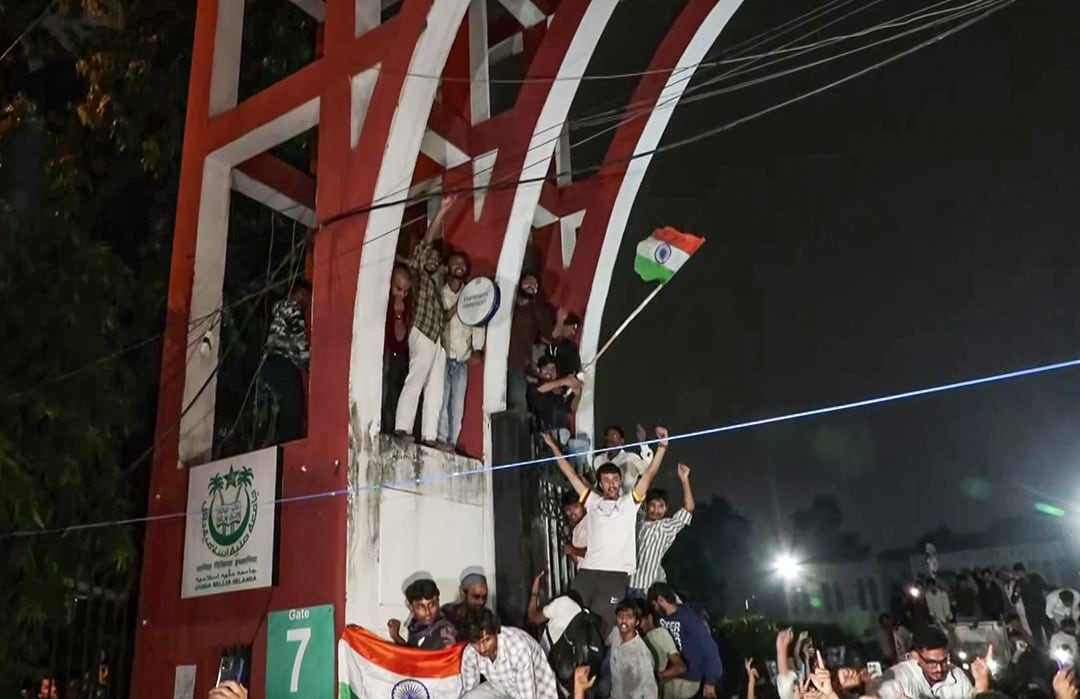
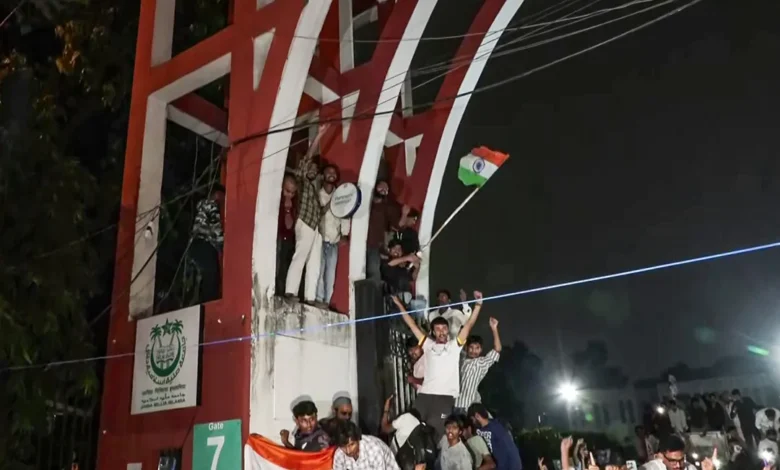
Students celebrating at the campus gate as the Jamia administration accepted their demands on October 29 evening.
Photo: ANI
The JMISU was dissolved in 2006, and the university has not held students’ union elections since. The administration reasoned that the disbanding was due to “a series of violent incidents, the last being the attack on the Vice Chancellor”. From 2012, it said elections could not be held while a Delhi High Court petition was pending, though students disputed that logic.
The latest protest began over two weeks ago. It followed a similar agitation at Aligarh Muslim University in neighbouring Uttar Pradesh. There, the administration agreed to restore students’ union elections after a 19-day hunger strike and scheduled polls for November 5.
The Jamia administration’s new order covers more disciplinary actions that would be revoked.
VIDEO | Delhi: Registrar of Jamia Millia Islamia (JMI), Mahtab Alam Rizvi says, “We received three written demands from the students. Their first demand was that the draft constitution be completed by May 15, 2024, following which they requested that elections be conducted in accordance with the Lyngdoh Committee recommendations. We accepted that demand and confirmed that we would finalise the draft constitution by May 15. Their second demand pertained to the Lyngdoh Committee guidelines, which stipulate that elections must be held within six weeks of the commencement of a new academic session. We fully accepted this condition as well. Their third demand concerned the students who were rusticated, suspended, or served show-cause notices during the protest period. We have revoked all such disciplinary actions. Along with this, we emphasised that as students of Jamia, we must remain united for the integrity of our institution and our nation, working together so that both Jamia and India continue to progress.” “Regarding online classes, as I mentioned directly to the students, the Diwali vacation extends until November 8. Once our students return after November 8, I will request them to resume, and we will immediately transition back to offline classes,” he added. (Full video available on PTI Videos – https://t.co/bIyFWTfmBd)
— Press Trust of India (@PTI_News) October 29, 2026
The October 26 order had said, “Suspension and show-cause notices issued to students during the period of protest are hereby revoked.” It had not addressed rustication orders or campus bans, both of which the students had sought to have withdrawn. That order had some conditions attached as well. It had said the protesting students had undertaken to apologise at a press conference for any defamatory statements, actions or social media posts against the administration, and directed that “all such posts shall be taken down from channels on social media with immediate effect”. It had further directed that “the protest shall be called off immediately on issue of this order”.
The protesters refused, saying no student should have to apologise for exercising the right to peaceful protest.
On October 23, the committee drafting the union constitution said an immediate announcement of elections would be premature because the union had no constitution or electoral mechanism in place.