New Delhi:
The world’s religious composition is expected to change significantly over the next five decades, with Muslims projected to grow faster than any other major religious group.
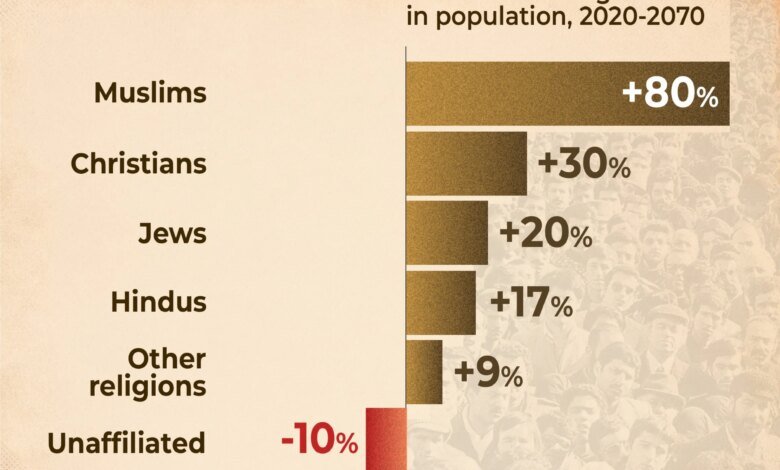
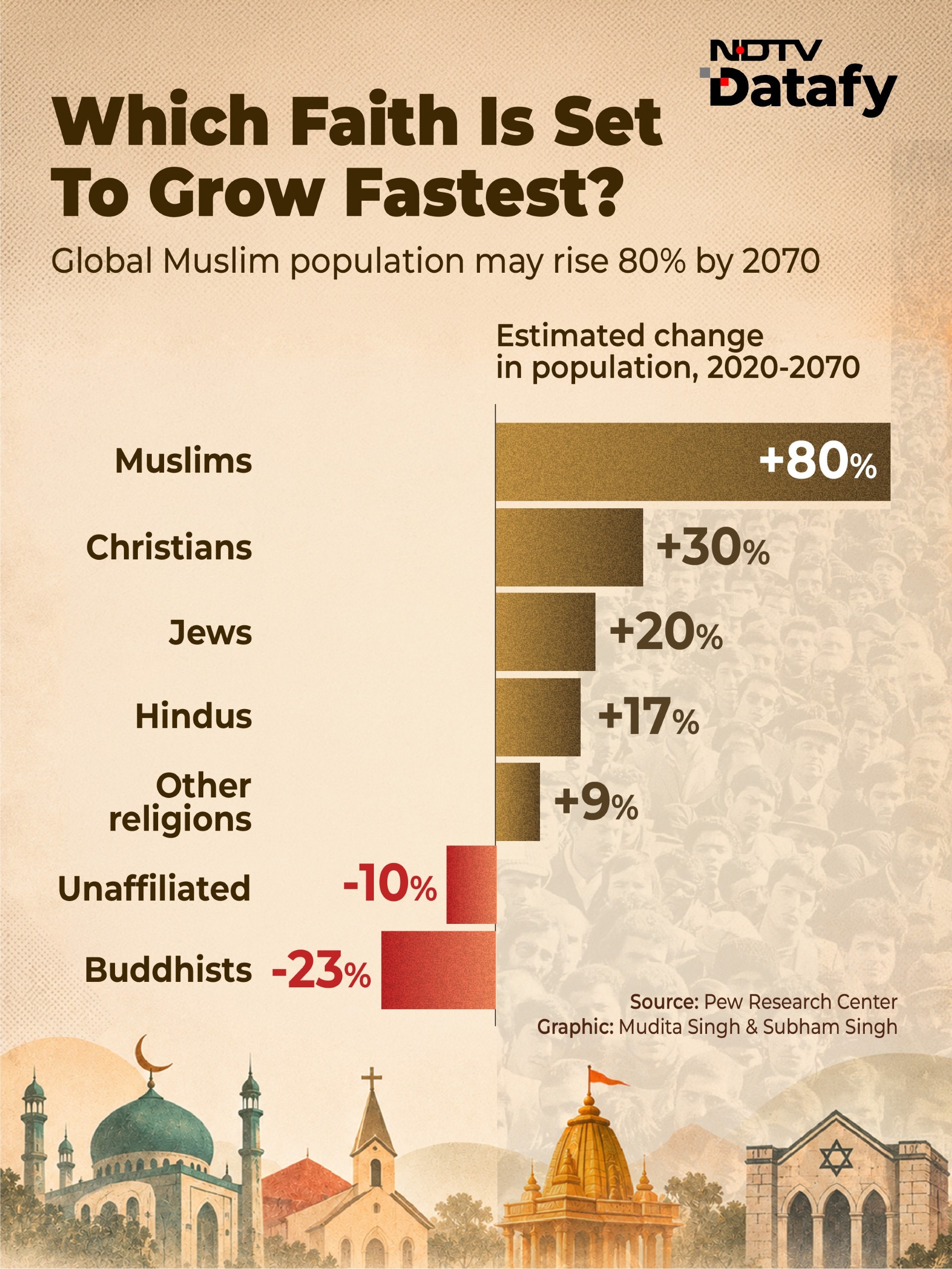
According to projections by Pew Research Center, the global Muslim population is expected to increase by 80 per cent between 2020 and 2070, far outpacing overall world population growth of 29 per cent during the same period. Christians are projected to grow by 30 per cent, while Hindus are expected to grow by 17 per cent. In contrast, Buddhist populations are projected to shrink by 23 per cent, and the number of religiously unaffiliated people is expected to decline by 10 per cent.
The projections suggest that fertility rate will play the biggest role in shaping the future religious landscape.
Higher Fertility Remains A Major Driver
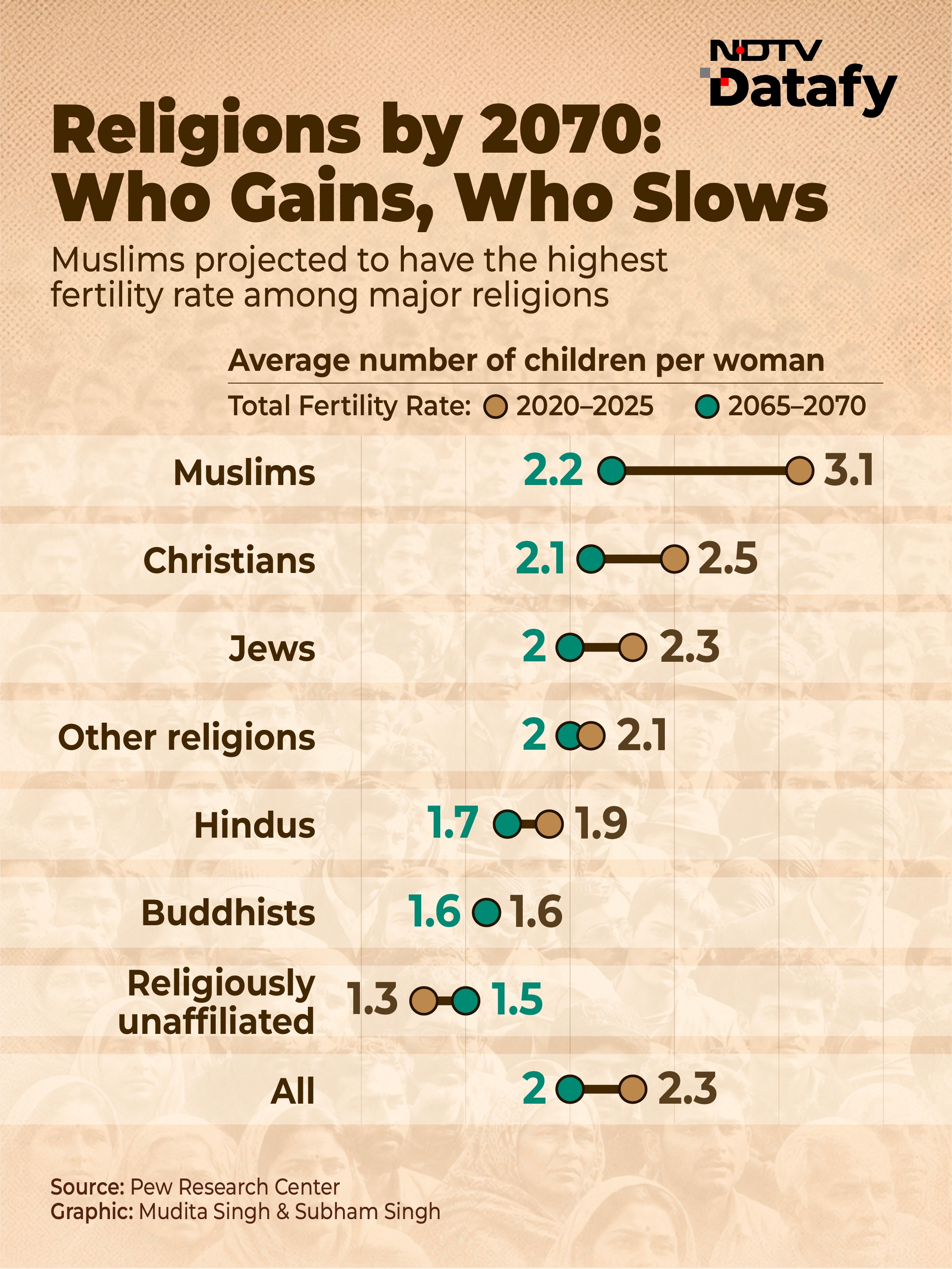
One of the clearest reasons behind the faster growth of Muslim populations is fertility. While fertility rates are projected to decline across nearly all religious groups over the coming decades, Muslims are expected to retain the highest fertility rate among major religions, as per Pew Research Center.
During 2020-25, Muslim women worldwide are estimated to have an average of 3.1 children, compared with 2.5 among Christians, 2.3 among Jews, 1.9 among Hindus, and 1.6 among Buddhists. By 2065-70, fertility is projected to decline across groups, but Muslims are still expected to have the highest average at 2.2 children per woman. Christians are projected to fall to 2.1, Jews to 2.0, and Hindus to 1.7.
The gap is smaller than it is today, but it remains large enough to produce substantially different population trajectories over time.
In addition to higher fertility, Muslims also have one of the youngest population profiles globally. A younger population means a larger share of people are entering child-bearing ages, which contributes to population growth even as fertility rates gradually decline.
Taken together, these demographic factors help explain why Muslims are projected to add people at a much faster pace than any other major religious group through 2070.
India Mirrors The Broader Trend
India, home to the world’s largest Hindu population and one of the world’s largest Muslim populations, is also projected to see changes in its religious composition over the next five decades.
The share of Hindus in India’s population is projected to decline from 79.4 per cent in 2020 to 75.8 per cent in 2070, a drop of 3.6 percentage points.
Over the same period, the share of Muslims is projected to increase from 15.2 per cent to 19.6 per cent, a gain of 4.4 percentage points.
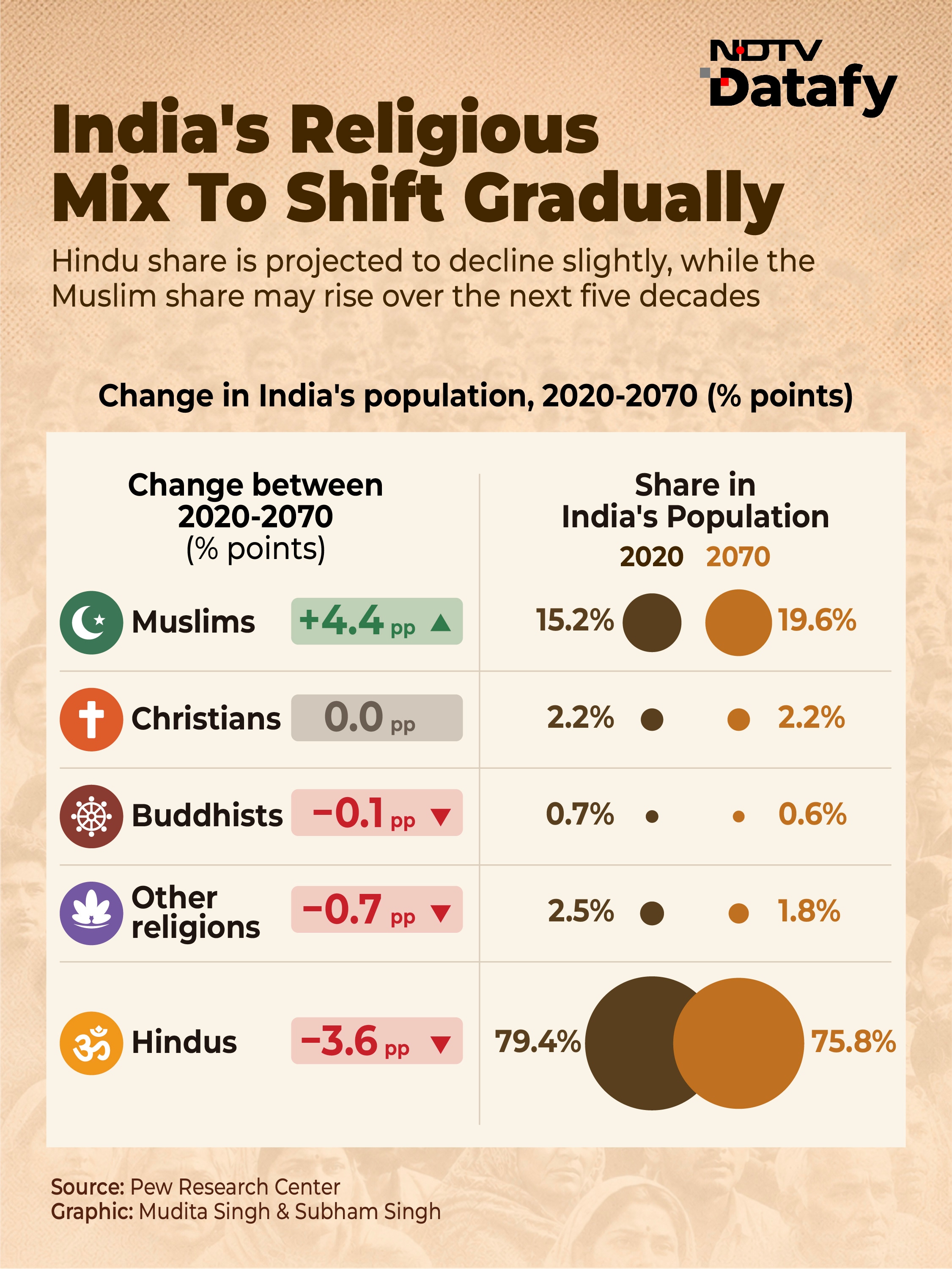
Christians are projected to remain broadly stable at 2.2 per cent, while the share of Buddhists and other religious groups is expected to decline slightly.
The projections do not suggest a shift in India’s religious majority. Hindus are expected to remain by far the country’s largest religious group in 2070. However, the data indicate that demographic differences, particularly fertility patterns and age structures, could gradually alter the relative shares of religious communities over time.