New Delhi:
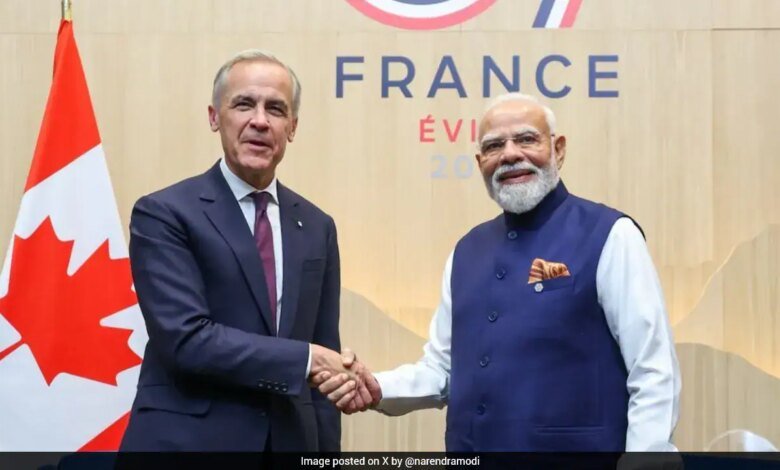
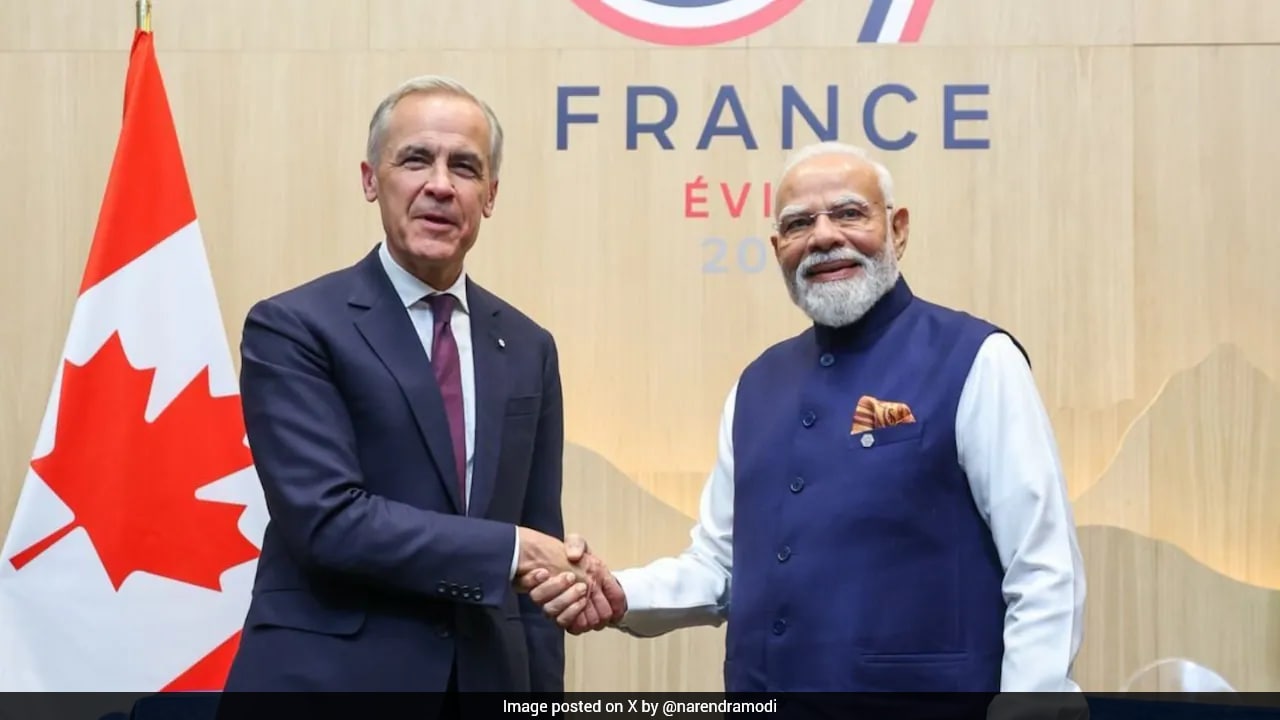
Prime Minister Narendra Modi and his Canadian counterpart Mark Carney held bilateral talks on the margins of the G7 Summit in Evian on Monday, marking the most substantive high-level engagement between New Delhi and Ottawa since the two sides began stitching together a relationship that had unravelled over the 2023 diplomatic row triggered by the Nijjar killing and uncalled remarks of Former Prime Minister Justin Trudeau against India.
The Evian meeting builds on the groundwork laid during Carney’s visit to India in March, increasingly being read as the inflexion point of the bilateral reset. According to a joint statement issued by India’s Ministry of External Affairs, the two leaders welcomed the “positive momentum” in ties and signed off on a clutch of new initiatives spanning trade, energy security and, notably, defence and security cooperation.
The standout deliverable from the meeting is the decision to launch negotiations on a General Security of Information Agreement (GSOIA) – a foundational accord that typically precedes deeper defence-industrial and intelligence-sharing arrangements between countries. Given that the diplomatic chill had specifically hit security and law-enforcement channels between the two capitals, the GSOIA move is being read as a marker of how far the rapprochement has advanced in just over a year, alongside renewed institutional exchanges such as the National Defence College of India’s recent visit to Canada.
On the economic track, both sides reaffirmed their shared objective of concluding the long-pending Comprehensive Economic Partnership Agreement (CEPA) within 2026, a deadline that adds pressure on negotiating teams after talks first stalled in 2023. The leaders also reviewed commercial movement on LNG, LPG and metallurgical coal, sectors central to Canada’s pitch as a stable, like-minded supplier as India looks to diversify its energy and critical-input sourcing.
The readout pointed to a steadier cadence of ministerial and institutional engagement as evidence of normalisation: Commerce and Industry Minister Piyush Goyal’s recent visit to Canada, a forthcoming Canadian trade mission to India later this year, and upcoming dialogues in defence, finance and migration – tracks that had gone largely dormant during the diplomatic freeze. The two governments also flagged recent meetings of the Joint Science and Technology Committee and the Consular Dialogue, alongside continuing work under the Canada-India Talent and Innovation Strategy on skilling, innovation and education ties.
In a move with clear Indo-Pacific signalling, PM Modi extended India’s support for Canada’s bid to become a Dialogue Partner of the Indian Ocean Rim Association (IORA), a grouping New Delhi has used to anchor its maritime and economic outreach across the Indian Ocean littoral. The two leaders also announced the launch of “Raisina Americas,” extending India’s flagship geopolitical dialogue brand to the Americas for the first time – a platform likely to be used to institutionalise track 1.5 engagement between New Delhi, Ottawa and the wider hemisphere.
Perhaps the most politically resonant marker of the thaw came at the close of the statement: PM Modi thanked Carney for inviting him to visit Canada later in 2026, with both sides agreeing to work through diplomatic channels to fix a mutually convenient date. Such a visit, once unthinkable amid the 2023-24 standoff over extremism and consular conduct, would cement the reset as a durable feature of the relationship rather than a one-off G7-sidelines courtesy call.
Taken together, the Evian outcomes suggest both governments are moving past confidence-building gestures into substantive, institutionalised engagement, even as the underlying irritants from the earlier rupture remain unaddressed in the public text of the statement.